




Business posts
Saturday April 06, 2024
The Bane of Feedback Emails
I got this email the day after I sat for three hours in 50-degree weather watching the Mariners lose 8-0:
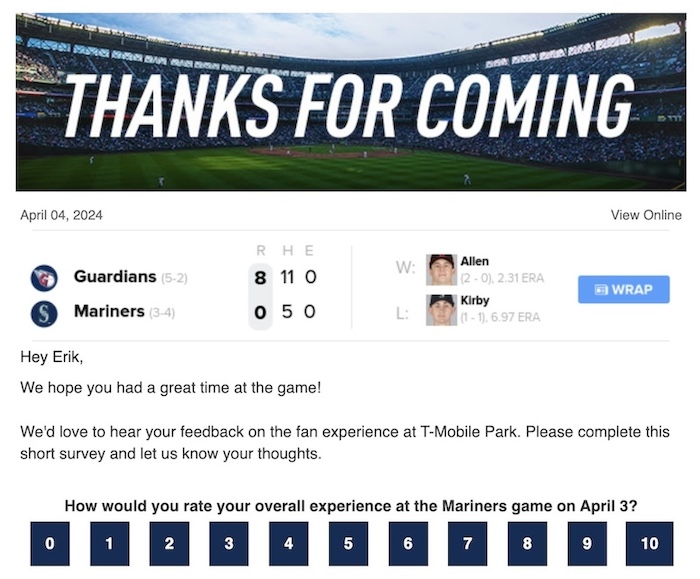
We hope you had a great time at the game? You see the score there? Does your left hand know what its right hand is doing, or are you fumbling around as much as the Mariners' defense on Wednesday?
I know, I know, every corporation does this now, but you'd think they might pause now and again. But I imagine whoever is running this dept. wants/needs engagement, for quarterly and annual goals, and it doesn't matter if it's negative engagement or engagement that in the long run sours the customer on the product, as long as they get their short-term clicks. Short-term numbers trump long-term viability in the minds of every middle manager in every American corporation. It's why we're all doomed.
I get these from my insurance company as well, Cigna, after doctor visits. “How was your visit with Dr. A?” A week later: “REMINDER: How was your visit with Dr. A? Your feedback in IMPORTANT!” OK, here's some feedback. How about go fuck yourself? Your feigned solicitiousness isn't fooling anyone. Hell, I get these from Ticketmaster, fucking Ticketmaster, getting all chummy with me: “ERIK: What did you (really) think of Silent Movie Monday?” The parenthetical is the nails on the chalkboard for me. Yeah, just a couple of girls chatting and spilling the tea. Me and Tick.
OK, I'm making a list:
- Ticketmaster
- Cigna
- Seattle Mariners
Just STOP. You assholes. Just fucking stop.
Saturday July 16, 2022
Dreaming of Being Bad at My Job
I had a job at a hip tech company that I hadn’t been going to much. I’d been doing my own thing. Which was what exactly? Some kind of big writing project I’d never finished. There was dissipation associated with it.
The job was to come up with humorous tweets for the company Twitter account but I felt woefully unprepared for the role. Also not right: I hadn’t figured out the tone but mostly I wasn’t funny. I was sitting at a desk next to several other people, including the friend who had gotten me the job and another guy who felt way wittier, way sharper than me. Shouldn’t he have gotten the job? He didn’t seem covetous of it, though. He just kept making witty remarks.
I had older items on my desk and was sifting through them and reading them aloud to try to get through them. My friend reminded me that other people were working. “Oh, right,” I said, and read them silently. Later, on a TV set, there was some interview with Tom Cruise playing, and I tried to turn it off, or at least down, and my friend tried to help, but his help led to the volume suddenly rising, and we scrambled to mute it. Then I imagined people walking by and wondering, “Why does he always have Tom Cruise playing on mute in the background,” and we thought this so funny we couldn’t stop laughing. I tried to figure out how to parlay that kind of thing into the tweet thing but didn’t see a connection.
“What about interviews?” I said to my friend. “I could interview people at the company and get their stories.” “That’s not a bad idea,” he said, with a tone that implied otherwise. “You’re good at interviewing,” he said, with a tone that implied I wasn’t good at what I was doing.
In another location, some mucky-muck came up to me to explain about the dialogue of the movie scene they were working on. The company was branching out into movies and this was the first. Someone else stood nearby, anxious I wouldn’t saying anything wrong to the mucky-muck, who seemed to need my approval. Did he know who I was? My movie critic background? And did he know I didn’t matter at his company? Later, my sister—who also worked for the company—came by. Some people seemed confused by our familiarity, so I introduced her: “This is my mister—I mean, my sister.” A witty, company woman, dark-haired and pretty, teased me when reintroducing us to others. “She’s his sister … or his wife, they haven’t figure out which yet.” I began to point out that “mister” hardly implied “wife” but figured it wasn’t worth it. I figured ignoring it was the best path forward.
Saturday October 27, 2018
‘No Time to Think About It’: FilmStruck Struck by AT&T

The site this morning. Soon, gone.
One of my few happy places over the last few months has been FilmStruck, a movie streaming service that combines the Criterion collection and the Warner Bros. archives, among others. I'd signed up for an annual subscription in early September. (You may have noticed the jump in James Cagney reviews.) I was looking forward to spending the winter with it.
Nope.
Yesterday it was announced that the site would be shuttered on Nov. 29. Why? From Variety's article:
In a statement, Turner and WB Digital Networks said, “We‘re incredibly proud of the creativity and innovations produced by the talented and dedicated teams who worked on FilmStruck over the past two years. While FilmStruck has a very loyal fanbase, it remains largely a niche service. We plan to take key learnings from FilmStruck to help shape future business decisions in the direct-to-consumer space and redirect this investment back into our collective portfolios.”
What’s more depressing—losing the service or having to read that language? Are these people even human? Can't they even fake it anymore? Look at that last sentence. I was going to mock it by emphasizing its more egregious parts but the whole thing is that. It says nothing. It says “We plan to make money.” There's not an iota of love for its product there.
FilmStruck had that love. You could tell. People cared. They were kindred spirits.
You don't even know who to blame. WarnerMedia? Or its new owner AT&T? A source in Todd Spangler's Variety article says the move was planned before AT&T's recent purchase by AT&T but “the strategy aligns with the new WarnerMedia blueprint to shift resources to mass-market entertainment services.”
A source familiar with AT&T's strategy said the telco is looking to eliminate peripheral projects that aren't major producers of revenue. “They felt Time Warner overall had too many initiatives,” the exec said. “[AT&T] have their hands full. They have no time to think about, ‘What do we do with this growth property?’”
They have no time to think about it. Jesus fuck.
Thursday December 08, 2016
Canceling Comcast
A few weeks back, I wrote an article for Salon about the hassles of trying to cancel my mother's Comcast cable service after she'd had a stroke.
Today, I felt the greater joy of canceling my own service.
Our building got Wave G a few months back, and after some starts and stops with various rang extenders (nope), and routers (yep: Netgear Nighthawk), I felt comfortable enough to cancel Comcast. Bye bye, shitty, overpriced service.
I'd heard horror stories from others about how difficult this could be: how this, that and the other were offered; how they were put on hold for 20 minutes.
I got none of that. Instead, that annoying, overly friendly female computer voice, and the following “conversation”:
Comcast: In a few words, please tell me what you're calling about.
Me: Cancel account.
Comcast: I understand you'd like to cancel your account. Does that mean you're relocating and would like to set up a Comcast customer account elsewhere?
Me: No.
Then I declined a post-call survey, got a rep, told him name and address, what I wanted, why I wanted it, and it was over like that. I'm now Comcast-free. Feels good.
Saturday August 29, 2015
Letters from Corporations I
I have three letters from corporations sitting on my desk that I need to deal with in some fashion. They are from:
- Bank of America, informing me that my late payment fee is going up to $38 (from $35, but they don't say that), effective Nov. 14, 2015. “Thank you for your business.”
- CVS/Caremark, informing me that if I insist on getting a particular drug from the pharmacy I will have to pay full price. I can avoid this with a 90-day supply, rather than a 30-day supply, but I can only get the 90-day supply through CVS/Caremark. “Sincerely...”
- Anthem, informing me that “cyber attackers executed a sophisticated attack to gain unauthorized access to Anthem's IT system,” and that “You are receiving this letter now because Anthem made additional efforts to obtain a current mailing address for potentially impacted indviduals...” Anthem has also hired a company to protect my identity for two years at no cost to me. Additional tips are given.
Fun times.
Monday September 22, 2014
McAdvice to McWorkers Making McPay
Maybe old news but worth repeating. Its from William Finnegan's New Yorker piece on the unionization of fast-food workers and the struggle for $15 an hour (or at least more than $7 and change):
McDonald’s has tried to acknowledge the real lives of its workforce by providing counselling through a Web site (since taken down) and a help line called McResource. A sample personal budget was offered online last year. The budget was full of odd assumptions: that employees worked two full-time jobs, for instance, and that health insurance could be bought for twenty dollars a month. The gesture made the corporation look painfully out of touch. The same thing happened with a health-advice page. Workers were advised to break food into pieces to make it go farther, sing to relieve stress, and take at least two vacations a year, since vacations are known to “cut heart attack risk by 50%.” Swimming, one learned, is great exercise. Fresh fruit and vegetables are good for you, McDonald’s declared. A mother of two in Chicago, who had worked at McDonald’s for ten years, called the help line and found herself counselled to apply for food stamps and Medicaid. This was, at least, realistic.
Read the whole thing.
Thursday August 14, 2014
Too Big to Care How It Looks
So I got a notice the other day from Chase. You know: Chase. I was supposed to read the notice carefully and retain it with my other important documents. It concerned by privacy. Or lack thereof. It began with this thought:
WHAT DOES CHASE DO WITH YOUR PERSONAL INFORMATION?
For some reason, this was in a chart labeled “FACTS,” when, you know, it's more of a question. But onward.
I assumed Chase was going to allay my fears about what it did with my personal information. Instead I got another chart:
| Reasons we can share your personal information | Does Chase Share? | Can you limit this sharing? |
| For our everyday business purposes —such as to process your transactions, maintain your account(s), respond to court orders and legal investigations, or report to credit bureaus | Yes | No |
| For our marketing purposes — to offer our products and services to you | Yes | No |
| For joint marketing with other financial companies | Yes | No |
| For our affilates' everyday business purposes — information about your transactions and experiences | Yes | No |
Those aren't really reasons, are they? Just like the other wasn't really facts. But onward.
They mention three other areas where they share my info—including “For non affiliates to market to you”—but apparently I can limit those. If I call. When I call. So we're not completely powerless. Just for all the above: everyday business purposes and marketing and joint marketing. But that's it. For now.
Anyway, nice notice. So nice to come home to.
Sunday May 11, 2014
Shorter Sorkin: Michael Lewis Focuses on Problem I Never Bothered to Write About
Last month I read Michael Lewis' “Flash Boys: a Wall Street Revolt,” in which the author of “Liar's Poker,” “Moneyball” and “The Blind Side” argues that high-frequency trading has created a rigged game on Wall Street, in which high-frequency traders can utilize faster speeds to figure out what we're doing before we do it, then act as middlemen in the transaction: buying what we were about to buy and selling it back to us at a higher price. Basically they're front-running trades. Legally.
But there's been pushback against the book by, among others, Andrew Ross Sorkin of The New York Times. I meant to check out his critique after reading the book. I finally did this week.
Sorkin basically agrees with Lewis that there is a problem and the game is rigged, or “rigged”: “(There remain a host of other problems that still make it 'rigged'),” he writes.  He just feels Lewis is blaming the wrong people:
He points mostly to the hedge funds and investment banks engaged in high-frequency trading. But Mr. Lewis seemingly glosses over the real black hats: the big stock exchanges, which are enabling — and profiting handsomely — from the extra-fast access they are providing to certain investors.
Of course Lewis does write about the exchanges, particularly Bats. In fact, the whole narrative of the book is built around the creation of a new exchange, IEX, one designed to be more fair—to offer, in a sense, exchange neutrality.
Even so, it's interesting that Sorkin agreed there was a problem. So I assumed he'd written about high-frequency trading before.
He has. A search on the Times website (for “high frequency trading” and “By Andrew Ross Sorkin”) yielded, when you parsed out the Dealbook/Times duplicates, three results.
The first, “A Lack of Transparency In S.E.C. Disclosure Rule” from November 2010, is about the troubling way the SEC allows corporations to release their earnings reports: on their website rather than as a press release issued simultaenously to hundreds of news services. The HFT reference? About halfway through:
In an age of high-frequency trading when every millisecond counts — even in after-hours trading — the move toward companies’ distributing earnings and other market-moving information via their Web sites rather than through wider distribution channels raises some serious questions about transparency.
It's the super-fast age we live in. But there's no critique of it.
The second column, “Volatility, Thy Name is E.T.F.” from October 2011, deals with the new volatility of the stock market, including the flash crash of May 2010. The HFT reference? That it wasn't the problem.
The third column is his critique of Lewis and “Flash Boys.” He calls the book important. He writes this:
Mr. Lewis’s well-crafted narrative highlights a perverse system on Wall Street that has allowed certain professional investors to pay hundreds of millions of dollars a year to locate their computer servers close to stock exchanges so they can make trades milliseconds ahead of everyone else.
In some cases, the superfast investors are able to glean crucial information from the stream of trading data flowing into their systems that allows them to see what stocks other investors are about to buy before they are able to complete their orders.
Then we get the line about the wrong villains: the exchanges, not the bankers.
Sorkin, in other words, isn't saying there isn't a problem. He just implies that Lewis is clever, hyperbolic, and demonizing the wrong group of people about this problem ... which he, Sorkin, has never bothered to write about.

Sign of the times.
Tuesday August 13, 2013
Why the Want Ads Suck
“The reason [the minimum wage] has become a big political issue is not that the jobs have changed; it’s that the people doing the jobs have. Historically, low-wage work tended to be done either by the young or by women looking for part-time jobs to supplement family income. ... Now, though, plenty of family breadwinners are stuck in these jobs. That’s because, over the past three decades, the U.S. economy has done a poor job of creating good middle-class jobs; five of the six fastest-growing job categories today pay less than the median wage. ...
”The situation is the result of a tectonic shift in the American economy. In 1960, the country’s biggest employer, General Motors, was also its most profitable company and one of its best-paying. It had high profit margins and real pricing power, even as it was paying its workers union wages. And it was not alone: firms like Ford, Standard Oil, and Bethlehem Steel employed huge numbers of well-paid workers while earning big profits. Today, the country’s biggest employers are retailers and fast-food chains, almost all of which have built their businesses on low pay—they’ve striven to keep wages down and unions out—and low prices.
“This complicates things, in part because of the nature of these businesses. They make plenty of money, but most have slim profit margins ... The combined profits of all the major retailers, restaurant chains, and supermarkets in the Fortune 500 are smaller than the profits of Apple alone. Yet Apple employs just seventy-six thousand people, while the retailers, supermarkets, and restaurant chains employ 5.6 million.”
-- James Surowiecki, “The Financial Page: The Pay is Too Damn Low,” on the New Yorker site. Read the whole thing.
Thursday April 11, 2013
Merit Pay in a Meritocracy
From Ken Auletta's profile of Henry Blodget in the April 8, 2013 issue of The New Yorker:
Not long after the 2000 merger of AOL and Time Warner, Blodget predicted that within two years the resulting enterprise would become the world's most valuable company. It turned out to be the most disastrous merger in corporate history. Meanwhile, Blodget's compensation at Merrill Lynch rose from three million dollars, in 1999, to twelve million, in 2001.
Tuesday October 25, 2011
Why Job Creators Is Such a Lie
Job creators.
We've been hearing that phrase a lot from the usual folks in the Republican party. They use it as a euphemism for the wealthiest people in the country, whom Republicans don't want to tax further, even though their current tax rate is half of what it was when I was growing up: 35% rather than 70%.
The right can't say “Don't tax the rich.” That won't play. So in a time of double-digit unemployment, someone dreamed up the term “Job creators.” The top 1% are wealthy, sure, but they're also the people who create jobs (Bill Gates, etc.), and taxing them at a higher level (at, say, 39%) will create such uncertainty that they won't expand their operations, and this will keep the economy from expanding as well. Taxing “job creators” is thus counterproductive to creating jobs.
It's a lie, of course.
The wealthiest people in this country (Bill Gates, etc.) are not job creators but profit creators. That's their job. If they have to add jobs in order to create profit, they'll do it. If they have to cut jobs in order to create profit, they'll do that, too. And if they can get you, their employee, to do more for less, they'll do that every day and twice on Sunday.
That's why the term “job creators” is such a lie. It ignores what a CEO does, what a corporation is. It ignores what capitalism is.
I've been feeling this all year. I've been waiting for someone in the mainstream media to say this all year. Nothing.
It's not the mainstream media, but recently, on his site, journalist Peter Lewis wrote about former Gannet CEO Craig Dubow, who resigned recently after six years at the helm. During his tenure, Gannett went from employing 52,000 to 32,000. Its stock went from $72 a share to $10 a share. Admittedly the last six years were particularly rough for newspapers, but—and here's the point—they weren't rough for Craig Dubow, whose salary was raised several million in 2010 to $7.9 million. Meanwhile, the pay of Bob Dickey, the head of Gannett’s U.S. newspapers division, was nearly doubled, from $1.9 million to $3.4 million, in 2010. This past summer he laid off 700 people. “While we have sought many ways to reduce costs,“ he told the workers, ”I regret to tell you that we will not be able to avoid layoffs.”
Job creators.
Dubow insists that his top priority as CEO was to serve the consumer: “We have always maintained an unwavering focus on the consumer,“ he wrote in his resignation letter. ”As a result, we have evolved into a digitally led media and marketing solutions company committed to delivering trusted news and information anywhere, anytime.”
Marjorie Magner, non-executive chairman of Gannett’s board of directors, echoed this thought. So did new CEO Gracia Martore.
Here's Peter Lewis:
These people are lying. The corporate goal is not to serve the consumer; it’s to maximize profits and pay packages for top executives. Can anyone argue that Gannett newspapers and journalism are better today, and that news consumers are better served?
How did Mr. Dubow and Gannett serve the consumer? They laid off journalists. They cut the pay of those who remained, while demanding that they work longer hours. They closed news bureaus. They slashed newsroom budgets. As revenue fell, and stock prices tanked, and product quality deteriorated, they rewarded themselves huge pay raises and bonuses.
Job creators.
Next time you hear someone use that term, feel free to punch them in the face.

One of the worst offenders.
Friday September 23, 2011
Why is The Seattle Times Linking to Exxon PR Blogs?
Doing some research on The Seattle Times website the other day I came across the following link (right-hand column, third down):
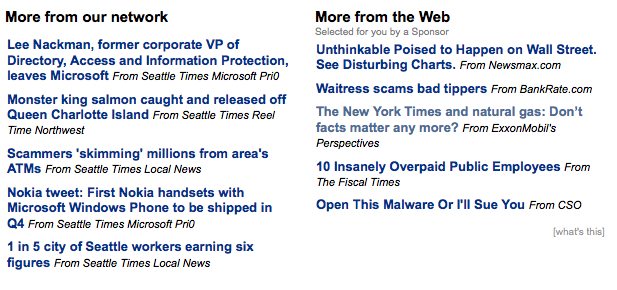
I noticed the headline certainly. The NY Times reporting poorly. Didn't have their facts. According to who? Exxon Mobile Perspectives? You're effin' kidding me. Why is this even on a legitimate news website? Or is The Seattle Times no longer a legitimate news website? Or have we created a culture where legitimate news organizations are so desperate for money they'll do what they need to do to survive. Like linking to Exxon Mobile Perspectives.
I clicked through but didn't even bother to read the article by Ken Cohen, vice president of public and government affairs for Exxon Mobil Corporation. But I did see his latest post: HIGHER TAXES ON OIL COMPANIES WON'T CREATE JOBS. Really? Hard hitting.
How does that guy sleep? How do I?
Monday July 11, 2011
Location! Location! Location!: Photos from the Death of a Mall
Last week I happened to be in the Southdale Shopping Center, near Edina, Minn., in the middle of a weekday afternoon, and the place was a ghost town. Seven miles east, on the site of old Met Stadium, you have the Mall of America, which still brings in (and takes away) the crowds. The recession, and the digitalization of business and culture, hasn't helped Southdale, either. Even its movie theater was pretty empty.




Monday April 18, 2011
Distilling the B.S. of CEOs
I read the following three paragraphs, from the article “Distilling the Wisdom of CEOs” by Adam Bryant, in yesterday's New York Times. Three grafs was as far as I got before I began railing in frustration:
IMAGINE 100 people working at a large company. They’re all middle managers, around 35 years old. They’re all smart. All collegial. All hard-working. They all have positive attitudes. They’re all good communicators.
So what will determine who gets the next promotion, and the one after that? Which of them, when the time comes, will get that corner office?
In other words, what does it take to lead an organization — whether it’s a sports team, a nonprofit, a start-up or a multinational corporation?
 In other words?
What is Bryant assuming here? He's assuming that the employee who demonstrates the greatest leadership skills will get promoted. He's assuming that promotions are based upon positive skills. He's assuming nothing pejorative—ruthlessness, ass-kissing, bad-mouthing competition—goes into success or promotion in a modern corporate office.
I mean, c'mon.
In distilling that CEO wisdom, Bryant comes up with the following traits that will help those 100 hard-working 35-year-olds (and presumably you and me):
- passionate curiosity
- battle-hardened confidence
- team smarts
- a simple mind-set
- fearlessness
All positive, of course. No CEO got where they got because of anything untoward. Maybe we should add “self-promotion” to the list. “Selective memory.” “Bullshit.”
Interesting, too, how these five traits may help the CEO but not necessarily the company. Or us. You'll probably find the last four traits, for example, in every CEO that led us straight into the global financial meltdown. When it comes to investing in derivatives based upon subprime mortage loans, fearfulness has its place.
Wednesday May 05, 2010
Morons, Crooks, and the People Who Saw It Coming: Assessing Credit on the Subprime Mortgage Disaster
Here are four names to remember. There are more but these are the ones I know:
Michael Burry
Greg Lippmann
Steve Eisman
John Paulson
They're the names to trot out whenever someone—particularly a higher up at an investment bank—says, vis a vis the subprime mortgage disaster, that no one saw it coming.
No, people saw it coming. These guys saw it coming. They bet against it and made hundreds of milions. Or billions.
 I certainly didn't see it coming. I'm an idiot when it comes to finance. I'm even more of an idiot when you get into esoteric matters like banks selling mortgages and bundling them into bonds, which are rated by agencies that aren't rating them properly, and some of these bonds, the worst of the bonds, are sometimes rebundled into new packages called collateralized debt obligations, or CDOs, that are also rated by agencies that aren't rating them properly, and then side-bets are placed on those... I mean, you lost me back at the pass. It's partly why I read Michael Lewis. He writes well enough that even I can fathom some of this stuff. Right now I'm reading "The Big Short: Inside the Doomsday Machine," about the subprime mortgage disaster.
Man, is it depressing.
There was an article in The New York Times yesterday, Andew Ross Sorkin's column, about uber-investor Warren Buffett coming to the defense of Goldman Sachs. He said: "I don't have a problem with the Abacus transaction, and I think I understand it better than most." He probably does. I didn't even know it was called the Abacus transaction. All I know is that John Paulson helped put together...what? A bond? Securities? An instrument? Then he shorted that instrument, the Abacus instrument, and Goldman Sachs didn't tell the people who bet long that the instrument was put together in part by the guy who was shorting it; the guy on the other side of their bet.
Buffett says:
“I don’t care if John Paulson is shorting these bonds. I’m going to have no worries that he has superior knowledge. ... It’s our job to assess the credit.”
To which Sorkin chimes in: "The assets are the assets. The math either works or it doesn’t."
All of that makes sense. But it still sounds wrong. It's like finding out that the lineup of the baseball team I'm betting on was put together, not by the manager, whom I trust, but by the guy in the stands who's betting against my team, whom I don't. This behavior may not be illegal but it should be.
There's also the matter of being able to see the line-up. That lineup may not be online. It may not be posted in the dugout. The manager might not exchange it with the other manager's lineup before the game begins. Buffett calls it "assessing the credit," but according to Lewis, the bond market is opaque in a way that the stock market, which is more heavily regulated, is not. It's often hard to assess the credit. Was this particular instrument that John Paulson created for Goldman Sachs one of those that was hard to assess? I don't know. Does Warren Buffett, who understands these things better than most, have greater access to Wall Street firms and can thus assess the credit more easily than, say, a Michael Lewis, or you, or I? I don't know. These are merely my follow-up questions. The follow-up questions that Andrew Ross Sorkin didn't ask.
Let's pull back further. Are roles being blurred here? Why are investors on either end of a deal creating that deal? Why are investment banks placing bets on their own creations? Why is this allowed? Why is this still going on?
Back to Lewis' book. Page 158:
It was in Las Vegas [in Jan. 2007] that [Steve] Eisman and his associates' attitude toward the U.S. bond market hardened into something like its final shape. As Vinny put it, "That was the moment when we said, 'Holy shit, this isn't just credit. This is a fictitious Ponzi scheme.'" In Vegas the question lingering at the back of their minds ceased to be, Do these bond market people know something that we do not? It was replaced by, Do they deserve merely to be fired, or should they be put in jail? Are they delusional, or do they know what they're doing? Danny thought that the vast majority of the people in the industry were blinded by their interests and failed to see the risks they had created. Vinny, always darker, said, "There were morons and crooks, but the crooks were higher up."
That's Eisman and associates in Jan. 2007. They saw it coming. And Michael Burry? He saw it coming in 2003.
You should read Lewis' book. Burry is the most interesting character in it but Eisman is the big quote. I leave with him:
I think Alan Greenspan will go down as the worst chairman of the Federal Reserve in history. That he kept interest rates too low for too long is the least of it. I'm convinced that he knew what was happening in subprime, and he ignored it, because the consumer getting screwed was not his problem. I sort of feel sorry for him because he's a guy who is really smart who was basically wrong about everything.
All previous entries

Baseball's Active Leaders, 2023
What Trump Said When About COVID
Recent Reviews
Everything Everywhere All at Once (2022)
Black Panther: Wakanda Forever (2022)
Doctor Strange in the Multiverse of Madness (2022)
Spider-Man: No Way Home (2021)
The Cagneys
A Midsummer Night's Dream (1935)
Something to Sing About (1937)
Angels with Dirty Faces (1938)
A Lion Is In the Streets (1953)
Man of a Thousand Faces (1957)
Never Steal Anything Small (1959)
Shake Hands With the Devil (1959)