Movie Reviews - 2011 posts
Monday April 08, 2013Movie Review: The Intouchables (2011)
WARNING: SPOILERS
There’s a scene 30 minutes into “The Intouchables,” the second-highest-grossing film in French history (after “Bienvenue chez les Ch'tis”), in which a family friend of French aristocrat and paraplegic, Philippe (Francois Cluzet), warns him about his new North African caretaker, Driss (Omar Sy).
By this point in the movie we’ve seen Driss: 1) barge into the job interview for the caretaker position by pretending to be someone else; 2) proposition Philippe’s red-headed assistant, Magalie (Audrey Fleurot) at the job interview; 3) steal a Faberge egg from same; 4) still get the job; 5) object to the most basic elements of the job, such as fitting Philippe with support hose; 6) pour boiling water on Philippe’s legs because he has trouble comprehending that Philippe feels nothing below the neck; 7) poke Philippe in the eye with a forkful of food because he’s watching Magalie’s ass; 8) refuse to give Philippe chocolates (M&Ms), saying “No handy, no candy”; and 9) disparage the artwork Philippe buys.
So by this point, the family, and the family friend, are justifiably concerned. “These street guys,” the family friend says at an expensive café, “they have no pity.”
“Exactly,” Philippe responds. “And that’s what I want. No pity.”
It’s the first true moment in the movie. It’s practically the last.
Our asshole
What to make of the appeal of this film? Google “the intouchables” and “magic negro” and you get 1,200 results from critics in America, where the film
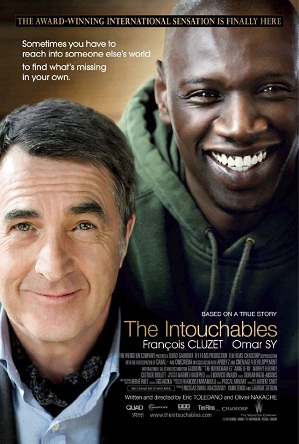
grossed $10 million. What must the French, with their tendency toward philosophizing, be saying? That Philippe is representative of modern France, a once-strong entity now reduced to wriggling its head helplessly? That the old, crippled France needs younger, more brash immigrants to revive it? That France, made immobile by centuries of crippling civilization, needs to find its brash voice again?
Who are the intouchables of the title? Both men, one assumes: the North African immigrant and the paraplegic. French society doesn’t want to touch either. They don’t know how to deal with either. If that’s the idea, we don’t get enough of it in the movie. No one stares awkwardly at Philippe. They tend to react with fear to Driss only when he physically threatens them.
Are we supposed to like Driss? He’s an asshole but the movie stacks the decks in his favor. At the job interview, the other applicants, with their degrees and knowledge and empathy, can’t answer the actorly question, “What’s your motivation?” Money, one says. The men, says another. I like crippled people, says a third. The question is never asked of Driss because we know the answer. He wanted the signature that showed he was looking for a job so he could continue to receive unemployment benefits.
There’s a jerk, a businessman, nouveau riche (you know), who parks his sports car in front of Philippe’s gated driveway, talking on his cellphone all the while, so Driss strongarms him, threatens him, to the smiles of the servant, Yvonne (Anne Le Ny) inside. Philippe’s daughter goes out with a boy with swooshy hair, who dumps her and calls her “a whore,” so Driss strongarms him, too. Demands croissant pour la famille tous le matin. The boy is dutiful. He even puts his hair in a barrette as Driss suggests. Driss may be an asshole, but he’s our asshole.
We get a bonding scene. One night Philippe wakes in a panic with labored breath, barely able to talk, and Driss put a warm compress on his face and talks him through it. He brings him outside in the night air. They stroll along the Seine. “It’s been ages since I’ve seen Paris at night,” Philippe says. Good, sad line. They talk about girls, sex. “How do you …?” Driss asks. “You adapt,” Philippe says. “You find pleasure elsewhere.” The ears, for example. Odd that he doesn’t talk about giving pleasure. He can still do that, yes? The two smoke pot. Philippe barely seems to know what it is, what it does. Assume Philippe is Cluzet’s age. That means he was born in 1955. That also means he was 18 in 1973, 21 in 1976. And he doesn’t know from pot? Please.
We wind up at Le Deux Magots at dawn and get some of Philippe’s backstory. He always liked extreme sports, he says. He liked speed. He went paragliding in heavy winds, crashed, broke his 3rd and 4th vertebrae. Et voila. At the same time his wife contracted an illness and died. “My real handicap,” he says, “is living without her.” Another nice line.
But at the moment he’s corresponding by mail with a woman named Eléonore (Dorothée Brière), who lives in Dunkirk. He dictates purplish prose to Magalie, who sends off the letters. When Driss listens to the awful dictations, when he finds out this has been going on for six long months, he takes matters into his own hands, as he is wont to do. He snatches one of the letters off the lap of the helpless Philippe, finds Eléonore’s number, calls, puts Philippe on. Magalie does nothing. In this moment she’s as helpless as Philippe. Of course Philippe loves it. Of course this is what he wanted all along. Photos are then exchanged. (Turns out Eléonore is gorgeous.) A meeting is set up. But Philippe is nervous, too nervous, and leaves just as Eléonore is entering. We see, he doesn’t. La tragedie.
The movie keeps doing this. Driss will act the asshole, but he’s either our asshole or he’s doing something the characters wanted all along. So it’s good. We were just too uptight, see? We were paralyzed with inaction. Thank God we hired this asshole. He’s making everything right.
Buying into the bullshit
Eventually Driss’ own life, in the form of a cousin being enticed and/or harassed by a drug-dealing gang, shows up, and Driss must return to it. This doesn’t ring true, either. Driss finally has a good job, with good pay, but he’s going to leave it in order to help his family? Really? We see him and his cousin meet the hard-working family matriarch (aunt/mother, respectively) at the train station and carry her bags. I liked that scene. We see Driss talk to the gang members in their black SUV. I didn’t like that scene. Because apparently that took care of the problem. Just that.
Meanwhile, Philippe is lapsing. None of the other caretakers work out. They’re too polite, no fun, don’t get it. When Philippe asks for a massage, the caretaker brings in a dude, for God’s sake, rather than two Asian babes who will massage both men while they smoke pot, as Driss had done. And Philippe can’t ask for himself. Because while some of Philippe’s culture rubbed off on Driss, none of Driss’ matter-of-fact brashness rubbed off on Philippe. So in the end, after a bad episode, they have to call Driss back, and he takes Philippe first on a joyride, then on a carride to a seaside town, where they go to lunch. That’s where Driss abandons him. Why? Guess. Right. Eléonore. And she and Philippe meet and fall in love. And Yvonne winds up dating one of Philippe’s relatives, and Magalie’s girlfriend (ah ha!) moves in with her, and we get a final shot of the real Philippe and Driss looking out to sea—because apparently this bullshit is based on a true story—and all is right with the world.
France loved it: $166 million at the box office in 2011. (Perspective: The No. 1 box office hit in France in 2012, “Skyfall,” grossed $60 million.) It was nominated for nine Césars, including best film, best director, best original screenplay, and two nominations for best actor. It won one: best actor for Omar Sy. Over Jean Dujardin in “The Artist.”
Me, I felt trapped 10 minutes in. I felt paralyzed, helpless, forced to endure the movie’s odd form of race fantasy and wish-fulfillment fantasy. Philippe isn’t representative of the problems of modern France; the success of “The Intouchables” is. Even France buys into the bullshit.
Tags: Movie reviews, French films, Cesars, Francois Cluzet, Omar Sy
No Comments yet | Permalink
Movie Review: The Monk (2011)
WARNING: SPOILERS
For half the movie we’re wondering: Is it “the devil is a woman” or is it just the devil? The answer disappoints. Me anyway.
Vincent Cassel plays Capucin Ambrosio, who, as a baby, was left at the doorstep of a monastery in 16th-century Spain. The title graphic, “1595,” intrigues on its own when you consider that, for most movies, 1979 is ancient history. (The source material, by the way, is a gothic novel first published in 1796 by Matthew G. Lewis, Esq., who was not yet 20 years old. It’s been filmed twice before: in 1972 starring Franco Nero; and in 1990 starring Paul McGann. We get a new version every 20 years, basically.)
Groupie? Snake? Gateway drug?
The movie opens with Ambrosio in the confessional telling a penitent, a man known only as Le Débauché (Sergi Lopez), that “Satan only has the power we give him.” Turns out Le Débauché has given Satan much power. He talks of falling, again and again. He talks of sleeping with his niece several times a day. “What an exquisite abyss,” he says with wonder in his voice. He seems to be enjoying his confession. Ambrosio is not amused. His eyes get darker and spookier. This is Vincent Cassel, after all.
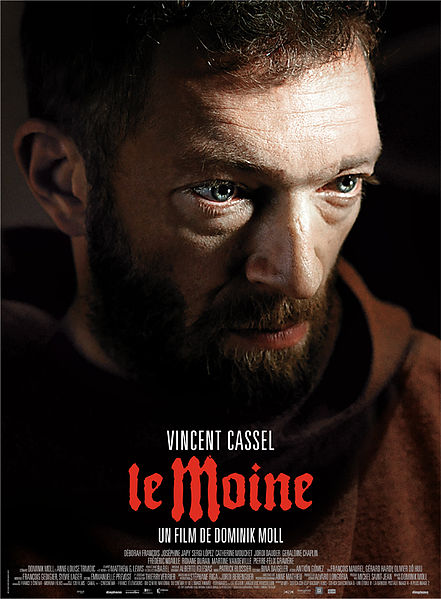
At this point, Ambrosio is something of a local legend. He is a firmly devout man who is able to communicate his faith, and the glory of God, to others. “His faith is so alive it swept my heart away,” says one supplicant, Antonia (Joséphine Japy), who faints after a sermon. We can’t help notice she’s pretty.
Then we follow several storylines:
- Ambrosio’s mentor is dying, and warns of great evil all around.
- A boy in a mask, a burn victim who has lost his parents, Valerio, asks to join the monastery. “I want to withdraw from the world and be closer to God,” he says. The other monks are doubtful and fearful; Ambrosio lets him in.
- A nun visiting Ambrosio’s confessional drops a note indicating an illicit relationship. She begs understanding but Ambrosio gives her up. “Instead of fleeing punishment,” he tells her, “you should yearn for it.” She gets it. Pregnant, she’s imprisoned by L’abesse (Geraldine Chaplin) until she starves to death. She blames Ambrosio for her fate.
- Antonia is courted by a handsome noble but her mother, Elvire (Catherine Mouchet), haunted by her own past, is doubtful.
We wonder how these stories will come together. Antonia’s, in particular, seems to have no relation to Ambrosio’s. Until it does.
The mentor dies, the nun dies, Valerio is revealed to be a girl (Deborah Francois of “Les tribulations d'une caissière”), who wants to be closer, not to God, but to Ambrosio. Is she an early version of a groupie? She asks for a rose from his garden before he sends her away, but as he reaches for it a scorpion bites him and poisons him. Near death, Valerio arrives and … Does she suck the poison out? Does she make love to him? Both? He lives, realizing he’s sinned, then sins again. She’s less groupie than the snake who has entered his Garden of Eden. But is she the snake?
The world turns dark. A fellow monk, about to finger Ambrosio for his infidelity, is killed by a fallen gargoyle. When Ambrosio investigates on the roof of the monastery, he realizes, as do we, that he’s living through a moment he’s dreamed about several times. Over the parapet, on the ground, he sees a woman in a red cloak praying in the baking sun. In his dream he reaches for her but can’t touch her. Now he does. It’s Antonia. She wants him to console her mother, who is dying and haunted by her past. He does. But now he’s haunted by his present and Antonia.
Rebuffed, Valerio offers Ambrosio a further temptation: a floral aphrodisiac, or organic date-rape drug, with which to seduce Antonia. He takes it, takes her, and the two of them, naked, are discovered by Elvire, who recognizes the birthmark on Ambrosio’s shoulder as the birthmark of the baby she gave up. Ambrosio is her child! And he’s sleeping with his sister! But before Elvire can say anything, Ambrosio wakes, walks up to her, and kills her. His mother.
By this point, yeah, I’d lost interest.
Why Satan should stay on the sidelines
While Ambrosio is worth watching in his moral rectitude, he’s not at all interesting in his fall—or in how he falls. It’s an unfair fight, really. Throughout I kept wondering what sexual release 17th-century monks had. None? How impossible. And to then have Satan gang up on you? Poison you and entice you with beautiful French girls? Speaking for men, we have little shot even if Satan stays on the sidelines. Once he gets into the game, it’s over.
The interesting battle, in other words, is internal, not external. The interesting foe is within, not without.
“The Monk” (“Le Moine”), directed by Dominik Moll (“With a Friend Like Harry…”), is beautifully photographed by Patrick Blossier, who juxtaposes the cool monastery with the white-hot, baked surroundings. As always, Vincent Cassel is a force, here mostly held in check. Joséphine Japy has a delicate beauty. But I’m not a fan of gothic anything.
After his trial but before his death, Satan finally appears before Ambrosio. He’s Le Débauché, from the beginning, who throws Ambrosio’s own words back at him: “Satan only has the power we give him.” Then a final deal is struck. Antonia has gone mad (her rapist is her brother who kills their mother) and Ambrosio sells his eternal soul to make her well and happy. One wonders: Is this redemption for Ambrosio, since it’s the ultimate sacrifice? Or is it the final step in Ambrosio’s fall, since his eternal soul belongs to Satan? At which point, black birds, who pecked at the baby Ambrosio at the doorstep of the monastery, pick at the remains of the grown man, dead in the desert.
So probably the latter.
-- March 10, 2013
Tags: French films, Movie Reviews, Vincent Cassel, Gothic, Deborah Francois, Josephine Japy
No Comments yet | Permalink
Movie Review: The Woman in the Fifth (2011)
WARNING: SPOILERS
There’s a moment in “The Woman in the Fifth” when the title character, Margit (Kristin Scott Thomas), having just given a handjob to down-on-his-luck novelist Tom Ricks (Ethan Hawke), leads him into another room in her high-ceilinged luxury apartment in the fifth arrondissement of Paris. The next shot is a close-up of an incredibly handsome man, with bare shoulders and hair slicked back, and, for a second, I wondered if Margit had led Tom into some kind of orgy with an Italian model. Then it dawned on me: Oh, that’s Tom. That’s Ethan Hawke. She’s bathing him.
Pause.
That’s right. He’s handsome.
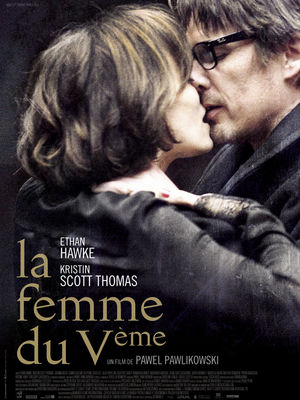
You forget watching “The Woman in the Fifth” (“La femme du Vème”). His character is so skittish and drawn, peering at the world through crooked, smudged glasses, and wearing the same musty clothes (hence the bath), that you forget the guy’s a movie star. Women in the movie are forever removing those glasses. With reason. They’re too askew, and the lenses enlarge his unstable eyes too much. They’re the glasses equivalent of Jack Nicholson’s bandaged nose in “Chinatown.” They’re so unflattering you can’t imagine a movie star wearing them.
An actor, on the other hand...
When did I begin to hate Ethan Hawke with the white hot hatred I usually reserve for members of the New York Yankees? Was it “Reality Bites”? The offhand way he explains the meaning of ‘irony’ to poor Winona Ryder? Was it the fact that he published a novel, “The Hottest State,” in 1996, at a time when I was trying and failing to get short stories published? Was it the privileged, pretentious way he moved through that privileged, pretentious decade? And when did I begin to let go of this unnatural hatred? “Training Day” helped. “Before Sunrise”/“Before Sunset” were OK but he played pretentious in the first and novelist in the second. So it must’ve been his loser brother in “Before the Devil Knows You’re Dead.” He stole the film from Philip Seymour Hoffman. I watched for Philip, despite Ethan, and Ethan blew me away.
He does it here, too. He’s a novelist again, with one published book, but you wouldn’t know it looking at him. He seems stunted. Every move he makes is tentative and uncertain. At times he tries to act confident, as before a lawyer, but his bluster augments the uncertainty in his face. It’s hollow and painful and followed by bursts of unrepentant anger. It’s no surprise when we find out he was recently in a mental institution.
As the movie opens, we see him bluffing his way through immigration, bluffing his way into a Parisian apartment building, and when a woman, Nathalie (Delphine Chuillot), tries to shut the door in his face, he pushes his way in. He speaks a passable French but talks to her in English (“Can’t we talk like normal people”) and she responds in clipped French (“Tu n’est pas normal”). Turns out she’s his ex-wife, but he’s less interested in her than in seeing his six-year-old daughter, Chloe (Julie Papillon), and, voila, runs into her as he’s leaving the building. She’s glad to see him; she’s not scared the way Nathalie was. He’s happy she wears glasses like his. Later, he’ll tell her, “You see the world like I do.” Even then, that doesn’t seem like a good thing.
He’s still on the run, though. Nathalie’s called the cops, so he leaves Chloe and tugs his luggage down the street. After falling asleep on a bus, his luggage and wallet are stolen. When he complains, the bus driver tells him, “Go to the police.” The very thing he can’t do.
In this manner he winds up in a rundown Arab cafe/hotel at “Au bon coin” (the Good Corner), which has a pretty Polish waitress, Ania (Joanna Kulig), and where he has to give up his passport to the owner, M. Sezer (Samir Guesmi), to get a small, dingy, second-floor room with a loud, angry neighbor, Omar (Mamadou Minte), who doesn’t flush their shared toilet. At the same time, some luck: Sezer, who may or may not be a petty gangster, gives him a job, €50 a night, to monitor a videocamera in a dingy, locked room, and let in anyone who asks for “M. Monde.” Then at une librairie anglaise, he’s recognized for his first novel, “Forest Life,” and invited to a swanky literary party, where he runs into Margit (Scott Thomas), whom we know to be our titular character, a potential femme fatale, with whom he talks on a balcony overlooking the base of the Eiffel Tower. She’s direct and gives him her card. When he shows up at her place, with a few scraggly flowers in his fist, we get the handjob scene mentioned in the opening graph.
So what’s her game? What’s his? He’s trying to see his daughter, as a father rather than as a stranger on the wrong side of the playground fence. In the meantime he writes her a long letter complete with drawings of woodland creatures, as in the enchanted forest of his first novel, which Ania finds in a Polish translation and reads. She’s impressed and he winds up sleeping with her, too. Unfortunately, Ania is Sezer’s girl, and Omar attempts to blackmail him. He leaves a note:
1,000 EUROS TOMORROW OR YOU’RE DEAD.
Margit, for her part, remains supremely confident in Tom. She tells him his next novel will be great since he has all this material: Sezer, down-and-out in Paris, her. He confides in her about Omar’s threat but she dismisses it:
Tom: You have no idea what these people are capable of.
Margit: You have no idea what you are capable of.
Then things move fast. Upon returning to au bon coin, he can’t open the second-floor WC. It’s blocked. Yes, by Omar, who sits on the toilet, dead, with a plunger down his throat. The cops come and question Tom about his arguments with Omar; they show him the blackmail note with his fingerprints on it. One wonders: Did Sezer set him up? To get back at him for Ania? Tom winds up in a solitary jail cell. Can he sink any lower?
He can. Margit is his alibi, and he tells the cops where she lives. But she doesn’t live there. She’s not even alive. She’s been dead since 1991.
But suddenly he’s released. The police have a new suspect, Sezer, who, when he sees Tom, reacts angrily, claiming Tom set him up.
Throughout the movie, intercut with the action, we’re shown dreamy images of a forest, like the one from Tom’s novel, with a girl in a colorful dress, blurry and just out of view, leaning against a tree. Is she dead? At one point we wonder if it’s Ania in her flower print dress. But when Chloe goes missing, we know it’s her. Not dead, though. We see her wandering back into the city, and the police pick her up and reunite her with her distraught mother. Tom, meanwhile, is reunited with Margit, who represents madness or death. At the end of the movie, he shows up at her door again, sees a flash of white hot light, and gives into it completely.
“The Woman in the Fifth,” the work of Polish writer-director Pawel Pawlikowski, is a smart, atmospheric, noirish thriller that clocks in, like a true 1940s noir, in under 90 minutes. I went in not expecting much. It has a 5.1 IMDb rating, so I assumed pretentious; I assumed it would fall apart. It doesn’t. I was hooked from the beginning. I’m still hooked.
We see the world through Tom’s eyes, like his daughter, and once we know that Margit doesn’t exist we try to figure out who does. Omar? Sezer? Ania? He could be imagining the whole thing from an asylum in England. It would explain why he often winds up in cells: the small chambre, the video room, the jail. It would explain why Paris is mostly empty side-streets.
Indeed, some post-coital conversations suggest that the entire movie is in his head:
Ania: It’s not good for you here.
Tom: There is no ‘here.’
With Margit:
Tom: I feel like the real me is somewhere else ... and the one that’s here is like a sad double.
At the same time, this last line is eminently relatable. Most of us have felt this way. How did I wind up here? Wasn’t I due for better things? Yet here I am. We don’t have to be in mental institutions to feel this way; we just have to be human.
Me, I want Omar, Sezer and Ania to be real. I think the movie’s better this way. So, yes, Tom is in Paris. Yes, he kills Omar but doesn’t remember it. Yes, he kidnaps his daughter. That’s why he returns to Margit. He gives in to the white hot light of death/madness to protect his daughter from himself.
That’s why he does what he does with the letter, too. That’s why it’s poignant. He’s been writing it throughout the movie. It’s long. But in the end he doesn’t trust it, or himself, enough. So to protect her, to make sure she doesn’t see the world through his eyes, he throws the letter in a trash bin. Then he returns to retrieve one page, which he tears in half. That’s the one he mails. It contains two words: Love, Dad.
Tags: French films, Kristin Scott Thomas, Ethan Hawke, Movie Reviews
2 Comments | Permalink
Movie Review: Starbuck (2011)
WARNING: SPOILERS
“Starbuck” is a small joy of a film: sweet without being cloying, gentle without being dull, and, above all, unassumingly, organically funny.
David Wozniak (Patrick Huard) is a genial bear of a middle-aged man. He’s affable, forgetful, bumbling, with a strong back, a widening middle, and a mane of dark hair. He’s the delivery driver for his father’s boucherie but can’t drive across town without getting a parking ticket. He’s dating a local police officer, Valerie (Julie LeBreton), but never invites her over because he’s growing pot in his apartment. He’s a friend to all and no one, a punchline within his own family, going nowhere and not really resenting it. Under his old warm-up jacket he wears the worn T-shirts of favorite hockey, futbol and baseball teams. He’s 42 and you get the feeling he’s been sleeping on a couch half his life. He’s been hibernating. He’s about to wake up.
He’s awakened at the start of this movie by local toughs, French-Canadian gangsters, who want the $80,000 he owes.
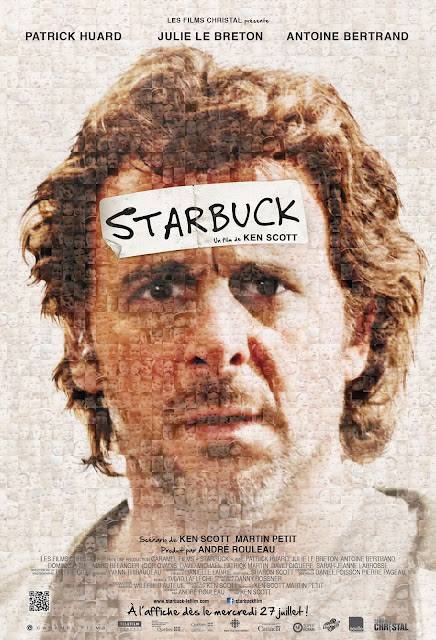
Later that day, he discusses it sheepishly with one of his brothers at the family butcher shop.
Brother: How much do you owe?
David: 80.
Brother: 80...?
David: ...thousand.
Brother: 80 thousand?
David: When you say it with a face like that, it sounds like a lot.
Everyone else is more interested in the jerseys. David has volunteered to get the jerseys for their own futbol squad and they assume he’ll screw it up. They keep reminding him, he keeps assuring them, until finally he explodes: “I have the jerseys!” There’s a pause until one responds, matter of factly, “He obviously doesn’t have the jerseys.”
He doesn’t. Attempting to retrieve them, he gets into an argument with a man in a sportscar who has taken his parking space, and while he’s arguing the shopkeeper closes shop. He has to talk him into reopening the shop, by which point he’s got another parking ticket. But he’s got the jerseys. “They’re in the van,” he tells his friends. Cut to: the van being towed because of the parking tickets. Cut to: the taking of the team picture, with everyone but David looking annoyed, and everyone but David attired in something besides the team’s red jersey.
Then his life gets complicated.
One of the running gags in the film involves all the different people who break into his apartment. The gangsters are first. A slick lawyer is second. He informs him that during the period between 1988 and 1990, under the pseudonym “Starbuck,” David donated sperm 693 times at a local sperm bank. (We later learn he was earning money to take his Polish-immigrant parents to Italy before his mother died.) Of those donations, 533 kids were born. Of those 533, 142 are enjoined in a class-action lawsuit to overturn the sperm bank’s confidentiality agreement and uncover who he is.
Oh, and Valerie’s pregnant, too.
There are good, honest bits on the horrors of children. “Never reproduce,” his brother with a pregnant wife tells him. His lawyer and friend (Antoine Bertrand), who must contact the local bar to get his license back to take David’s case, talks about his post-parent impotence. David wonders how he can use such language in front of his kids, but his friend remains unfazed. “I can say whatever I want,” he responds. “They don’t listen to me. They don’t pick up the frequency of my voice.” Even level-headed Valerie worries about what kind of mom she will be. She sees the snotty-nosed kids at the local playground and wants to smack them around.
All of David’s kids, of course, with the exception of Valerie’s, are in their early 20s now. David is given a manila envelope with the names and stories of each. He’s told not to look at it. Being David, he can’t resist.
The first is a professional soccer player. He and his lawyer attend a game and whoop it up. The second is a would-be actor working as a barista. David takes over for him so he can make an important audition. The third is a young drug addict. David takes her to the hospital when she ODs.
In this manner, anonymously, and seeing himself less as father-figure than guardian angel, he makes contact and tries to help those who need it. He’s as curious about them as they are about him. One is a lifeguard, another is a street musician, a third is developmentally disabled and living in an institution. David follows one offspring around town, a handsome gay man seemingly meeting boyfriend after boyfriend, until he hooks up with a girl in front of a fancy hotel. David follows them inside and into a conference hall where—he slowly realizes—he’s attending a meeting the 142 children of Starbuck. By this point he’s standing, looking around in disbelief at all of the life he’s helped create, and he’s asked, by the moderator, the street musician (played by French-Canadian musician David Giguère), why he’s there and what he wants. He claims to be the adoptive father of the developmentally disabled child who can’t make it. But he bucks them all up. He tells them that they may not know their biological father but they now know half-brothers and sisters. They now have another family. Everyone applauds.
“Starbuck” has its problems. All of the characters are a little too good-hearted. Maybe it’s a Canadian thing. The gangsters, for example, have the patience to wait out the rest of the film, and break no bones, merely hold David (and then, more horrifically, his father) underwater in a bathtub. The second time they do it to David, in the midst of all his problems, he doesn’t even struggle. He seems to be thinking, “Well, this is one way out.”
Then there’s the scene with the drug addict, Julie, played by former child actress Sarah-Jeanne Labrosse. David helps her, trusts her, and the next morning she doesn’t betray that trust. Problem solved. Anyone who knows anyone who’s alcoholic or a substance abuser knows that one morning is nice, but it’s one morning.
And how did David wind up owing $80 K anyway? It’s the opening salvo that drives the rest of the film but it doesn’t fit into his T-shirt and sweatpants lifestyle. Is he a gambler? Did he sink all of that money into sports memorabilia or harebrained business schemes? How do we know he won’t do it again?
Even so, the script by Ken Scott and Martin Petit, which won the Genie Award for best French-Canadian screenplay last year, goes in interesting, unexpected directions, and it never stops being funny. Its lead, meanwhile, Patrick Huard, handsome in profile, with a bit of Gerard Depardieu in his stunned, close-set eyes, and a bit of Bill Murray in his overall slacker demeanor, is glorious.
“Starbuck” winds up celebrating what it mocks (fatherhood, for example) but in a way that never tips over into schmaltz. Its joys are small: a baby’s hand in the tip of your finger; a montage of people jumping off a dock. Its laughs are big.
Tags: Movie Reviews, SIFF, French Canadian Films, Starbuck, Patrick Huard
No Comments yet | Permalink
Movie Review: Goodbye (2011)
WARNING: SPOILERS
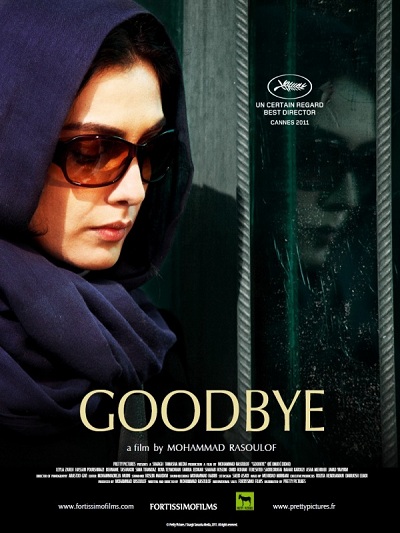
The first word spoken by the protagonist of “Goodbye” is hello. Noora (Leyla Zareh) is an Iranian lawyer whose license has been suspended, and who, we learn by and and by, is pregnant and trying to leave the counry. The lawyer she’s hired has helped others escape, and he has a plan for her. She’ll give a talk abroad and then just walk away. So why do we feel the weight of her ambivalence? Why does she talk of abortion when her pregnancy, she’s told, will help her escape? Is she ambivalent about leaving Iran or being pregnant? Answers come by and by.
“By and by” is the key to “Goodbye.” Writer-director Mohammad Rasoulof is a fan of the long, static shot, with characters moving into and out of frame, and he directs Zareh as if she’s close cousin to Catherine Deneuve at her most aloof and unknowable. If Hollywood movies are avalanches of action and suspense, “Goodbye” is a slow drip of often unreliable information. Where is her husband? Is he working in the fields in the south? Is he a journalist working against the regime? Is he a former journalist the way she’s a former lawyer, and now he’s working in the fields in the south? Either way, it beats her current job. In her dingy, gray-blue apartment, she glues together pretty boxes that a man picks up once a week.
Most of the time, though, she’s waiting, and we’re waiting out her waiting. She goes to this office, that office. She feeds her pet turtle. She gives him water. She takes him from his atrium and puts him in a pan of shallow water from which he tries to escape. She puts up a flimsy barrier of newspaper around the pan—a kind of metaphor for media blackout?—and he escapes anyway. Shame. That turtle was the most dynamic part of “Goodbye.”
Background: In 2010, Rasoulof was arrested in the same raid that nabbed fellow Iranian director Jafar Panahi, who went on to make “This Is Not a Film,” with which “Goodbye” shares much. Panahi put himself at the center of his film but otherwise both movies are Kafkaesque explorations of authoritarian limbo. Both characters are accused and await sentence or escape. Panahi’s film, being real, ends more ambivalently.
Noora’s ambivalence, it turns out, is not about leaving Iran. She often goes to the rooftop of her apartment building for a cigarette, and in the background we see airplanes taking off. Despite the jet-engine noise, she doesn’t bat an eye. She doesn’t even look at them. She betrays nothing. But this is what she wants: escape; goodbye. Near the end of the film, she tells one of her husband’s colleagues, sitting on a small park bench, “If one feels a foreigner in one’s own country, it’s best to leave it and be a foreigner in a foreign land.” Great line.
No, the weight of her ambivalence is about her baby, who has been diagnosed with Down Syndrome. She’s not sure whether to keep it. Then she’s sure she wants to keep it. After that, everything else is machination. The timing must be right. To get the money to pay off the lawyer who has her passport, she needs the deposit on her apartment. To get the deposit on her apartment, she needs to vacate a few days early. To get a hotel room in Tehran, she needs a husband. She’s like the pet turtle in the shallow pan: barriers, large and small, continue to confront her.
The night before her flight, at the Shiraz Hotel (Rasoulof was born in Shiraz), she leaves word with the front desk for a wake-up call and taxi to the airport. A mistake? We watch her cut bread for the journey. She sleeps, and dreams of a Down Syndrome child, then wakes to a knock on the door. Earlier in the film we watched her apartment being methodically searched by plainclothesmen. This time we just hear them.
She: Yes?
Man: Open the door.
She [pause]: Who is it?
Man [pause]: Open the door.
She fetches a more formal veil to wear from her suitcase; and as she walks away and opens the door, the camera stays on the suitcase even as we hear the sounds of men arresting her and taking her away. Unfamiliar hands paw through her belongings and remove evidence. The final sound we
hear is the screech of an airplane taking off—the one that doesn’t incude Noora. I thought of a spin on a Bob Dylan song: It takes a lot to laugh, it takes a plane to cry. The suitcase stays.
“Goodbye” is, I admit, a movie more interesting to write about than to watch. I almost nodded off several times during the screening. It’s a slow drip of a movie, a kind of Iranian water torture, and I wanted it to give me more. But I’m a spoiled moviegoer and a spoiled man. When Noora first says her famous line, about feeling a foreigner in one’s own country, I felt that it applied to me, too. I certainly felt similar during most of the Reagan and George W. Bush administrations. But my discontent is mild, and with my fellow citizens who elect such leaders, while hers is overwhelming and with leaders who allow no opposition voices. It’s the difference between “1984” (her world) and “Brave New World” (mine).
I kept thinking of a line from E.L. Doctorow’s “The Book of Daniel”; something Daniel’s father, Paul Isaacson (read: Julius Rosenberg), tells his young son about all of the injustice in the world. “And it’s still going on, Danny,” Paul Isaacson says. “In today’s newspaper, it’s still going on. Right outside the door of this house it’s going on.” This is current events as art.
The movie begins with a hello and it ends with a goodbye, but it’s not the goodbye we wanted. Noora doesn’t escape from; she disappears into. And it’s still going on.
Movie Review: Monsieur Lazhar (2011)
WARNING: SPOILERS
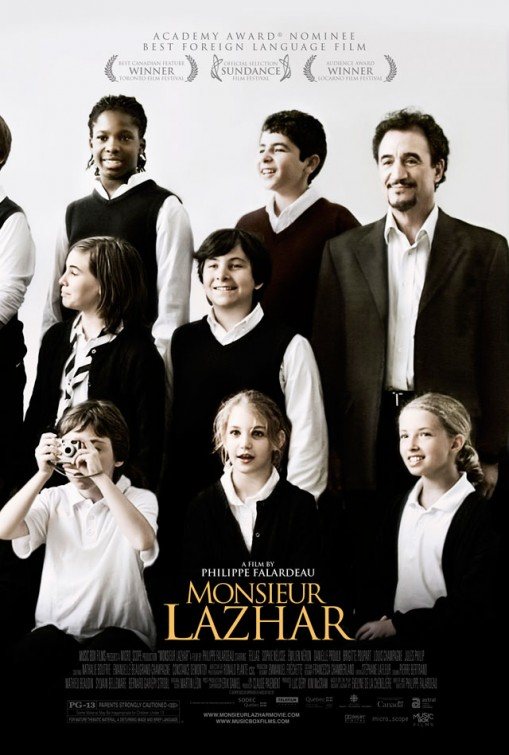
“Monsieur Lazhar,” a nominee for best foreign-language film at the most recent Academy Awards, is such a gentle film, and so evocative of childhood, that I began to think it was set during my childhood. This evocation is particularly true of throwaway shots: the winter streets of Montreal at twilight; teenage boys play hockey at night under the lights. At the same time, I grew up 40 years ago. Is Canada still so innocent? Do the kids not need locks on their lockers? Do they get pint milk cartons after recess? Do they have recess? Do American kids?
The milk
The movie begins with a shock. At an elementary school in Montreal, Alice (Sophie Nélisse) reminds Simon (Émilien Néron) during recess, “Isn’t it your turn for the milk?” We don’t know what that is yet, “the milk,” but writer-director Philippe Falardeau is precise in his details:
Simon, on his way, knocking the hat off a fat schoolmate, being chastised by another teacher but pleading “the milk” and allowed to continue; loading up a plastic milk crate with pint-sized containers from a small refrigerator and carrying the thing clumsily to his locker, where he removes hat, jacket, scarf, mittens, picks up the crate again, balances it with one arm as he tries to enter the classroom, and finds the door locked. He looks in, cupping his hand over his eye, then stumbles back in shock, dropping everything. In the classroom, his teacher, Martine Lachance (Héléna Laliberté), is hanging from a rope. Dead.
Other teachers scamper to herd the kids back outside before they glimpse what Simon glimpsed (one, Alice, gets through), which, it turns out, is what they do for much of the rest of the movie: attempt to hide the fact of death and suicide from the kids. One of the first administrative acts is indicative: they paint the walls of the classroom from dull yellow to dull gray. It’s a thin, unwelcome veneer.
Into the post-suicide chaos, the title character, Bachir Lazhar (Mohamed Fellag), arrives. He’s Algerian, taught in Algeria for 19 years, and brings a gentle but old-school spirit to the classroom. The desks are in a semicircle? He puts them in regimented rows. Dictation lessons? Here’s Balzac. He chastises Simon for taking his photo without permission, then slaps him upside the head for insulting another student. When informed that touching the students, let alone hitting them, isn’t allowed, he lies about hitting Simon.
Montreal le slush
Most teachers in these types of movies are human but heroic. Think Robin Williams in “Dead Poet’s Society,” Morgan Freeman in “Lean On Me,” Meryl Streep and Michelle Pfeiffer and Edward James Olmos in their various films. Think confrontation scenes and uplifting, swelling music. Monsieur Lazhar is human but a fake. In Algeria, he was a civil servant and restaurateur, not a teacher. His wife taught. She also wrote a progressive book that was condemned by Islamic authorities and the family had to flee. Bachir preceded them to Canada. The night before his wife and kids were to join him, they died in a fire. Arson suspected.
Bachir isn’t even a citizen. He’s struggling to stay in the country as a political refugee, but the government has doubts about his story. It thinks Algeria is back to normal now. “Algeria is never completely normal,” Bachir responds, quiet and perplexed.
Lazhar may be a fake teacher but he’s genuine. He’s fussy and a little nervous. He’s scrupulous in manner. He wants the kids to learn. He has nightmares that, because he didn’t do his job correctly, they’ll become grown-ups but speak as children. That could describe our entire culture, by the way.
He plays favorites. Alice, adorable, looking a bit like Anna Chlumsky 20 years ago, is smart and curious. She looks up Algeria online and thinks it’s beautiful: all white and blue. He tells her it’s called Alger la blanche. She dismisses her city thus, Montreal le slush, but he tells how he was stunned by its greenness when he first arrived. When Alice’s mother, an airline pilot, shows up, he admits Alice is his favorite.
He also wishes to confront, rather than cover up, the tragedy that began the film. In this way he butts heads with worried administrators and reticent parents, but, again, this is not a Hollywood wish-fulfillment story. The administrators, led by Ms. Vaillancourt (Danielle Proulx), as well as the other teachers, aren’t bad folks. They’re overworked, underpaid, understaffed. They’re like all of us, mixed bags, and our opinion on them keeps shifting. One of Lazhar’s fellow teachers, the enthusiastic and attractive Claire (Brigette Poupart), is actually kind of annoying, and thinks too highly of her African travels, while the macho gym teacher, who warns Lazhar that they live in a “woman-curacy,” and whom the students dismiss as someone who probably can’t even read, has some nice lines on the difficulty of teaching kids the pummel horse without touching them. “We now treat kids like they’re radioactive waste,” he says.
More to the point, Bachir doesn’t win. In the clash with a sensitive modern culture, it’s not even a contest. There are no “Captain, my captain” moments, no marches down to the jail cell, no final victories as the music swells. In his class, by chance, he gets the kids to open up about their former teacher’s death, which helps two of them: Simon, who blamed himself for the suicide, and Alice, who blamed Simon. “Don't try to find a meaning in Martine's death,” he tells the students. “There isn't one.”
The Tree and the Chrysalis
But for this act he’s investigated, his past is discovered, and he’s fired. He pleads to stay the rest of the day, to say good-bye to the kids. Oddly, we don’t see this good-bye. The class is studying fables, and they’re all supposed to write their own, including Bachir. We see him read his to the class. You could call it “The Tree and the Chrysalis.” Earlier in the year he taught them that word, “chrysalis,” whose metaphoric overtones for 11- and 12-year-old kids are obvious. “Commes vous,” he says of the stage between caterpillar and butterfly.
In his fable, things don’t go well. The tree tries to protect the chrysalis, but a storm and a fire damages it. The butterfly that emerges isn’t the same.
The movie ends well by ending quietly. While in voiceover we hear Bachir complete his fable, we watch Alice, on his last day, get her things from her locker, then return to the classroom. She’s obviously distraught, losing her favorite teacher, and displays a kind of abject vulnerability by dropping all her things. He hugs her. The fable he tells is sad, the various tragedies of life are sad, but the true sadness of the film is this. It’s in every step we take that leaves more behind. It’s in all of our good-byes. The film offers no uplift, no final victory. Writer-director Philippe Falardeau knows we don’t need swelling music to make our hearts swell.
Tags: Movie reviews, French Canadian Films, Movies About Teachers, Montreal
No Comments yet | Permalink
Movie Review: Footnote (2011)
SPOILERS: WARNING
This is some Old Testament shit right here.
The trailers make “Footnote” seem like a lighthearted romp, but there’s nothing lighthearted about it. It’s a comedy, sure, but it’s a comedy like the British version of “The Office” was a comedy. Laugh-out loud moments are rare because we’re often struck dumb with embarrassment and anguish.
Eliezer’s tragedy
Uriel Shkolnik (Lior Ashkenazi) is a professor of Talmudic studies in Israel, as was his father, Eliezer (Shlomo Bar-Aba), before him. The younger Shkolnik is celebrated, the elder not, and, as the movie begins, the father is a reluctant audience member at another ceremony in which his son receives another honor, and gives another
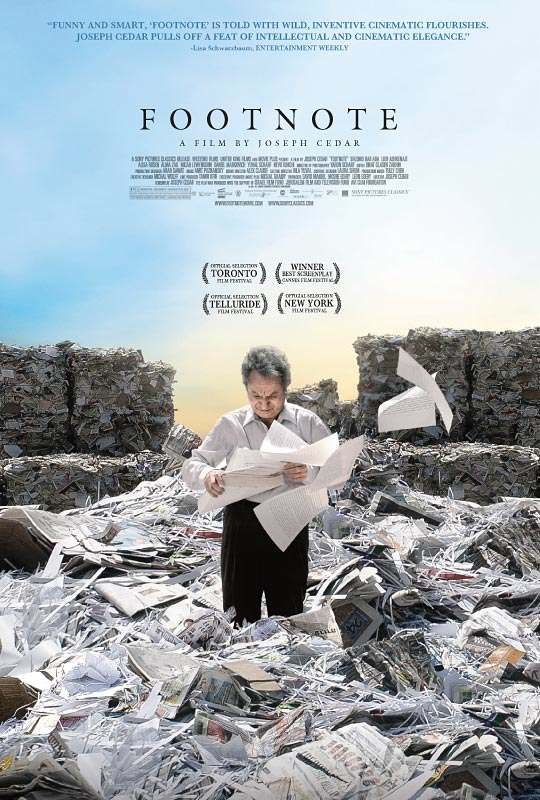
speech honoring his father. He talks about how, in third grade, asked for his father’s occupation on a school form, he wanted to write “professor,” since that’s what he was, but his father insisted upon the plainer and—to him—more meaningful word “teacher.” When the speech is over, everyone stands and applauds. The last to stand and applaud, and the first to stop and sit, is Eliezer, who is lost in his own bitter world. Later, in bed with his wife, the son reveals that that childhood moment wasn’t so lighthearted. His father forced him to write “teacher” by grabbing his hand hard. His hand hurt for days.
Eliezer’s tragedy, his long-stewing resentment, is that his life’s work was usurped by a lucky break by another scholar, Prof. Grossman (Micah Lewensohn), who, a month before Eliezer was set to publish, simply found what Eliezer’s 30 years of careful, scientific study was attempting to point towards. His entire career is now seen as unnecessary and vaguely ridiculous. His one solace: a great scholar once mentioned him in a footnote. Every year, too, he applies for the Israel Prize, the most honored of honors, but never wins.
This year, that changes. He’s walking to the library, as always, to continue his pointless research, when he receives a phone call from the committee chair congratulating him. He sits back on a nearby rock, stunned. We wonder what he’ll do. Whoop it up? No. He continues on his silent way; but at the library, bursting, he can’t do research, and instead he and an elegant older woman head outside. From a distance, we, and eventually his son, see them talking. He says more to her than he does to his family.
But there’s a wrinkle. The committee called the wrong Prof. Shkolnik. The honor is supposed to go to the son.
Uriel’s tragedy
When Uriel discovers this, and, worse, discovers that the committee, with Prof. Grossman as its chair, wants him to tell Eliezer of the mistake, he’s distraught. He declines, then thinks about it, then declines, then thinks about it, then flatly refuses. “It will kill him,” he says. “It will bury our relationship.” He wants the committee to honor his father, as it should have done years earlier. He voices his father’s bitter complaints. Does Grossman hold a grudge against Eliezer? Uriel accuses him, shoves are exchanged, and Grossman, the distinguished, elderly professor, whose forehead has the deep folds of a shar pei, winds up on the floor with a bloody nose. In the end, Grossman acquiesces. On two conditions: Uriel must write the judges’ considerations; and Uriel must never again submit for the Israel Prize. The highest honor will thus be denied him forever.
Each section of the movie is given a chapter title—“The most difficult day in the life of Prof. Shkolnik” is the first, for example—and the next chapter is titled “The revenge of Prof. Shkolnik.” And who is this revenge against? His son.
You know that great juxtaposition scene in “The Godfather” when Michael becomes godfather at his nephew’s baptism as he become mafia godfather by taking out his enemies? The dual baptisms scene? It now has a rival. Writer-director Joseph Cedar cuts between the younger Prof. Shkolnik praising his father’s work in the faux judges’ considerations while the elder Prof. Shkolnik trashes his son’s work as unscholarly and unscientific to a visiting journalist (Yuval Scharf). As his son creates a triumphant fiction out of his father’s tattered career, the father trashes the son’s scholarship as fiction. It’s brutal stuff.
So what now? To save his father, Uriel has sacrificed some part of his reputation, which his father, triumphant, has now trashed from the high perch on which his son placed him. He can’t lash back. That would defeat the whole purpose. He can’t go back, either. Grossman’s in the way.
Their tragedy
Both men live with long-suffering women. Earlier in the movie, Uriel’s wife, Dikla (Alma Zack), informs her husband , during one of his many complaints about his father, that Eliezer is at least true to himself and says what he means, while he tends to avoid confrontation. He’s certainly done that with the Israel Prize. Eliezer’s wife, meanwhile, hardly says a word. She merely exudes the pain of living with a silent, bitter man for nearly half a century.
So what now? Two things happen. At a production of “Fiddler on the Roof,” Uriel tells the truth about the Israel Prize, in a whisper, to his mother, and we immediately hate him for it. It’s a small, cowardly act—yet wholly understandable. If the universe won’t know the good he’s done, at least his mother will. But why burden her with this knowledge? Isn’t she burdened enough? Does he hope she will tell the father, who will recant his public criticisms of the son?
Moot point: Eliezer figures it out himself. He shows us what a true scholar he is by realizing the word “fortress” in the judges’ considerations is a word Grossman never uses but his son overuses. His research confirms this. He flashes back to the phone call, and how he was supposed to receive the formal letter the next day but didn’t receive it for several days. It all clicks. His son was supposed to get the honor but honored his father instead.
At the great hall where the ceremony takes place, we watch Eliezer watch dancers rehearse a surreal number, and for a moment we wonder whether he’s dreaming. But then it all becomes too ordinary for a dream. We get Uriel in the audience, suffering in silence as his father suffered in silence, estranged from his son as his father had been estranged from his son, not communicating with his wife as his father had not communicated with his wife. He spies the elegant older woman he’d seen with his father. What’s her deal? What’s their deal? Is it an affair? The movie doesn’t say. Things are unknowable. His father is unknowable. The ways of God are unknowable while the smallness of man is overwhelming. We’re all footnotes.
Our tragedy
In the end, Eliezer, silent and bitter, waits to go onstage to receive his honor, just as, in the beginning, he sat in the audience, silent and bitter, waiting for his son to receive his honor. We wonder: Will he go through with this charade? Or will he remain true to himself, and to science, and to scholarly research? He listens to the accolades being told about him, the fabrications and fictions, and at that moment, as he’s about to be introduced, the movie ends. It cuts off, goes dark, rolls credits. The movie ends with Eliezer doing what he’s always done: waiting in the wings.
Talk about brutal—and for the audience this time, too. Because we’ll never know. My guess? Everyone goes through with the charade, and everything that isn’t said poisons what remains. The fiction Uriel creates to save his relationship with his father destroys his relationship with his father. But that’s just my guess. The ending remains unknowable. It’s a Jewish ending, an Old Testament ending. It recalls the Yiddish proverb: Man thinks, God laughs. “Footnote” is a comedy for God.
Movie Review: Les Hommes libres (Free Men) (2011)
OUI, SPOILERS
Most movies about civilian life in Nazi-occupied Europe are pretty straightforward, whether they’re set in France (“La rafle”), the Netherlands (“Oorlogswinter,”), or Poland (“Katyn”). The Nazis are occupying your country. They’re rounding up Jews. They’re killing your friends. Everyone knows who to root for and against.
“Les Hommes libres” (“Free Men”), directed by Ismaël Ferroukhi, focuses on Algerian Muslims living in occupied Paris, and thus adds a twist. The country that has occupied your country for more than 100 years is itself now occupied. So is the enemy of your enemy your friend?
Younes (Tahar Rahim of “Un Prophete”), a black marketeer, begins the film as the classic disinterested protagonist, a kind of less-connected, rootless Rick Blaine. His cousin, Ali (Farid Larbi), a communist, tries to involve him in union issues. “We’re getting organized,” Ali says. But Younes sticks his neck out for nobody. “I’m not interested,” Younes responds. He says he wants to “make my pile and go home.”
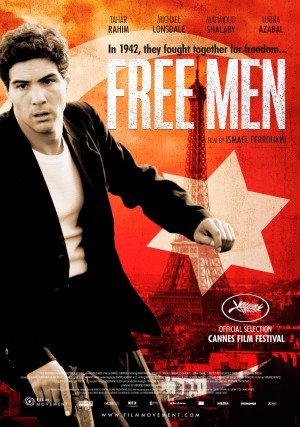
Then he’s fingered—by Ali?—and the authorities swarm in, take his goods, put him in jail. There, L’inspecteur (Bruno Fleury) offers him a deal. He’ll let him go if he hangs out at the Grand Mosque of Paris and reports back what’s going on. Younes, conflicted, accepts.
Younes, we’re told, is an amalgamation of several World War II-era Algerians, but two of the folks he meets at the Grand Mosque are based on historical people: Si Kaddour Ben Ghabrit (Michael Lonsdale), the founder of the Mosque, and a French loyalist; and Salim Halali (Mahmud Shalaby), an up-and-coming Algerian singer with Elvis sideburns and amazing eyes. To the latter, Younes sells, for 800 francs, an Algerian drum he had acquired for two packs of cigarettes. For a moment, as he calculates his profit, he’s a happy man.
The authorities are watching the Grand Mosque because they suspect—rightly—that the Muslims are harboring Jews. The number of Jews Ben Ghabrit’s Mosque saved is debated these days, but both sides agree it’s somewhere between 500 and 1600. That’s Oskar Schindler territory.
Younes discovers all of this but feeds the authorities harmless information. He discovers Salim is part Jewish but warns Salim rather than telling the authorities. Ben Ghabrit actually makes short work of Younes’ snitching activities by complaining to a German official with whom he’s friendly, Major von Ratibor (Christopher Buchholz), that the Vichy French have sent in spies. Word gets back to L’inspecteur, who grabs Younes off the street, threatens his life, but ultimately lets him go. Younes is now free from that double life, about to enter another one.
The more he hangs out at the Mosque, and the more he sees the fiery-eyed Leila (Lubna Azabel), the more he’s drawn into the resistance. At first he reluctantly goes on errands. Then he volunteers. By the end, he’s a part of it rather than apart from it. He’s a leader.
In this way Younes is similar to Malik, the role Rahim played in “Un Prophete”: the loner who becomes a leader for his people after being co-opted by the enemy. Both characters never seem particularly strong, smart, or calculating, and yet, because they’re underestimated, they come out ahead. Rahim is an interesting actor. He exudes calm rather than intensity. I like his small gestures. The surprise on his face when he witnesses Salim kissing a French girl (“You can do that?”). Asked how he’s doing after being let go by the authorities, he gestures, without heat but vaguely annoyed, at the scar on his cheek. You feel his shame as a snitch and his awful grogginess waking up from his first hangover.
This is French drama so there’s less force driving the narrative; there’s a randomness that feels real. Younes saves two Jewish kids during the Vel’ d’Hiv round-up but we only see them again at the end. He begins a flirtation with Leila but she’s rounded up before their first date. As she’s being led away in the back of a military vehicle, their eyes lock, and in those few seconds their eyes say everything that time and circumstances won’t allow.
So why the Hollywood moments? The rain falling on Salim after the cemetery subterfuge; the look the Jewish girl gives Younes after he guides her to the getaway boat on the Seine; the unnecessary introduction of Salim’s homosexuality; the emaciated cheekbones of the Gestapo agent.
“Les Hommes libres” is a good film but no more. There’s a simplicity and economy to the story, an almost conscious attempt to avoid histrionics and melodrama—which is appreciated after the recent spate of melodramatic World War II fare: “Le Rafle,” “City of Life and Death,” “John Rabe.” The movie ends after D-Day and liberation, but a better ending might have been the moment Younes, again by the Seine, takes out Omar (Zakariya Gouram), his original black-market source, and a true snitch. It’s Younes killing the man he might have been.
Tags: French films, Tahar Rahim, Michael Lonsdale
1 Comment | Permalink
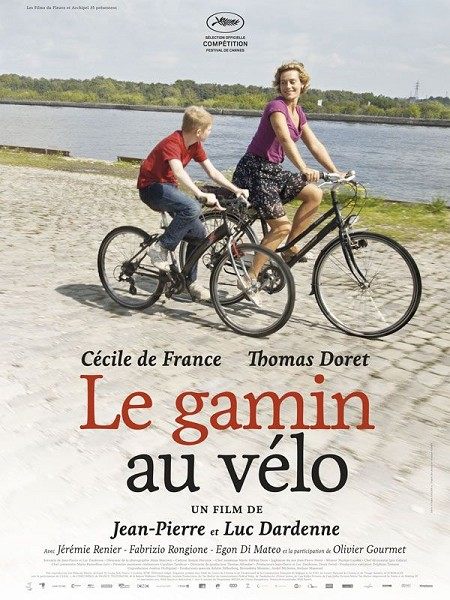
Movie Review: Le gamin au velo (2011)
WARNING: SPOILERS
Has there been a more misleading movie poster in recent years? After the movie was over I assumed the U.S. distributor pulled a Weinstein to draw in American crowds but the poster is the same abroad. We all want that happy, breezy, leggy image. We all want to see that kind of movie.
Which isn’t this movie.
It begins with Cyril Catoul (Thomas Doret), 10 or 11 or 12, on the phone, listening with a worried brow, and being told by an unseen adult to hang up. He doesn’t. He clings to the phone like it’s a lifeline, which it is, and accuses the adult of misdialing. The world is not right, he knows that much, and assumes it’s this adult’s fault. So the adult lets Cyril dial the number himself, and they put it on speaker phone, and we hear those three annoying tones—which apparently are international—before the equally annoying message, which doesn’t sound any better for being in French: “The number you have dialed is no longer in service...” But Cyril continues to hang by the phone as if to will a different response. When the adult, an educator at an orphanage or “youth farm,” tries to guide him away, Cyril attacks, runs away, is chased, caught, brought back.
This scene is repeated throughout the movie in different ways. Cyril is a boy in perpetual motion. He’s a kid who’s running away from the truth. He’s also running toward the truth.
Dad
A month earlier, his father, Guy (Dardenne brothers’ staple Jérémie Renier), placed Cyril in the orphanage, telling him he’d be back for him within 30 days. Those 30 days are now up but he hasn’t returned, hasn’t called, and his home phone is no longer in service. When Cyril bolts the youth farm and makes his way back to their old apartment building, he’s told, through the intercom, that his father doesn’t live there anymore. He sneaks inside the building anyway, is chased, grabs onto the nearest adult, a local hairdresser named Samantha (Cecile de France—smart kid), and refuses to let go until he’s allowed inside the apartment. But it’s like with the phone all over again. The apartment is empty. He inspects each room carefully, looking for evidence but really looking for a different reality. At this point he refuses to believe any adult, any evidence, because the truth is too painful. It means his father abandoned him. It means he’s alone.
Back at the youth farm, Samantha shows up with his bike. Cyril had accused another kid of stealing it, but the father of the kid claims he bought the bike off Cyril’s dad, so Samantha simply buys it back. Cyril refuses to believe this story but he does show Samantha some stunts: how long he can stay still and upright; how long he can pop a wheelie. He flits around her car, almost dangerously, but even when showing off he never loses his dour, pinched expression. The movie will be half over before we see him smile.
His father had his own bike, a motorcycle, and Cyril, widening his search with the bike, keeps asking for a man with “a golden helmet.” It’s great image. It brings to mind Greek gods.
In a sense, that’s what Cyril is searching for but he finds the fallen kind. His father now works prepping food in a restaurant in a small town, and, when Cyril shows up, Dad acts distracted and claustrophobic around him. I was going to write he’s uncaring, but that’s not quite it, even though he obviously doesn’t care. Put it this way: there’s no guilt over what he’s done. On Cyril’s part, there’s no anger, either. Around his father he affects the nonchalance of boys. “C’est pas grave,” he keeps saying, even though it’s all grave. He clings to his belief in the man with the golden helmet. Eventually Samantha steps in and demands that Guy tell Cyril the truth to his face.
Three times during the movie we get a noticeable, almost distracting blast of Beethoven’s fifth piano concerto, and each blast seems to follow a moment of realization for Cyril. The first blast comes shortly after Cyril learns about his father.
Wes
So what happens to a fatherless boy? He looks for substitutes. In this case, substitutes come looking for him. Another boy, a different boy, steals his bike, and Cyril chases him into the woods, where he meets Wes (Egon di Mateo), a local tough who admires Cyril’s tenacity, calls him “pitbull,” and takes him under his wing. Do we trust this guy? He gives off a bad vibe. In his room, he gives Cyril a sodapop and lets him play his PS3, and Cyril, unsmiling, feigning his usual nonchalance, is nonetheless captivated by this new father figure. It never shows in his face—the way it would in a Hollywood film—just in his actions. It’s heartbreaking the lengths he’ll go for Wes’ approval. He winds up fighting Samantha, with whom he’s staying weekends, and who’s the only good thing in his life, in order to commit crimes for Wes. When things go awry, Wes refuses his money, which Cyril then takes to his father, who also refuses it. Neither is particularly magnanimous in their refusal. They just don’t want to get caught. They leave Cyril holding the bag. Cue second blast of Beethoven’s piano concerto.
Thomas Doret, I should add, is heartbreaking and annoying and completely believable in the title role. After the father revelation, Samantha tries to comfort him and he jerks his shoulder violently away from her. When he first enters Wes’ cramped room, with the bed the only sitting option, he seems awkward and confused, out of either etiquette or fear. For much of the movie, he keeps pursuing the wrong path even though the right path is right there. In this, he’s like most of us.
Samantha
Most people will have two questions after watching “The Kid with a Bike”:
- Why does Samantha care so much about him?
- What’s with the end?
Cyril raises the first question within the movie but the movie smartly doesn’t answer. Most movies would give us a facile rationale for her actions: oh, she can’t have kids, or she was an orphan, too, or she lost her brother when he was 10. Jean-Pierre and Luc Dardenne, the Belgian writer-director brother team (“La Promesse,” “L’enfant”), are smarter than that. They leave it unknowable to us, and to Cyril, and maybe even to Samantha. Much of life is like this. We don’t know why we do what we do.
It’s the third act that’s weak. Cyril, with Samantha’s help, finds the right path, and he’s riding on it, when stuff from the wrong path—in the form of the father and son he attacked for Wes—appears before him. The boy attacks him, chases him into the woods and up a tree, and throws rocks at him. One rock finds its mark and Cyril falls. Motionless. Dead? After the son retrieves the father, Cyril recovers. He wakes up groggily, makes his way back to his bike, gets on, rides off. We get our third blast of Beethoven. The end. It’s a very European ending but I didn’t find it meaningful or resonant. The past always catches up? The right path doesn’t mean a clean path? What?
“The Kid with a Bike” is an honest movie with a dishonest poster and a weak ending. I wanted to like it more.
Tags: French films, Cecile de France, Movie Reviews
2 Comments | Permalink
Movie Review: Bill Cunningham New York (2011)
WARNING: MARVELOUS, EXOTIC SPOILERS OF PARADISE
“He who seeks beauty will find it.”
Bill Cunningham, quotidian fashion photographer for The New York Times, says this near the end of Richard Press’ excellent, moving documentary, “Bill Cunningham New York,” while accepting an award from the National Order of the Legion of Honour of France; and it’s so true to him, so meaningful to him—and, really, to the documentary about him—that his voice begins to crack. He’s not just espousing something he read. He’s telling us his life philosophy. The point of what he does, he says, is “not the celebrity, and not the spectacle. It’s as true today as it ever was: He who seeks beauty will find it.” Then he thanks the French and leaves the stage.
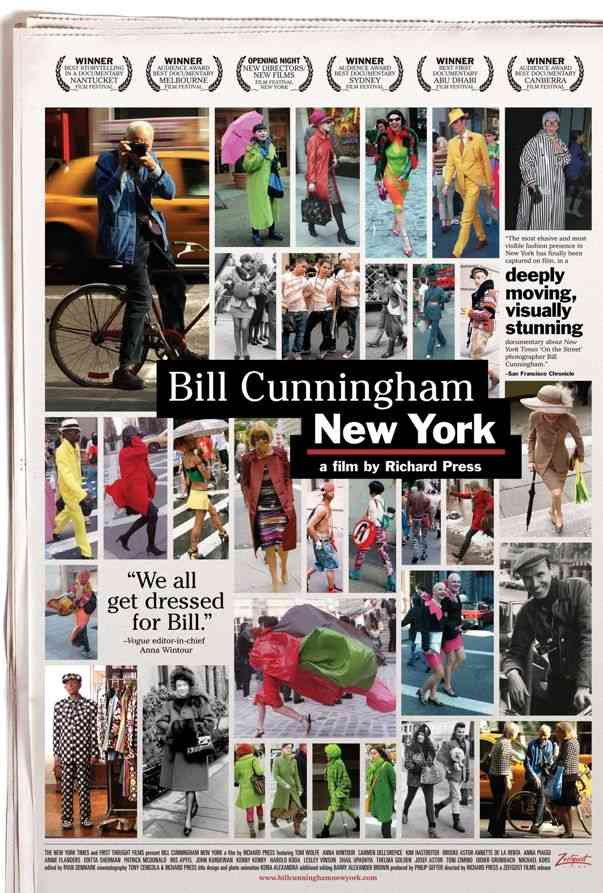
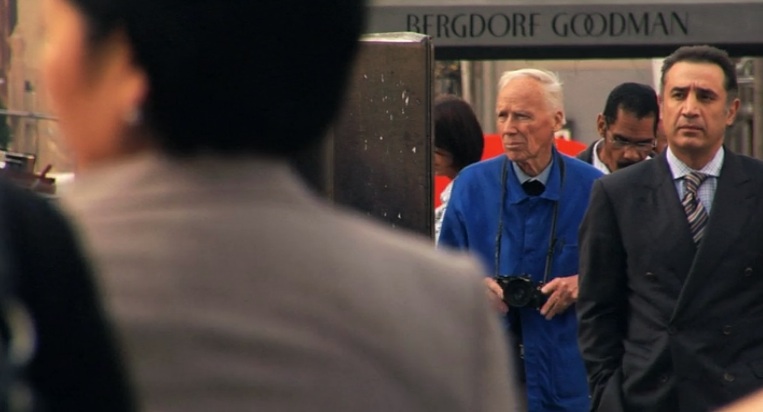
Cunningham is an American original. He covers the tux-and-gown society scene for The New York Times on a Schwinn bicycle. He covers the haut couture fashion shows wearing the sturdy blue jackets of French street cleaners. He is one of the better known fashion photographers in the country even though he’s the first to admit he’s not really a fashion photographer. He has an overwhelming joie de vivre that covers an overwhelming personal sadness.
His “On the Street” column is an American original. Screw the models; screw high society; what are the people wearing?
“The best fashion show is definitely on the streets,” he tells us early in the doc. “Always has been and always will be.”
What trends are forming? What’s interesting? What’s fun? Who’s fun? What “marvelous, exotic bird of paradise,” as he calls them, might he spot today? His frequent subjects include: Iris Apfel, the nonagenarian teenager wearing her great, round glasses; Patrick McDonald, the carefully chapeaued and eyelined dandy; and Shail Upadhya, the former U.N. official from Nepal, whose loud, colorful, homemade suits are at humorous odds with his dour visage.
“You’ve just got to stay out there and see what it is,” says Cunningham. “You’ve got to stay on the street and let the street tell you what it is. There are no shortcuts, believe me.”
A gentleman in the age of snark
Cunningham is in his early 80s, and so, despite his pep—and he’s someone who actually deserves that word—there’s something inevitably old school about him. He still uses film in the digital age, for example. He’s also a gentleman in the age of snark.
“He’s incredibly kind,” says socialite Annette de la Renta. “I don’t think we’ve ever seen a cruel picture done by Bill. And he’s certainly had the opportunity.”
Back in the day, and for a time, Cunningham wrote a millinery column for Women’s Wear Daily. Then he wrote a piece, similar to what he does now, on women in the street wearing the clothes of the models of the runway. It was a positive piece about style: how each woman made the fashion her own.
“And they changed his copy to make fun of the women,” says Annie Flanders, founding editor of Details magazine. “He didn’t think he’d ever get over it, because he was so embarrassed and upset. ... That was the end of his career at Women’s Wear Daily.”
Tellingly, Cunningham doesn’t say a word on the subject. He’s someone who focuses on the positive: the fashion he likes and the stories he likes.
Who’s that boy?
So who is he? Where does he live? Is he from an upper-class family? Is that why he fits in so well with socialites? Is he straight? Gay? Why is someone so passionately interested in fashion so disinterested in fashion for himself?
“People don’t get to know him very well, do they?” asks Iris Apfel. “I get the feeling he doesn’t sit down and talk to people very much.”
“I have no idea of his private life,” says Annette de la Renta. “I have no idea if he’s lonely.”
Answers come by and by. He lives at Carnegie Hall, of all New York places, in a room so cluttered, so full of file cabinets and old magazines, it could be used to torture claustrophobes. Part of the drama of the doc is that Cunningham, and the few remaining artists living there, are being evicted by the grandees of Carnegie Hall. By doc’s end, he’s in an apartment overlooking Central Park. We should all be so displaced.
His background is working class. That helps explain the blue jacket and the taped poncho, and the egg sandwich and coffee lunches, but Women’s Wear Daily also helps explain these things. If you spend less, you need less, and you need to work less with folks whose purpose is the opposite of yours. That torn poncho, looking almost like a garbage bag, which he happily fixes with electrician’s tape, is a kind of freedom.
So: a fascinating man. A good documentary. Then, in the last 10 minutes, it becomes a great documentary.
The patron saint of unspecified sorrows
Press, the documentarian, gets Cunningham to do what Iris Apfel suggested he doesn’t do. He sits him down and asks him questions. He says has two very personal questions for him, which Cunningham may or may not want to answer. He says it’s up to him.
First: Have you ever had a romantic relationship in your entire life?
Cunningham, elfin and buoyant as usual, laughs at the question and answers it with one of his own: “Now do you want to know if I’m gay?” Then he answers it—his own question—but elliptically, with a callback to his working-class family, and how they most likely discouraged him from entering the fashion world for that very reason. Because they suspected. Even if he didn’t. Not then.
When he gets back to the romantic relationship question, he answers in the negative. “There was no time,” he says, his smile now strained. “I was working night and day. In my family, things like that were never discussed.”
His answers simply bring up more questions. Was his work a means to ignore, or cover up, what he didn’t want to face? Early in the doc, Cunningham calls fashion “the armor to survive everyday life.” Is that what his camera, and his work, is for him? A means of staying on the sidelines and not getting in the game?
Press’ second personal question isn’t a question at all. It’s a pretty innocuous statement. But it releases the deluge.
“I know you go to church every Sunday,” Press says.
“Oh yeah,” Cunningham answers. Then he bows his head, and his shoulders begin to shake, and a second later one realizes he’s crying. He sobs for 10 to 15 seconds. Then he lifts his head and answers. He seems to be clarifying things for himself as much as for Press:
Yeah, I think it’s a good guidance in your life. Yeah, it’s something I need. Yeah, I guess maybe it’s part of your upbringing, I don’t know. Whatever it is. Everyone... You do whatever it is you do as best you... Yeah, I find it very important. For whatever reason. I don’t know. (Laughs) As a kid, when I went to church, all I did was look at women’s hats. (Serious again, nodding.) But later, when you mature, for different reasons.
In the very next scene, his colleagues at The New York Times celebrate his birthday by wearing Bill Cunningham masks (photos of his face attached to sticks), but it’s in this scene where his mask slips, and a huge pool of sorrow is revealed, and we’re not quite sure what to make of it. What is the sorrow? What are the different reasons he goes to church? It seems mixed up with the usual: love and family and sex and relationships and loneliness and work and faith, and the things we try to leave behind but which stay with us, and the things we hope will eventually catch up with us but never do.
We never find out. I think this makes the doc better. Up to this point, Cunningham is admirable. He’s a professional and an original and a gentleman: someone who set out to do what he wanted and is still doing it on his own terms. Once he breaks down, he becomes us. Because we all have our pools of sorrow. We all have questions that might release a deluge. It’s part of the reason why, like Bill Cunningham, patron saint of specific joys and unspecified sorrows, we go out, every day, and seek beauty.
Movie Review: Page One: Inside the New York Times (2011)
WARNING: INK-STAINED SPOILERS
I was talking about this documentary with Evan, the friend who recommended it, and admitted it made me realize why I never became a true journalist. It wasn’t because I wasn’t curious enough or a good-enough writer or a fast-enough writer when I needed to be. It’s because I wasn’t tough enough.
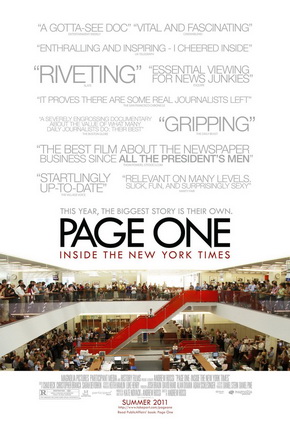
In the doc you watch David Carr, media columnist for The New York Times, take on various bombastic elements and shut them up. He stares them down, calls them on their bullshit, then moves on. Even when I’m able to do the first two things, I don’t move on. I allow the first two actions to linger and infect the surroundings. Carr, who looks like nothing much, Bilbo Baggins’ after a bad night, with a hoarse voice and a skinny neck and a wide middle and a face that seems permanently bent toward the ground—that seems to have trouble looking up—is able to cut so surgically through situations that there’s actually little bleeding. It’s like those scenes where Zorro takes a swipe at a candle and it doesn’t move, causing the villain to laugh at Zorro’s ineptitude and anticipate his demise. Which is when Zorro holds up the tip of the candle, or pushes the tip off with his sword, or stomps on the ground and the candle crumbles to bits.
That’s what Carr is like. The other guy laughs at his ineptitude and then David stomps on the ground and the dude’s argument crumbles to bits.
As both Evan and I admired this ability of Carr’s, and lamented our own ability to cry bullshit in social situations, he added, “You know what I could use? A David-Carr-in-the-box. So when I get in those situations, I can take out my David-Carr-in-the-box, and just, you know, pop. Let him loose.”
I agreed. We could all use a David-Carr-in-the-box. The New York Times should get on that. Talk about your revenue streams.
Who’s afraid of the big bad Wolff?
“Page One: Inside the New York Times” also reminded me, of course, of something I lamented daily about two years ago: the death of newspapers; the death of print. I’m in the business, an offshoot of journalism, a small, momentarily protected niche, but I haven’t worried about the death of investigative journalism much in the last year. I’m not sure why. The problem certainly hasn’t gone away.
It’s a seemingly insurmountable problem. Investigative journalism, done right, is expensive, and in the past was paid for by two revenue streams: ads and subscribers. The Internet, our new, more democratic printing press, has cut into, if not obliterated, both of these. Craig’s List killed classified ads, online ads pay a fraction of print ads, and online readers, those spoiled, spoiled children, have been conditioned to expect content for free.
There’s also the problem of audience. Investigative journalism is not only tough to do but tough to read. It takes work. How much better to go to an aggregate/opinion site/blog that boils it all down and also gives you pictures of celebrities in bikinis or with baby bumps or in the midst of divorces. How much easier to just be distracted. How much more fun.
One of the pivotal and most satisfying scenes in “Page One” occurs about halfway thorough, at a debate by a group called “Intelligence Squared,” which, for its topic of the night, raises a purposely provocative one: GOOD RIDDANCE TO THE MAINSTREAM MEDIA.
Carr, the schlub, gets to represent the mainstream. His opponent, at least as far as we see in the doc, is Michael Wolff, founder of newser.com, an aggregate site. Wolff looks a bit like Alvy Singer’s balding, viral man. He seems fit, and tough, and his bald head gleams like he’s from the future. And he brings us a message from the future:
What you’re going to hear tonight is that the media is necessary for the commonweal. An informed citizenry is what this nation is about. That is self-serving crap. The New York Times is a good newspaper—sometimes... But after that it’s off the cliff. It’s oblivion. The news business in this country is nothing to be proud of. The media is a technology business. That’s what it is. That’s what it has always been. Technology changes, the media changes.
Carr obliterates him. He begins politely by holding up a print copy of the home page of Wolff’s site. “Newser is a great-looking site,” he says, “you might want to check it out. It aggregates all manner of content. But I wonder if Michael’s really thought this through. Get rid of mainstream media content...” Then he holds up that index page without the aggregated mainstream articles. It’s mostly holes. It barely exists. He peeks through it at the audience, which is applauding, and says, “OK, go ahead.”
Great scene. It not only reveals Wolff’s hypocrisy—how he’s making money off the very thing he’s disparaging—but it reveals the hypocrisy of the Web. Much of the Web simply repurposes someone else’s work. The Web doesn’t care for originality or accountability; and it’s creating a society that doesn’t care for originality or accountability.
Is the Times necessary because it’s good?
At the same time ... OK, Carr makes a salient point. What happens when mainstream sites like the New York Times, which still drive much of the discussion on the Web, disappear? What replaces them? Don’t we need vegetables? Don’t we need meat? Or are we just going to keep popping the content equivalent of Milk Duds in our mouths?
But it doesn’t address all of Wolff’s points. From the above, two remain:
- The Times says it’s necessary because it’s good but Wolff says it’s not that good so it’s not that necessary. So: Is the Times good?
- Media means technology. Technology changes. You can gripe all you want but it’s going to change.
To the first point. The Times has its weaknesses. It’s a serious paper—it’s not sensationalistic like most of the mainstream media—but it has a love for, or at least a trust of, the institutional voice. The doc treats Judith Miller’s reporting on WMDs like it’s an anomaly but that was based upon institutional trust—upon getting access to the institutional voice and printing it—and the Times does this all of the time. Its coverage of Hollywood, say, is almost always from the studio perspective. Its coverage of business is almost always from the Wall Street perspective.
And in politics? It gets played. It assumes an opposition voice, no matter how marginalized, provides balance. It assumes that an institutional voice is legitimate even if it’s in the middle of a lie. It won’t call a lie a lie. Public Editor Arthur S. Brisbane’s recent column, “Should The Times Be a Truth Vigilante?,” is indicative of this attitude. Brisbane wrote:
[Some readers] fed up with the distortions and evasions that are common in public life, look to The Times to set the record straight. They worry less about reporters imposing their judgment on what is false and what is true.
Is that the prevailing view? And if so, how can The Times do this in a way that is objective and fair? Is it possible to be objective and fair when the reporter is choosing to correct one fact over another?
That sound you heard was people around the country exclaiming, “WTF!?!”
The answer to Brisbane’s dilemma is obvious. If a public figure says something demonstrably false, you call him on it, and as high up in the article as possible. If a public figure says something harder to disprove (or prove), but without evidence, then that’s your story: X ACCUSES Y OF Z: PROVIDES NO EVIDENCE. It’s less choosing to correct one fact over another than printing what facts we have. And if an institutional voice proclaims factual what is not factual, that’s your story. Objectivity is not stupidity.
But the doc doesn’t own up to this or any weakness in the Times. It’s basically saying: we’re good so we’re necessary. So please don’t kill us. For your own good. It's saying, as Carr said to the Intelligence Squared audience, “OK, go ahead.”
The Times they are a changing
For the most part, I agree. But then we get into the second of Wolff’s unaddressed points: It doesn’t matter if the Times is good or not. Its model, the printing press, is now obsolete. Everyone has a printing press. Most everyone’s printing. Or posting. Or uploading. The Times used to have to compete against however many newspapers in New York City, and maybe two or three nationally, and another one or two internationally. Now the competition is everyone and everywhere. Even this little ol’ site is competition. You’re reading it, after all, instead of the Times. Wastrel.
“Page One” is a fine-enough doc, particularly when David Carr’s onscreen, but, in journalistic parlance, it misses the story. Can one support serious investigative journalism in the digital age and on a digital budget? If not, what replaces it? And what becomes of our misinformed and malinformed and don’t-want-to-be informed citizenry—and, by extension, our democracy—then?
Movie Review: The Rum Diary (2011)
WARNING: 161 MINIATURE SPOILERS
“The Rum Diary” is a 2011 movie based upon a 1998 novel, which was actually written in the early 1960s, about misadventures in Puerto Rico in the late 1950s. It doesn’t have to be old news but it is.
It’s an odd version of old news. The lessons its protagonist learns are lessons its writer, Hunter S. Thompson, along with many others, communicated to the culture a long time ago. Druggies can be heroes and upstanding citizens can be villains. It’s us vs. the bastards, and the bastards are businessmen and bankers and land developers, shady and older and curiously sexless, while we, the heroes, or antiheroes, are young and aimless and vaguely anarchistic. We booze it up and experiment with drugs and lament the poor while trying to find ...something. Our artistic voice. Freedom. America. A girl.
If most movies present an absolutist vision from the right, with a taciturn hero taking on bad guys through direct violence and winning, the alternative version, the left-wing version popularized in the late 1960s, gives us an antihero, often glib, taking on dull but horrific institutional elements through subterfuge and losing. The very thing that Paul Kemp (Johnny Depp) needs to learn in “Rum Diary,” in other words—bankers, etc., are bad—was communicated to the culture so long ago, by Kemp’s creator, that it became a genre unto itself: “Easy Rider” and “Animal House” and almost every B-movie from 1967 to 1982. So we wait for him to catch up. We wait for him to figure out what kind of movie he’s in.
It takes awhile.
Kemp may arrive in Puerto Rico in 1960 unformed in Hunter S. Thompson’s politics but we first see him in the classic Hunter S. Thompson pose: waking up, in a hotel room overlooking the beach in San Juan, dazed and hungover and horrified, unable to recollect who knows what godawful escapades from the night before. He’s there for a job, at the San Juan Star, because his two novels never caught on—either with publishers, or, in the end, with Kemp himself. Later in the movie he’ll talk about writers he admires. He’ll quote a line from Coleridge and talk about how the poet wrote it when he was only 25; he’ll talk about the difficulty of finding his own voice. The movie is the story of how Kemp, and by extension Thompson, finds his own voice.
He wants to write meaningful articles but his toupee-wearing editor, Lotterman (Richard Jenkins), isn’t interested. He assigns him horoscopes, and pieces about the bowling alleys of San Juan, frequented by the dull and overweight middle class of middle America, and Kemp’s mind wanders. He finds a beautiful girl, Chenault (Amber Heard), but she’s engaged to a jerk, Sanderson (Aaron Eckhart), who wants Kemp, of all people, to write marketing copy for land development on a nearby uninhabited island. They plan to wreck paradise again. Kemp goes along for the ride, signing an NDA and everything, but mostly he’s sniffing after Chenault. He doesn’t reject Sanderson until Sanderson rejects him. He finds religion because he’s cast out of Eden.
Did we need narration in this thing? Once Kemp finds his voice, we get noteworthy lines, presumably culled from the novel, such as: “I discovered the connection between starving children scavenging for food and the shiny brass plates on the front doors of banks.” We could’ve used such language throughout. The movie would’ve benefited.
Depp is obviously a great actor. “How does anyone drink 161 miniatures?” Lotterman demands when he gets Kemp’s hotel bill. There’s a pause, a few blinks, a slight wobble. “Are they not complimentary?” he finally responds.
But he’s too old. Sorry. Kemp is supposed to be unformed and learning. He’s supposed to be 22. Depp is nearly 50. He should’ve been playing Lotterman.
I actually identified with Lotterman. The movie doesn’t. It hates him. He’s on the side of the establishment. He’s old and toupee-wearing and soul-crushing. He makes sure that nothing really noteworthy gets in his paper. Except, I kept thinking, it’s not his newspaper, is it? He’s just the editor. He’s a higher-up flunky. Maybe I’m projecting, maybe Richard Jenkins added a humanity at odds with his character (see: Philip Seymour Hoffman in “Patch Adams”), but I get the feeling Lotterman would’ve liked the San Juan Star to be more than articles about bowling alleys and horoscopes. He would’ve liked to have had hair. He would’ve liked to be as handsome as Johnny Depp. Who wouldn’t? But that wasn’t his world.
Instead, the movie has sympathy for the worthless and vaguely fascistic Moberg (Giovanni Ribisi), who also works at the San Juan Star but who rarely contributes copy. He spends his days in a drug-addled stupor, stumbling from spot to spot, and occasionally putting on an LP of speeches by Adolf Hitler. Riotous, dude.
To be honest, “Rum Diary” reminded me of all I disliked about those cinematic, absolutist visions of the left: the celebration of drugs and anarchy. We get that damned quote of Oscar Wilde’s for the zillionth time: “Nowadays, people know the price of everything and the value of nothing.” We get Depp as Kemp writing his credo:
“I want to make a promise to you, the reader. And I don't know if I can fulfill it tomorrow, or even the day after that. But I put the bastards of this world on notice that I do not have their best interests at heart. I will try and speak for my reader. That is my promise. And it will be a voice made of ink and rage.”
It’s tiresome. Putting hallucinogens in your eyes isn’t a political act, it’s a stupid act. The left never got that. They conflated the two. Watching “Rum Diary,” I thought of the sadness of the political arc I’ve lived through. Kemp is working toward a credo, an ethos, a style, that dominated our culture for a time but ultimately led to Reagan and Bush and Bush. He puts the bastards on notice but the bastards only got stronger.
Tags: Movie Reviews, Johnny Depp, Hunter S Thompson
No Comments yet | Permalink
Movie Review: One Day (2011)
WARNING: A SPOILER A DAY
“One Day” is a gimmicky little film that doesn’t deliver. It gives us one day a year for 20 years in the lives of Emma (Anne Hathaway), a smart, mousy girl who loves Dexter, and Dexter (Jim Sturgess), an attractive, outgoing, shallow lad who's too busy sowing wild oats to get serious about Emma. That’s the film’s main conflict: When will they get together? This year? Next?
The day in question is always July 15th, or St. Swithin’s Day in Britain, which is famous because of the following traditional verse:
St. Swithin's day if thou dost rain
For forty days it will remain
St. Swithin's day if thou be fair
For forty days 'twill rain nae mair.
I knew about the day mostly because of the Billy Bragg song, and because it sounds so fantastically British: Swithin’s. According to a quick online search, St. Swithin was “a Saxon Bishop of Winchester. He was born in the kingdom of Wessex and educated in its capital, Winchester. He was famous for charitable gifts and building churches.”
So is the movie about building churches? No. Is it about the weather? Not so much. Does it have anything to do with Billy Bragg’s song of lost love?
The Polaroids that hold us together
Will surely fade away
Like the love we spoke of forever
On St. Swithin's Day.
Sort of. But the movie fudges things in the manner of movies about love.
It begins chronologically in the late 1980s with the graduation of Emma and Dexter from college. Each has grand plans. She’s moving to London to write a book. He’s going to France to... I forget what. Learn about other cultures and then forget them.
In London, Emma winds up working long hours in a cheesey Mexican restaurant and getting nowhere with her writing and feeling defeated. Eventually she becomes a teacher involved with the wrong guy, Ian (Rafe Spall), a drab fellow who wants to be a stand-up comedian even though nothing he says is remotely funny.
Dexter winds up breezing through life. Before we know it, he’s the host of a loud, shallow TV show aimed at loud, shallow twentysomethings who like clubbing and video games. His dying mother (Patricia Clarkson) is appalled that he’s wasting his talents and his time in this manner. His father (Ken Stott) is merely appalled. He feels his son is drinking too much and not spending enough time with his dying mother. We’re supposed to take the father’s side in this, but the structure of the film, the one-day-per-year template, doesn’t allow for much emotional involvement. The father harangues the son for drinking before we even realize he’s drunk, for example.
Then fortunes change. Emma breaks it off with Ian, writes a book, it’s popular, and she moves to Paris and meets a gorgeous Parisian man. Dexter gets married to a busty blonde, has a kid, but loses his job and can’t find another. His wife cheats on him with his best friend. He’s washed-up and gray at 30.
But Emma still takes him back. She ditches Frenchy for him. True love.
With the central tension of the film thus resolved, other tensions need to emerge. They do. Year by year, Emma: 1) wants a kid; 2) still hasn’t had a kid; 3) dies in a biking accident. All on St. Swithin’s Day.
Afterwards, director Lone Scherfig (“An Education”) and screenwriter David Nicholls (from his novel) do a good call-back to that first St. Swithin’s Day, in the late 1980s, and to a moment where the relationship could’ve deepened immediately but didn’t. There’s a sadness to it, certainly, this early scene, but it’s not the sadness of the Billy Bragg song. Bragg’s sadness is about how love, which we claim to be forever, fades. “One Day” claims that love is forever. So the sadness of the callback, and of the movie, relates to the earlier, shallow choices Dexter made with his life and his love. It’s about all that time wasted.
I would argue that, regardless of what we do with time, whether we “waste” it like the grasshopper (Dexter), or "make proper use of it” like the ant (Emma), it keeps going. That's what's truly sad. It's not about bad choices made but of any choices made. Time takes us from a place where we are young and have many choices to where we are old and have but one: death. It takes us to the moment when one of us is gone and the other is mourning, to the moment when both of us are gone and what survivors we have are mourning, to the moment when both of us are long-gone and there’s no one left to mourn.
Love the poster, though.
Tags: Movie Reviews, One Day, Anne Hathaway, Jim Sturgess
No Comments yet | Permalink
Movie Review: A Separation (2011)
WARNING: SPOILERS
Our sympathies keep changing in “A Separation” in a way that reminded me of life.
Initially, Simin (Leila Hatami) seems the sympathetic one, at least to western eyes, since she wants out of Iran for both herself and her daughter, while her husband Nader (Peyman Maadi) seem stubborn and awful for refusing to go. When Simin does leave, she goes, not out of the country but across town, to stay at her mother’s, leaving Nader to care for their daughter, Termeh (Arina Farhadi), who’s 11 and smart, as well as his father (Ali-Asghar Shahbazi), who is old and suffering from Alzheimer’s.
But we also have sympathy for Razieh (Sareh Bayat), whom Nader hires to help in his wife’s absence. She’s pregnant; she has her own daughter, Somayeh (Kimia Hosseini), an adorable, big-eyed thing, to worry about; and now, for 300,000 rials a day (about US$26.50), she has to look after Nader’s father, who wets himself, and who may wander off at any moment to get the newspaper at the newsstand down the street. Wetting himself, and not being able to change himself, is the big problem. She’s unsure whether it’s a sin for her to be this close to a man she doesn’t know, but there’s a kind of Islamic hotline she can call to plead her case. She does, successfully, but it’s really more than she bargained for. So she asks Nader: Could her husband, Hodjat (Shahb Hosseini), take the job instead?
Nader is willing, even grateful, but surprised when it’s still Razieh who shows up the next day, and the next. Something about her husband being in jail? Something about creditors? Nader is even more surprised, and angered, when he comes home early one day to find no one at home and his father tied to the bed. Initially he thinks he’s dead. He’s not, but he’s bruised. And really who would do such a thing? And where is the day’s money Nader left on the dresser? And it’s at this point that Razieh returns, with her daughter, and with nothing like shame or guilt on her face. Who is this woman? How could she do such a thing to his father? And still she demands her day’s pay? Why doesn’t she get out of his apartment. Out! Out!
Yeah, so what if Razieh slipped when he shoved her out the door. Really? She miscarried? That’s awful. From the shove? That doesn’t seem...? She and her husband are pressing charges? For murder?
Poor Nader.
God, where the fuck is his wife during all of this?!
The relativity of all of this is key. The lack of absolutes is key. The small lies that occur daily, or the big lies that occur when our backs are to the wall, or the information withheld to make one’s case better, all of these things are key. “A Separation” begins inconclusively before an unseen judge, and it ends—beautifully—in a kind of purgatory of inconclusiveness, and in the middle ... is anything resolved? The more both parties go to find justice, the more injustice they find. The more control they attempt to exert, the more things fall apart. “A Separation” isn’t just about the separation of a man and a wife; it’s about a separation from truth, from respect, and maybe from love.
My Top 10 Movies of 2011
In my late twenties I got corrective lenses for the first time, for near-sightedness, and I remember how they not only clarified my vision but polarized the world. The muddy middle disappeared. Both beauty and ugly became sharper: the former's perfections, previously half-hidden, now dazzled, while the latter's imperfections, also half-hidden, were now sadly revealed. The glasses seemed unfair. Part of me felt the world would be a kinder place if we all walked around with a bit of myopia.
Writing about movies is in some sense like putting on corrective lenses. It clarifies my vision but it also also polarizes my feelings. The good becomes very, very good; the bad godawful. The muddy middle disappears.
I think this explains why I'm always a little surprised when end-of-the-year pronouncements are made and the recent year in movies is found lacking. People said 2009 was a bad year for movies and I thought, “Really? With 'Summer Hours' and 'Up' and 'A Serious Man' and 'Seraphine' and 'Avatar'?” People said 2010 was a bad year for movies and I thought, “Really? With 'Un Prophete' and 'Restrepo' and 'True Grit' and 'The Social Network' and 'A Film Unfinished' and 'Inception' and 'Toy Story 3'?”
Now people say it of 2011 and my reaction is just as strong. Really? Because I can't squeeze all I want to into my top 10. I think, “Surely I have room for 'Hugo' or 'Midnight in Paris' or 'Tinker Tailor Soldier Spy,'” and I look back at what I already have and I think maybe this, or maybe that, or should I substitute the other? For what it's worth, my top six were decided early. It's the last four that caused hand-wringing.
I love the many connections between the choices below: the ominous, near silent moods of 9, 8 and 7. (“Tinker Tailor” would've fit in well there.) The stubborn, sad persistence of character in 8 and 3. The everyday transcendance of 5 and 4. The search for safety and God in 2 and 1.
Lacking? No, 2011 was a great year for movies. Here is my very, very late top 10.
10. “Bridesmaids”: When I came home from viewing this opening night and Patricia asked me how it was, I said, “It's the funniest movie of the year.” I paused. “And not just so far. I'm saying it'll be the funniest movie I see all year.” That prediction was really only threatened by one film, “Young Adult” (see below). Much of the movie is actually conventional. When her best friend, Lillian (Maya Rudolph), gets engaged, Annie (Kristen Wiig) tries to be happy for her but can’t help compare where she and Lillian are both heading. Annie's life is in the crapper but she's her own worst enemy. She keeps going back to the wrong guy (Jon Hamm), keeps ignoring the right guy, (Chris O’Dowd), is forced to move home with her mother (Jill Clayburgh, the original unmarried woman). We’ve seen this kind of thing before yet it feels different here. It’s funnier, yes, but it also feels truer. The way people try to talk Annie out of her downward spiral and the way she doesn’t listen. There’s a scene where, after Rhodes encourages her to bake again, she does, she bakes a glorious cupcake, topped with all kinds of candied configurations. Then she stares at it on the counter, unhappily. Then she eats it, unhappily. Not because she wants the cupcake but because she doesn’t want to make the cupcake. Because baking isn’t satisfying what it used to satisfy.

9. “Drive”: Driver (Ryan Goslling) is so laconic he makes Clint Eastwood’s characters seem like blabbermouths. Initially this annoyed me. Initially I felt there was too much atmosphere and not enough substance. I’m not a fan of cool, or profess to be such, since cool is silent and distant, and the most interesting people I’ve encountered in life are the ones who are most engaged. Who talk. I’m a word man. Driver is not. He’s most definitely cool, with his toothpick in his mouth or tucked behind his ear, and so silent, a man of so few words, that I began to wonder, a half-hour in, if there wasn’t something wrong with him mentally. Was he autistic? And yet, despite all this, by the end of the movie I had absorbed him, or he me. I could feel it as I put on my yellow biking jacket, so similar to his silver racing jacket, and my biking gloves, so similar to his driving gloves, and walked out of the theater immersed in the dreamlike silence of the movie. I imagined I was tough and cool and hard-to-read instead of what I am: a tired 48-year-old in need of a shave and a beer. Holden was right. The goddamn movies.

8. “Shame”: “Shame” is a snapshot from a life because there’s no real resolution. There’s just need and heartache and awful need again. Sissy (Carrey Mulligan) tries to kill herself but she’s tried to kill herself before. Brandon (Michael Fassbender) binges on sex but no doubt he’s binged before. It leaves him exhausted and crying but the thing inside him won’t come out. Sexaholism used to be a punchline to me—who isn’t addicted to sex?—but writer-director Steve McQueen shows us the difference as well as the similarity. The difference is in volume and the similarity is in almost everything else. The similarity is in trying to get this thing out of us. The similarity is in the lack of resolution or resurrection. In the end, Brandon is back on the subway, and there’s that girl again, and now she’s ready; and the hunger is always ready.

7. “Margin Call”: J.C. Chandor's debut film is our best dramatization of the global financial meltdown and should be seen on a double bill with “Inside Job” and maybe several “Frontline” episodes, including the ones on Brooksley Born and the demise of the Glass-Steagall Act. It's an ominous, moody, sometimes silent film with a great cast and a kill-or-be-killed message that the film doesn't celebrate but doesn't exactly condemn, either. It's about knowingly selling toxic assets so they infect some other schmuck. It's about how to SURVIVE, as CEO John Tuld (Jeremy Irons) tells the 3 a.m. board meeting. I love how the characters surprise in small ways. Will Emerson (Paul Bettany) immediately comes off slick and fierce but that doesn’t mean he’s disingenuous or doesn’t have a moral code of his own. Sam Rogers (Kevin Spacey) is appalled by what he’s asked to do but that doesn’t mean he can’t rally the troops to do that very thing. What kind of world is Wall Street? The kind where Kevin Spacey plays the moral pillar. Be very afraid.

6. “The Artist”: I think both fans and detractors have gotten this one wrong. They think it's a bit of lightweight nostalgia, a throwback not only to the silent era but to the next generation of filmmakers, which made great films about the silent era (“Singin' in the Rain,” “Sunset Blvd.,” etc.). But to me there are few films more relevant to the United States in 2011 than this silent, black-and-white, French film. For all its charms and zip and melodrama, it's ultimately about a man made irrelevant by new technology. It's about a man made silent by new technology. And in 2011, after 15 years of entire professions being decimated by the digital revolution, that describes too many of us.

5. “The Descendants”: Everyone says that comedy is tragedy plus time, but in “The Descendants” writer-director Alexander Payne removes time from the equation. A woman—a mother, wife and daughter—is dying in a hospital bed, having spent the last year of her life cheating on her husband, Matt (George Clooney), and we find ourselves laughing out loud. Payne creates comedy out of tragedy as it’s happening. The movie's main characters, Matt and his two daughters—plus all of their cousins, including Beau Briddges' own version of The Dude—are the descendants of the title. They’ve been entrusted with this great wealth and the question is what they do with it. But the dynamic and the dilemma filters through to us in the audience. All of us are descendants. All of us are entrusted with this great wealth. And the question is what we do with it.

4. “Moneyball”: The feeling captured in the opening sentence of my review, written in September, hasn't gone away: I had trouble with the falsehoods but was won over by the poignancy. Slowly I'm forgetting the falsehoods, however, the reduction of the career to one year, and I keep returning to the poignancy: the close-up of Billy Beane (Brad Pitt) as he listens to his daughter singing on her homemade CD with words that fit him. Throughout the movie he wants to be the uberman. He wants to change baseball, and he does, but not the way he envisions, through ultimate victory. He changes it because he hits a mammoth homerun in a losing cause, but the mammoth homerun draws attention. Others steal his stance, his style, and in that way the game changes. In this moment, though, he's not the uberman but the everyman. He's us. Most of us are stuck in the middle; most of us don't know when we hit homeruns, or, if we suspect it, the homeruns go unnoticed and unmentioned. They're before the sparsest of crowds. Most felt “Moneyball” couldn't be filmed because it's about baseball stats, and who beside geeks like me care about baseball stats? But I knew it could be filmed because it's really about underdogs who band together to beat the big boys, the corporation, the evil empire, and that's most of our movies. I just didn't know how they would do the ending. The underdog A's under Billy Beane never won it all; they never even went to the World Series. I thought it was the story's great weakness. In the end, screenwriters Steve Zaillian and Aaron Sorkin and director Bennett Miller make it the film's great strength.

3. “Young Adult”: Mavis Gary is one of the most original characters American cinema has produced in years and Charlize Theron totally embodies her. So why didn't it get out there more? It was written by Diablo Cody and directed by Jason Reitman, the team who gave us “Juno” back in 2007, but this one isn't so traditionally feel-good. Mavis is an awful person (no empathy or tact), involved in an awful enterprise (winning back her high-school boyfriend at the age of 37), and in the end she doesn't change. She stays on the less-righteous, all-American path of perpetual consumerism and loneliness. Most people won't find it touching or amusing but I thought it was both. I found Mavis sympathetic in her situation and entertaining in her response to her situation. When Paige, Patricia and I saw it in a small, downtown theater with maybe a dozen other people in attendance, we were about the only people laughing; but we were roaring. It's that kind of movie. Its ending is so cynical, I felt something like pure joy wash over me. Most feel-good movies make me feel bad because they aren't any good. “Young Adult,” with its awful characters, made me feel great.

2. “Des hommes et des dieux”: “Of Gods and Men” is a monastic movie. It’s filmed as unaffectedly as the Cistercian monks lived their lives in Tibhirine, Algeria, in 1996. It documents their modest activities in a modest manner. We see them carry firewood and clean floors. They pack honey, miel de l’Atlas, and sell it at the local market. They farm, tend to the sick, help procure visas. They study—both St. Augustine and the Koran. They pray and sing hymns and psalms. Mostly they are caught, trapped, between a growing Islamic fundamentalism and an authoritarian military government. They are trapped between the need for safety elsewhere and the need to do good here. What to do? What to do? At one point, the Islamic revolutionary, Fayattia, tells Brother Christian (Lambert Wilson), a tall, bespectacled man who likes to walk in the woods and feel the bark of trees, that he doesn't have a choice in the matter they're discussing. “Vous n'avez pas le choix,” he says. Brother Christian replies: “Si, j'ai le choix.” (Yes, I have a choice.) “Of Gods and Men” is all about the awful, potentially transcendant weight of “J'ai le choix.”

1. “The Tree of Life”: Was there any doubt? It's not only one of the more evocative films about childhood (ball, butterfly, blocks, baby brother arriving and cramping your style); it's not only one of the more honest depictions of coming of age (from fighting father to wishing him dead to becoming him in his absence); it keeps in mind the existential. It doesn't allow us a cultural memory of 10 or 15 or 100 years; it goes back to the beginning of time. It blends religion and science, Job and the dinosaurs. How can bad things happen in Waco, Texas in the 1950s? Where were you when I laid the earth's foundations? Where were you when I allowed entire species to go extinct? The vast background puts the life, and the questions, in perspective. The fundamental dilemma of the movie, and of life (the movie suggests), is between the way of nature and the way of grace. The short cultural memory, the one presented in most of our products, certainly most of our movies, leads to the way of nature: the “I” standing in this spot and pronouncing dominion over this spot. The long cultural memory, blending science and religion, in which the “I” dissolves against the vastness of time and space stretching behind us and ahead of us, leads, not to despair, but to the way of grace. When the world is shining around us. And love is smiling through all things.

Tags: Movie Lists, Movie reviews, Terrence Malick, Charlize Theron, French films
1 Comment | Permalink
The Five Worst Movies of 2011
In my late twenties I got corrective lenses for the first time, for near-sightedness, and I remember how they not only clarified my vision but polarized the world. The muddy middle disappeared. Both beauty and ugly became sharper: the former's perfections, previously half-hidden, now dazzled, while the latter's imperfections, also half-hidden, were now sadly revealed. The glasses almost seemed unfair. Part of me felt the world would be a kinder place if we all walked around with a bit of myopia.
Writing about movies is in some sense like putting on corrective lenses. It clarifies my vision but it also also polarizes my feelings. The good become very, very good; the bad godawful. The muddy middle disappears.
I think this explains why I'm always a little surprised when end-of-the-year pronouncements are made and the recent year in movies is found lacking. People said 2009 was a bad year for movies and I thought, “Really? With 'Summer Hours' and 'Up' and 'A Serious Man' and 'Seraphine' and 'Avatar'?” People said 2010 was a bad year for movies and I thought, “Really? With 'Un Prophete' and 'Restrepo' and 'True Grit' and 'The Social Network' and 'A Film Unfinished' and 'Inception' and 'Toy Story 3'?”
Now people say it of 2011.
I'll get to the very, very good movies soon but first here's the godawful: the five worst movies I saw in 2011. Your results may vary.
Keep in mind, as an independent reviewer, I'm not called upon to review just anything the studios put out. So I never saw the following: “Bucky Larson,” “Jack and Jill,” “Big Mommas: Like Father, Like Son,” “Abduction,” “Atlas Shrugged” and anything starring Nicholas Cage.
That said...
5. “Cowboys & Aliens”: The aliens are scouts after our gold, and they’re kidnapping our people to see what it takes to kill us, all of us, but that’s not the problem with the movie. The problem with the movie is this: When deciding between doing what’s true for the characters or what furthers the clichés of the genre, the filmmakers, director Jon Favreau and his six screenwriters, always opt for the latter. Always. They’re not interested in the perspective of their 19th-century characters; they’re only interested in the perspective of their 21st-century audience. Dolarhyde and Lonergan (Harrison Ford and Daniel Craig) are hard and selfish not because life is hard and selfish but so they can redeem themselves in the end. The town’s name, Absolution, is a giveaway. Lonergan, always on the verge of leaving, always has to return as if it’s a surprise. Dolarhyde, a growling, racist cuss for the first half of the movie, has to bond with the orphaned boy; he has to come to an understanding with his half-Indian, bastard son (Adam Beach); and he has to save the Indian chief so the two of them, in the midst of battle, with death all around, can give each other a nod of understanding.
4. “The First Grader”: Would this have made my list if it hadn't opened the 2011 Seattle International Film Festival? I'm a member, and a fan, of SIFF, and love the fact that they resurrected the Uptown Theater, a block from my workplace, and are showing good movies there; but the organization also has a kind of upper-class, stupid liberal sensibiity that tends to trump, I don't know, aesthetics. That's how you wind up with “First Grader” on Opening Night. It's about Africans, in Africa, so it must be meaningful, even though the good in the movie are way good (and good-looking), and the bad are unjustifiably, incomprehensibly bad (and scowling), and the big reveal is no reveal at all. The movie focuses on an 84-year-old former Mau Mau warrior, Maruge (Oliver Litondo), who fights to go to first grade so he can read a letter on his own that the president of Kenya sent him. His teacher, Jane (a gorgeous Naomie Harris) backs him in the endeavor, but suffers from officials, who transfer her to another part of the country—until Maruge and the other students drive away the new teacher with stones and win Jane back. Yay! And after all this, Maruge has Jane read the letter for him anyway. OK. So what's in this letter we’ve waited the entire movie to hear? Well, the President of Kenya thanks Maruge for his service to his country; he also says Kenya is now independent because of people like him. Then Jane looks at him with proud, shining eyes, and he looks at her with proud, shining eyes, and the soundtrack gives us more generic African music, and we fade to a shot of the real Maruge, who died in 2009, and that’s the movie. To some of the honchos at SIFF this meant one thing: Opening Night. My thought: I got dressed up for this?
3. “War Horse”: Destined to go down as one of the worst movies to be nominated best picture. Detractors accuse Steven Spielberg of being “manipulative,” a criticism I've never really understood, since most directors are manipulative; that's what they do. Spielberg just tends to do it better. Not here, though. Let's look at the film's climax. The horse's true owner, Albert, has been gassed and blinded in the trenches of WWI, and Joey, the horse, after his magnificent gallop through the German trenches, has been injured and is due to be shot, and they’re like 50 yards from each other and don’t even know it. But the sergeant is given his orders and raises his gun and points it at Joey’s head. In that moment, before a familiar whistle is heard that startles Joey, that reminds him of Devon, England, a whistle that’s repeated twice more until the crowd of soldiers parts, miraculously revealing Albert, the man we already knew was there, and the music wells up, and Albert makes his case that the horse is his, that it has white hooves and a white diamond-shaped mark on its forehead, which can’t be seen for all the mud, but which is slowly, miraculously revealed even though we know that that, too, is already there; before all of this, in that moment when Sgt. Fry raises his gun and points it at Joey’s head, I had but one amused thought: I dare ya, Steven.
2. “Green Lantern”: Some movies have absurdly long backstories, but none are more absurd or longer than the one in “Green Lantern.” These are the first words were hear, in voice-over:
Billions of years ago, a group of immortals harnessed the most powerful force in existence: the emerald energy of willpower. These immortals, the guardians of the universe, built a world from where they could watch over all of existence: the planet Oa. A ring powered by the energy of will was sent to every sector of the universe to select or recruit. In order to be chosen by the ring, one had to be without fear. Together these recruits formed the intergalactic peacekeepers known as the Green Lantern Corps.
Lord, save me now. And half of it's a lie! Hal Jordan is told he reeks of fear but this turns out to be his strength: the ability to admit fear and act anyway. So we start out with a point of view that isn't ours (who is truly without fear?) only to arrive at one that is (admitting and overcoming fear is a good thing, etc.). Meanwhile, the longstanding heroes of the movie, the Green Lantern Corps, guardians of the universe, are actually like little Nazis: all willpower and no professed fear and shooting their beams into the sky during some kind of intergalatic bund rally. They've spent a billion years searching for the fearless to wear powerful rings when, as Hal Jordan is told during his training: “The ring creates only what you can imagine.” So why don't they choose someone with imagination? Wouldn't that be better? I suppose the same can be asked of DC Comics and Warner Bros. Pictures.
1. “Sucker Punch”: There's a rogue group of critics out there who are trying to elevate this movie into, in Kim Morgan's words, “one of the most misunderstood, feminist, wildly experimental, anti-patriarchy pictures this year.” A critic named Nordling on the Ain't It Cool site seems to agree with her. He writes:
“The film becomes an opportunity for [director Zack] Snyder to wear his influences on his sleeve — from a World War I trench warfare sequence where anime mech meets clockwork zombies to a medieval siege complete with orcs and a really big dragon — think Vermithrax, not REIGN OF FIRE — as our heroines do battle using a World War II Flying Fortress. I imagine everything Zack Snyder ever said 'Cool!' at in passing is in this film in some way or another.”
Question: Aren't they praising the film for opposite reasons? She thinks Snyder is involved in deconstruction, he thinks celebration. Or is he deconstructing on one level (Fantasy I) and celebrating on another (Fantasy II)? A bigger problem is that everything Snyder and Nordling think is cool, I think is crap. “Where anime mech meets clockwork zombies” makes me think: “Mech.”
Both Nordling and I agree that the movie is like a video game but for him this is a huge positive and for me it's a huge negative. He's a gamer, I'm not (STE at Xbox circa 2000-2003 notwithstanding). What he doesn't tell us is why a movie that's like a video game—that tells its story vertically rather than horizontally—is actually worth watching. Isn't the point of a video game to play it? To have some measure of control? To me, there are few things more boring than watching someone else play a video game.
Switching metaphors, Nordling writes:
“You're basically watching Snyder riff on his guitar for two hours. That's okay if you like that sort of thing, because Snyder's one of the best in the business. But if you can't stomach the way Snyder spirals, jazzlike, through the film's setpieces, you're going to be fairly miserable.”
Lord save us from jazz metaphors. The world is full of people who think they can riff, jazzlike, on musical instruments, just as it's full of people who think they can write great free-verse poetry. Most can't. Most need structure and discipline. Snyder is like that. He's the guy who thinks he's a great free-verse poet when nothing he says is close to profound or beautiful.
Bottom line: “Sucker Punch” is a movie in which there's violence without consequence, titillation without release, and a gritty, comic-book surrealism masking as realism. The women are dolled up for sex, prone to violence, and treated as extras in their own story. The only thing more shabbily treated is the whole of human history, which is seen as a backdrop for cool stuff to happen. Tossing the worst aspects of our culture into one movie—either to deconstruct the worst aspects of our culture or to celebrate them—doesn't change the fact that Snyder is in fact tossing the worst aspects of our culture into one movie. He's created a shit sundae. To critics like Morgan and Nording, words like “meta” are the cherry on top of this sundae. To me, it's still a shit sundae. Who's hungry?
Tags: Movie Lists, Zack Snyder, Green Lantern, Steven Spielberg, War Horse, SIFF
3 Comments | Permalink
Movie Review: The Girl with the Dragon Tattoo (2011)
WARNING: SPOIL YOU, YOU SPOILING SPOILERS
I believe in Lisbeth Salander.
The movies offer us a new ass-kicking heroine every other week, it seems: Angelina Jolie, Charlize Theron, Zoe Saldana. Even Natalie Portman tried her little hand last year. Even 12-year-old Chloe Moretz.
I don’t believe in any of them. But I believe in Lisbeth Salander.
She’s not fighting men three times her size in hand-to-hand combat. She takes them down with guile and tools and fury and ruthlessness. She either meticulously plans and strikes or just grabs a golf club and strikes.
One of the great moments in the Swedish version of “The Girl with the Dragon Tattoo” (“Män som hatar kvinnor”) occurs near the end, with the golf club, after Lisbeth (Noomi Rapace) rescues a tied-up and tortured Mikael Blomkvist (Michael Nyqvist), and then, on her own, chases down Martin Vanger (Peter Haber), the neo-Nazi serial killer and general sick fuck who was torturing him. Let me repeat that. The bad guy was torturing him and she came to the rescue. Then she didn’t wait for him to recover to go after Vanger. To be honest, he’d just slow her down.
The girl who laid down and died
Here’s how original this concept is. In the 1996 movie “12 Monkeys,” directed by the unconventional Terry Gilliam, Bruce Willis plays a man from a dystopian future sent back to attain an apocalyptic virus in its pure form so an antidote can be made; Madeline Stowe plays the 1990s psychiatrist who initially thinks he’s crazy but realizes he’s telling the truth. Her world will end and almost everyone she knows will die. And they’re chasing the bad guy through the airport when Willis is shot by airport security. What does she do? Does she go after the bad guy who has the virus that will kill five billion people, including probably herself? No. She cries, kneels beside the man, and cradles his dying head in her arms. When the man dies, all movement dies with him—even with the fate of the world at stake.
Barely anyone said shit about this idiocy. It seemed natural to them. Hero falls, girl falls with him. That’s the way of movies.
Here’s what I imagine Lisbeth would say: “Madeline Fucking Stowe.” Here’s what I imagine Lisbeth would say to the movie industry, who perpetuate this kind of storyline: “Fuck you, you fucking fucks.”
So I was worried how Hollywood would handle this aspect of the story. Obviously director David Fincher makes daring movies, but the actor now playing Mikael Blomkvist, Daniel Craig, happens to be the latest James Bond, the ultimate action hero, who rescues women and saves the world. That’s his job. Is it allowable, culturally or legally, to have the current James Bond rescued by a mere wisp of a girl who then tracks down the killer on her own? Because he’d just slow her down?
The girl who does the tattooing
Fincher’s version of “Dragon Tattoo” is like a speed-reader’s version of the Swedish version and it still clocks in at more than two and a half hours; but it’s an improvement in many ways. It gives us a better sense of Lisbeth’s inner life, as well as a better sense of her relationship with Blomkvist and why she becomes distant in the sequels. It also doesn’t stick Harriet Vanger out in the Australian outback; it sticks her right under our noses.
Plus David Fincher’s signature gloom is all over it.
The novel is difficult to adapt cinematically because it really begins with three storylines:
- Swedish industrialist Henrik Vanger (Christopher Plummer) is taunted by the murderer of his beloved niece, Harriet, 40 years after her disappearance.
- Journalist Mikael Blomkvist (Craig) loses a libel suit brought by an industrialist.
- Computer hacker Lisbeth Salander (Rooney Mara) loses her longtime legal guardian for one who demands sexual favors.
The connections between the storylines are initially tangential at best. Vanger investigates Blomkvist, via Salander and her computer-hacking skills, before hiring him to look into the disappearance of Harriet. Then, for almost an hour, Blomkvist and Salander follow separate paths. He traipses about in the cold of the Vangers’ various estates on their private island in Hedestad, digging into the past and searching for Harriet’s killer, while she deals with her new legal guardian, Bjurman (Yorick van Wageningen, the bad uncle of “Winter in Wartime”), a fat man who demands oral sex before allowing her access to her own money. When her computer is destroyed in an attempted subway robbery and she needs to buy a new one, he invites her to his home where he incapacitates her, ties her up and rapes her.
This is another scene I worried about in translation. The Swedish version is pretty graphic. And while the director of “Se7en” can obviously get pretty graphic, I wasn’t surprised, after the drugging and the tying up, that the camera began to pan out of the bedroom and down the narrow hallway, away from the shutting bedroom door. Yes, I thought. Leave the horror to our imaginations.
Which is exactly when Fincher brings us back into the bedroom for the brutal rape scene.
Did it seem more horrific in the Swedish version? Because I wasn’t expecting it or because it was more horrific? I remember Lisbeth limping home afterwards. We’re disappointed in her, this tough, smart girl who allows herself to get into that situation—until she reveals the camera in her bag and acts out her exquisite revenge. Fincher doesn’t give us the limping home; he reveals the awkward moments immediately after the rape. They’re in Bjurman’s place, after all. He has to untie her, after all. We see him slumped in the kitchen nook with something like guilt in his posture. “I’ll drive you home,” he offers, pathetically. When she slams the door, he thinks he’s gotten away with it.
I wonder what Bjurman thinks when Lisbeth calls and agrees to return to his place for more money. That she’s desperate? An addict? That she liked what he did? That his perversion fits into hers? Instead, he’s tasered, tied up, stripped and sodomized. He’s forced to watch a video of the initial rape and threatened with its internet upload if anything ever happens to her. Finally, she tattoos the following on his chest: I AM A RAPIST PIG. “Lie still,” she says, getting out the needle and promising blood. “I’ve never done this before.”
It’s the tattooing that makes the moment indelible. Up until then, her logic is Old Testament: an eye for an eye. But tattooing him adds something. The movie is about awful people who hide in plain sight, and Lisbeth is making sure they don’t hide too well. She’s handing out nametags. She’s branding scarlet letters.
The girl who is offered a purpose in life
What to make of the Vanger family tree? It’s a backstory better suited to novels. Henrik’s brother, Harald, is a Nazi who still lives in Hedestad, as does his daughter Celia (Geraldine James), while another daughter, Anita (Jolie Richardson), lives in London. Harriet’s father, Gottfried, also a Nazi, died the year before Harriet went missing, while Harriet’s brother, Martin (Stellan Skarsgård), now runs the company. “I’m quickly losing track of who’s who here,” Blomkvist says. Amen.
Of this crew, Martin is the one we see most often, and who’s played by the best-known actor, and who seems a decent sort. Which means, of course ... There’s a dinner over at his place with Celia and Blomkvist, and it’s one of the few moments where the harsh, Northern lighting of Sweden, which Fincher revels in, gives way to a softer, warmer lighting. It feels almost cozy in Vanger’s place—particularly with the harsh weather outside. One can even hear the wind howl. Or cry? Like a distant scream? It’s a subtle bit but people who know the story know it’s not the wind.
Blomkvist does well digging into a 40-year-old, missing persons case. The day Harriet disappeared there was a parade in town, and there’s a picture for the local newspaper of Harriet in the crowd. Blomkvist goes to the paper, retrieves the rest of the photos, digitalizes them, and creates a crude film in which it’s apparent that Harriet sees something, or someone, that stuns her. Another girl is taking her own photos behind Harriet. Might she have taken a shot of what Harriet saw?
The old inspector on the case is still alive. He tells Blomkvist that Harriet’s case is his “Rebecca case,” which is an unsolved murder case. There are several of those. There’s also a list of names and numbers written in the back of Harriet’s Bible: “Magda 32016” and “BJ 32027” and the like. Eventually the web becomes wide enough that Blomkvist feels the need for a research assistant.
Two reaction shots from this movie stay with me. When the Vanger family lawyer, Dirch Frode (Steven Berkoff), suggests to Blomkvist that they hire the girl who did the background check on him, Blomkvist responds, “The what?,” with a mixture of surprise and annoyance. He’s used to being the investigator, not the investigated. That’s the first one. Then when Blomkvist goes to recruit the girl, which finally brings our disparate storylines together, Lisbeth is wary of him until he says the line: “I want you to help me catch a killer of women.” Her reaction isn’t the blank one in the Swedish version. It’s the look of someone who is finally offered a purpose in life.
The girl who can hack into your soul
Now that I think about it, there’s a third reaction shot I love. It’s earlier in the movie. Lisbeth is meeting her boss, Armanasky (Goran Visnjic), and Frode, in a conference room in a corporate high-rise, where her mohawk, tats, boots and attitude don’t begin to fit. She asks, without worry, sitting at the other end of the long, gleaming conference table, if something was wrong with her initial report on Blomkvist. There wasn’t. They just want to know if there was anything she chose not to include. She turns away, offering her profile, and that great swoop of a mohawk, before adding, “He’s had a long-standing sexual relationship with the co-editor of his magazine.” Pause. “Sometimes he performs cunnilingus on her.” Pause. “Not often enough, in my opinion.” By now she’s staring back at them, chewing her gum, gauging their reaction. Frode, a proper gentleman, looks away. “No,” he admits, “you were right not to include that.”
This raises a point. Once they see how good Lisbeth is, why don’t they just hire her as their investigator? Remove the middleman by hiring the middleman. As good as Blomkvist is, he’s still 20th-century: forced, like all of us, to rely upon interview and instinct to uncover the truth. Lisbeth is 21st century. She can hack into your computer and see your soul. I love the bit where Blomkvist attempts to show her something on his computer, and her impatience with his tentative movements is palpable. It’s all she can do not to grab the mouse and drive.
As for how Hollywood handles the golf-club scene? The breadth of the investigation forces hero and heroine to split up—a trope that, in thrillers, usually plays to the detriment of the heroine. Not here. Alone in Martin’s house, Blomkvist figures out Martin is the longtime serial killer just as Martin comes home. But he manages to get out of the house. Then Martin sees him and calls out to him and invites him in for a drink. Later, when he has a gun on him, when he’s about to torture and kill him, he asks why he accepted the offer, knowing what he knows, then answers his own question. “The fear of offending is stronger than the fear of pain,” he says, amused by human nature. He taunts him about Lisbeth: “I like that one. I can’t thank you enough for bringing her to me.” He’s in the process of suffocating Blomkvist when Lisbeth arrives, swings the nearest weapon, a golf club, and takes off half of Vanger’s face. Vanger flees and Lisbeth attends to Blomkvist for a second before asking a kind of permission: “May I kill him?” she asks. I forget if she waits for a response. Probably not. It would just slow her down.
The girl who rides off into the sunset
Was it worth it? Making this U.S. version so soon after the Swedish version? Fincher’s a better director, no doubt, and the acting is a little better. The script is tighter but misses the creepier elements of the serial-killer investigation. The bit with the cat is a good addition, but... I don’t quite see the point, to be honest. Other than to get Americans, who don’t read subtitles, to see the fucking thing.
As for what happened to Harriet Vanger? It’s not Martin. When he had the upper hand, he confessed to everything but not that. So there’s more unraveling to do, another half hour, really, and Fincher almost, almost, goes the route the novel went. When Harriet turns up alive—in Australia in the Swedish version, in London under her cousin’s name in the U.S. version—and we realize that she did this to save herself from her awful, abusive brother, my reaction was something like disappointment. Wait, I thought. She knew what her brother was and yet let him do what he did for 40 years?
That, it turns out, is Lisbeth’s reaction in the book:
“Bitch,” she said.
“Who?”
“Harriet Fucking Vanger. If she had done something in 1966, Martin Vanger couldn’t have kept killing and raping for thirty-seven years.”
The Swedish version ignored these lines—they didn’t want to disturb the happy reunion between Henrik and Harriet—while Fincher merely alludes to them. “Harriet Fucking Vanger,” Lisbeth says at one point. But she doesn’t go further. Too bad. That’s key to me. Harriet Vanger is pretty but passive. She warns no one, passes out no nametags. She’s no hero. Most heroes, our stories tell us, are men. Most heroes, our stories tell us, save the day and ride off alone in the end.
One out of two.
Tags: The Girl With The Dragon Tattoo, Lisbeth Salander, Daniel Craig, Mikael Blomkvist, David Fincher, Rooney Mara, Movie Reviews
No Comments yet | Permalink
Movie Review: Shame (2011)
WARNING: TOP-OF-THE-HEAP SPOILERS
In “The Unbearable Lightness of Being,” it took Daniel Day Lewis four words to get women into bed: “Take off your clothes.”
Piker. It often takes Brandon Sullivan (Michael Fassbender), the protagonist of “Shame,” no words. He’ll just look at a pretty girl on the subway, suggest with his eyes, smolder a bit, wait for the tension to mount, and she’s ready. He’ll sidle up to his hyperactive boss, David (James Bade Dale of “The Pacific”), who’s trying to make the pretty one at the bar, say one or two words, and suddenly she’s casting him the kind of glances most men don’t receive in a lifetime.
Normally such a character would be wish fulfillment. Not here. Fassbender, impeccably groomed, is in almost every shot of “Shame” but it’s writer-director Steve McQueen’s movie. He sets the tone, which is moody, atmospheric, full of dread. Every day for Brandon is another day of desperately needing sex but desperately not needing the contact that goes with it. There’s something inside of him that can’t be fulfilled. In this, he’s like all of us, but his need is greater and the moments he’s satiated shorter. The title of this movie could be the title of McQueen’s first movie: “Hunger.”
“Shame” is more portrait than story. It’s a snapshot from a life. Brandon has a business-type, investment-type job in New York, which he apparently does well even though he’s rarely thinking about. He’s a sex addict so he’s always thinking about his next fix. In the toilet stall at work? In his bathroom at home? Via online pornography, magazines, DVDs? With Prostitute A, B, or both? With this girl at the bar or that girl on the subway? At that straight club? At that gay club?
There’s a cool exterior to Brandon, an unknowability and mystery that’s obviously appealing. Who is that man behind the scarf? But the cool exterior hides ... what? His sexual need and what else? A few books line the shelves of his high-rise condo, including, I was happy to see, Don DeLillo’s “Underworld”; but one can’t imagine him reading it. How could he sit still that long?
His careful routine, the veneer of respectability hiding his monstrous shame, is upset when his sister, Sissy (Carey Mulligan), shows up at his place. She’s a free spirit, a singer at posh bars, and later we hear her rendition of “New York, New York,” the triumphant ode to Manhattan that’s played after every Yankees victory; but she delivers it slow and sad, from the perspective of someone who isn’t A-number-1, top of the heap. It’s a beautiful moment in the movie, one of several moments Mulligan gives us. I still think of the way she bounces with delight on the subway platform after Brandon agrees to hear her sing. She wants to be part of his life—that’s her need—but it conflicts with his need. At one point, she alludes to their fucked-up childhood, and one wonders if there’s more there than the usual fuckedupness; if there wasn’t abuse of some kind. But we never get specifics. We get vapors.
She sleeps with his boss, his married boss, at Brandon’s place, and he can’t deal with it and goes running. She hangs too close to the tracks on the subway platform and he pulls her back. They’re both self-destructive but hers is sloppy and showy—there are scars on her wrists—and his is secretive and shameful and infecting every aspect of his life. She wants to pull him into the light but he reacts with anger. “I’m trying to help you,” she says. “How do you help?” he responds through clenched teeth. “You come here and you’re a weight on me.” After the movie, Patricia said he reminded her of me in this moment. That’s one thing I have in common with Brandon. We both feel easily trapped. We both live life in the exit row.
He makes a feint at respectability. He goes on a date with an attractive co-worker, Marianne (Nicole Beharie), and reacts to the dinner conversation as if it’s all new and amusing to him. A back and forth ... with words? He admits his longest relationship was just four months. He admits that that’s how he likes it. She doesn’t flee. Maybe, after the usual, first-date bullshit, this straightforwardness is refreshing. Maybe it’s the scarf and the Ewan McGregor smile. All those small charming teeth.
Was he always interested in Marianne as more than just another lay? Or did that idea only emerge when Sissy found him jacking off in the bathroom and found live sex girls on his home computer? After that, he tries to get rid of it all—the magazines, the DVDs, the computer itself—as if getting rid of the evidence of his need will get rid of the need. He wants to be clean again and he sees Marianne as the path to cleanliness. But when they finally fall into bed together he can’t get it up. For a moment we think this is his fate—to overdo it and then be unable to do it—but after she leaves we get a quick cut of him banging a prostitute in the same room, so that’s obviously not the problem. The problem is the cleanliness and the respectability. He can’t have it with any kind of meaning. He can only have it in a way that leaves him unfilled and seeking it again. It’s as if the disease is protecting itself from him. His disease needs to keep him hungry. It’s saying: You’re married to me.
“Shame” is a snapshot from a life because there’s no real resolution. There’s not even a program he enters. That would be too afterschool special. There’s just need and heartache and awful need again. Sissy tries to kill herself but she’s tried to kill herself before. Brandon binges on sex but no doubt he’s binged before. It leaves him exhausted and crying but the thing inside him won’t come out. Sexaholism used to be a punchline to me—who isn’t addicted to sex?—but Steve McQueen shows us the difference as well as the similarity. The difference is in volume and the similarity is in almost everything else. The similarity is in trying to get this thing out of us. The similarity is in the lack of resolution or resurrection. In the end, Brandon is back on the subway, and there’s that girl again, and now she’s ready; and the hunger is always ready.
Tags: Michael Fassbender, Movie Reviews, Carey Mulligan, Sex
No Comments yet | Permalink
Movie Review: The Help (2011)
WARNING: EAT MY SPOILERS
In “Guess Who’s Coming to Dinner,” Katharine Hepburn does it to Virginia Christine. In “Mississippi Burning,” Gene Hackman does it to Brad Dourif. In “The Help,” it’s Allison Janney to Bryce Dallas Howard. They’re the somewhat-enlightened white people who berate the less-enlightened white people in movies about civil rights. They’re the white people who make the white people in the audience feel good about themselves.
Apparently Jim Zwerg wasn’t enough.
The Janney moment occurs near the end of “The Help” and it’s a wholly unnecessary scene in which Charlotte Phelan (Janney), mother of the film’s protagonist, Skeeter Phelan (Emma Stone), does a 180. For most of the movie, she’s had one goal: marry her daughter off. “Your eggs are dying,” she says early on. “Would it kill you to go on a date?” At the 11th hour, suddenly she’s OK with her daughter being the way she is and getting a job in New York and being a modern woman and all; and she apologizes for the way she’s been for most of the movie and most of her life: cowardly and overly concerned aboout societal matters. And to make it up to her daughter, she berates the movie’s villainess, Hilly Holbrook (Howard), a classic “mean girl” from one of the most connected families in Jackson, Mississippi, in language that will end any connection between their families. “Get your raggedy ass off my porch!” she says.
We’re supposed to cheer. Some people probably did. The bad person has been told off, and Allison Janney, whom we loved on “West Wing,” is someone we can love again. And we get that nice mother-daughter feeling going.
Years ago, “In Living Color” did a spot-on satire on Hollywood movies about civil rights. It was mostly lampooning “Cry Freedom,” I think, and a bit of “Mississippi Burning,” both of which focus on well-meaning whites and the problems they encounter (losing jobs and homes, etc.) as they stand up to racism. The black folks around them are being beaten and killed, sure, but it’s the white folks we worry about because it’s the white folks we focus on. Black folks are non-entities: walk-ons in their own story.
“The Help” is an improvement on this kind of historical myopia since it actually gives half-time to its title characters. Okay, 45 percent.
It’s 1962 and Skeeter Phelan is returning from college to her hometown of Jackson, where she lands a job ghosting a household-advice column for The Jackson Journal. (Aside: The actor who plays the editor, Leslie Jordan, steals the scene; he’s so authentic I assumed he was a local.) Catch: Skeeter doesn’t know from household advice; she was raised by a beloved maid, Constantine (Cisely Tyson), who has mysteriously disappeared, and initially she has nowhere to turn. But eventually she relies upon the people who do know housework: the black maids who bus in from the outskirts, and raise the kids and cook the meals and clean the floors of the white folks in town. From this initial contact, she gets an idea for a book. What is it like to raise a child who then becomes your boss? What is it like to leave your own child to care for another? Her editor in New York, Elain Stein (Mary Steenburgen), who has suggestions of a “Sex and the Single Girl” lifestyle in her few moments on screen, is open to the idea, but doubts she’ll get any Southern black maid to trust her and talk. It’s the North reminding the South how the South lives.
Even so, one voice slowly emerges: Aibileen Clark (Viola Davis), who works for Hilly’s friend, Elizabeth (Ahna O’Reilly), raising the little girl that Elizabeth can’t or won’t. You could call Aibileen the soul of Skeeter’s book just as she is the soul of the movie. Davis is able to portray a bone-deep sorrow few actors can. She has a dignity about her but it’s never the proud, Hollywood kind meant for oppressed minorities. In the roles I’ve seen her in—“Doubt,” “Extremely Loud & Incredibly Close” and this—her characters are often skittish and distracted, as if they were thinking of other, sadder things. Most likely they are, since the movies are never wholly about them. The things she’s thinking about are the things Hollywood doesn’t portray: her life. But through Skeeter’s eyes, we do get a portion of that life.
If Skeeter is a progressive in racial matters, Skeeter’s childhood friend, Hilly, is the regressive. At a time when the civil rights movement is gaining strength, with marches in Albany and Birmingham and Washington D.C., she’s lobbying for a state law requiring separate bathrooms for black maids. “They carry different diseases than we do,” she says.
Hilly’s fears and prejudices lead to the ultimate in just desserts. When she fires her maid, Minny Jackson (Octavia Spencer), for using the family toilet on a rainy day, then talks trash about her so she can’t get other work, Minny returns with a peace offering: a chocolate pie. But it’s not a peace offering because it’s not wholly chocolate. Hilly, who didn’t want to put her ass where Minny put hers, winds up eating ... no nice way to say this ... Minny’s shit. Literally. Minny planned on keeping this fact a secret, but Hilly is so awful, and Minny so volatile, that they have the following exchange:
Minny: Eat my shit.
Hilly (shocked): Excuse me?
Minny: I said eat... my... shit.
Hilly (still shocked): Have you lost your mind?
Minny: No, ma’am but you is about to. Cause you just did.
One wonders to what extent a black maid could say “Eat my shit” to a white woman in early 1960s Mississippi, let alone make it literally come true, without losing more than an income. The movie suggests that Hilly is so embarrassed by the incident that she’ll do anything to keep it under wraps. But wouldn’t she want revenge? And if she couldn’t tell the truth, what’s to stop her from makin’ up a little ol’ fib? She’d hardly be the first Southern belle to do so.
(Aside I: When did Bryce Dallas Howard become the villainess de rigueur of Hollywood? Not only Hilly here but the worst girlfriend in the world, Rachael, in “50/50.” Who knew the daughter of Ron Howard, Hollywood’s Mr. Nice Guy, had it in her?)
(Aside II: Does anyone else think of this movie as the battle of the Gwen Stacys? Howard and Stone, squaring off here, have both played Spider-Man's girlfriend: Howard in a bit part in “Spider-Man 3,” and Stone as the main squeeze in “The Amazing Spider-Man” this summer.)
(Aside III: OK, nerd hat off.)
Post-pie, Minny finds work on the outskirts of town with an ostracized white girl with a heart of gold. Celia Foote (Jessica Chastain) is from Sugar Ditch, Miss., and is viewed as white trash by the girls in town, particularly Hilly, who once dated Celia’s husband, Johnny (Mike Vogel). Basically Celia is too dumb to be racist, to know all of the things you are supposed to do or say, or not do or say, with the help, and this, combined with a childlike enthusiasm, makes her adorable. She’s the other good white girl in town, and Minny teaches her how to cook, clean, sass other women. Apparently she knew none of these things. One wonders what she was she doing for the first 20 years of her life.
Meanwhile, Yule Mae Davis (Aunjanue Ellis), Minny’s replacement in the Holbrook household, asks Hilly for a $75 loan so she and her husband can send both of their kids to college. OK ... Where to start with this? She asks Hilly for a loan? To send two kids to college? At a time when it took the National Guard to send James Meredith to the University of Mississippi? And she’s shocked when Hilly says no?
Later, while vacuuming, she finds Hilly’s engagement ring behind a couch, pockets it, pawns it, and is eventually arrested. This is the awful, unjust incident that sends all the other black maids in Jackson into the arms of Skeeter and into the pages of “The Help”: the fact that someone who stole something got arrested for it.
But never you mind. The book becomes a huge success, the maids get royalties, Skeeter gets a job in New York, and Hilly, awful Hilly, gets hers. Everyone—from Charlotte to Aibileen—tells her off. It’s a happy ending. How could it be otherwise? It’s now Mississippi 1964. What could possibly go wrong?
Movie Review: Young Adult (2011)
SPOILERS: HERE I COME
Mavis Gary is one of the most original characters American cinema has produced in years and Charlize Theron totally embodies her. So where’s the buzz? The film, and Theron, had caché among critics last summer but landed with hardly a noise in December. Maybe Paramount pushed it poorly; “Young Adult” has never appeared in more than a thousand theaters. Maybe critics haven’t shouted loudly enough. Some of them seem put off by the film’s dark humor, too. Is the audience as well? When Patricia, Paige and I saw the movie in a small, downtown Seattle theater with two dozen other people, I got the feeling we were the only ones laughing.
But man were we laughing.
The Concept
A writer of a series of young adult novels centering around the solipsistic machinations of high school girls, Mavis lives in a high-rise condo
overlooking the Mississippi river in downtown Minneapolis. Nights are for drinking (and one-night stands), mornings are for hangovers (and regret), afternoons are for coffee with friends, or cadging bits of overheard dialogue from teenage girls—such as the Office Depot clerk who mentions her “textual chemistry” with a boy, which Mavis then includes in her next book.
But the routine is getting old, a new “Waverly Place” book is due, and after staring at the blank page of “Chapter One” in her computer she distracts herself with email. Along with the usual spam and Facebook crap, there’s a message, “Look who’s arrived!,” with a picture of the new baby of Buddy Slade (Patrick Wilson), Mavis’ high school boyfriend, who still lives in her hometown of Mercury, Minn. And it dawns on Mavis: this is the solution to her misery. Not to have a baby of her own but to win Buddy back. She’s 37 but it’s as if she’s still involved in the machinations of high school girls. It’s as if she never grew up.
That’s the film’s tagline, by the way: “Everyone gets old. Not everyone grows up.” Why doesn’t Mavis?
When We Grow Up
You can blame what she calls “Y.A.,” the young-adult novels she’s been writing for ... 10 years? Fifteen years? They’ve stunted her. Her imaginative world has never left high school.
You can blame her beauty, which is otherworldly (this is Charlize Theron, after all), and which, even at 37, allows her to get away with shit mere mortals can’t. “Guys like me are born loving women like you,” says Matt Freehauf (Patton Oswalt), one of the guys she ignored in high school, when she returns to Mercury. It’s not necessarily a compliment. To either one of them.
You can blame alcoholism. More on this later.
Mavis may also be a victim of the American myth of “getting out,” embodied, most notably, in the early songs of Bruce Springsteen: It’s a town full of losers and I’m pulling outta here to win, etc. This is exactly what Mavis did. She saw Mercury as a town full of losers, so she pulled out of there to win. She made it all the way to the big city, to Minneapolis, but discovered another dead end. It’s a familiar story: She escaped Mercury but can’t escape herself. The look of disgust on her face isn’t just for what she sees around her—the sad little malls, the sad little people—but for the sad little person inside her.
She knows this, too, deep down. She’s not dumb. The opposite. “Young Adult” is a movie about delusions, and Mavis’ are whoppers, but she maintains them through her own deeply skewed internal logic. She maintains them because she can argue so well.
When Matt reminds her that Buddy Slade has a wife, she counters, “No, he has a baby. And babies are boring.” When Buddy says he feels like a zombie from all the sleepless, new-baby nights, she seizes upon it. “It’s a pretty strong statement to make,” she tells Matt later. “A zombie is a dead person, Matt.” Finally when she makes her play, and Buddy, astonished, tells her, “I’m a married man,” she responds sweetly, as if they were talking about an addiction, “I know. We can beat this thing together.”
It’s hilarious and awful and delusional, but what she’s offering is actually enticing— and not just because Charlize Theron is offering it. Family means responsibility, which means roots, which means being stuck in one spot for the rest of your life. It’s a trade-off everyone makes. Mavis is offering Buddy what age and responsibility tend to restrict: possibility and freedom.
It’s a Shame About Mavis
Even so, every one of her scenes with Buddy is excruciating. During her road trip to Mercury, she rewinds the same ancient mixed tape, the one that reads MAD LOVE, BUDDY on the spine, so she can listen, over and over, to “The Concept,” an awful, early-’90s college-radio song by Teenage Fanclub. It’s their song. Yet when Buddy’s wife, Beth (Elizabeth Reaser), drumming for the all-mom band “Nipple Confusion” at the bar, Champion O’Malley’s (“Where everyone’s a winner”), launches into the band’s opening song, it’s, yep, the same song. One senses that this is now a song Buddy shares with Beth—as he shares a life with Beth. Mavis senses this, too, and for a second she pulls away in anger and disappointment. For a second, there’s clarity. Then she looks over at Matt. He’s eyeing her sympathetically, feeling sorry for her, which, to Mavis, is the exact opposite of the way the world is. She feels sorry for them, not the other way around. So she narrows her eyes and leaps back in. She leans close to Buddy, and shouts, happily, over the music, “I think this song was playing the first time I went down on you!”
She’s delusional about her career, too. A few years earlier, she was written up in the Mercury paper: a “local girl makes good” kind of thing. But in an exchange with a clerk at a local bookstore, it comes to light that: 1) she doesn’t get true author credit on her books; the Waverly Place series creator, “Jane Mac Murray” (the F.W. Dixon of Y.A.), does; and 2) the series isn’t popular anymore. What her publisher wants from her is the last book in the series so he can end it. After which Mavis will have ... what exactly? Not much. She’ll have spent a dozen years writing someone else’s books.
Most importantly, she’s delusional about the way people view her—particularly the people of Mercury. She assumes envy: for her looks, for her career, for the fact that she got out of Mercury in the first place. This envy sustains her. But after Buddy rejects her advances at the baby-naming ceremony (“You’re better than this,” he says with finality), she has a climactic scene with Beth and guests out on the front lawn, in which she spews a rambling, drunken, expletive-laden diatribe against the entire town. Then she beseeches Buddy: “Why did you invite me?” Meaning: Why am I here if you didn’t want to change your life for me? And that’s when her world gets upended. Buddy tells her he didn’t invite her; Beth did. She felt sorry for her. They all do. That look Matt shot her at Champion O’Malley’s? That’s how they all feel. It’s obvious she’s having some kind of mental breakdown. Hey, they just want to help.
Low
There’s been talk of a supporting-actor nomination for Patton Oswalt, but I don’t see it, to be honest. He good, but he doesn’t blow me away the way that Charlize Theron blows me away. The range she displays—from full-on bitchery to abject, near-naked vulnerability—is stunning.
But I do love their scenes together. They have chemistry, and sharp conversation, and both are blunt in a way that the nice folks of Mercury are not. In high school, they had lockers close enough to each other that he remembers the heart-shaped mirror inside hers; but she only remembers him as “the hate-crime guy,” as a victim of a brutal, homophobic jock attack in the woods, which garnered national media attention until it came to light that he wasn’t gay after all. Since it was no longer a “hate crime,” just a horrendous one, it was no longer a story, and the press stopped caring. But Matt carries the reminders. He still walks with crutches. He pisses sideways. He’s a shattered physical reminder—to us—how awful high school was; and he’s a verbal reminder–-to Mavis—how awful she was. He mentions the heart-shaped mirror inside her locker. “I think you looked at that mirror more often than you looked at me,” he says.
After the front-lawn debacle, Mavis flees to Matt’s house, which he shares with his sister, Sandra (Collette Wolfe); and as she stands there, vulnerable, askew, fruity beverage spilled over the front of her frilly white dress, he tries to break down her quixotic quest. Why Buddy? he asks. He’s a good man, she responds; he’s kind. “Aren’t other men kind?” he asks. She restarts: “He knew me when I was at my best,” she says, meaning high school. “You weren’t at your best then,” he says. “Not then.”
It’s a great scene. Mavis idealizes her high school years but Matt implies she’s better now, and I tend to agree. Throughout the movie, there’s little that is sympathetic or representative about her—she’s an awful person on an awful mission: a “psycho prom-queen bitch,” in the words of one of Beth’s friends—but there is something representative about her situation. Life didn’t pan out for her. That’s most of us. She lives alone. She’s lonely. Like many. Like Matt. You could say the very thing she’s holding onto—the image of her perfect, high-school prom-queen self—is the very thing she needs to let go if she’s going to have any chance at happiness. And she does. She finally breaks down, and falls into Matt’s arms and into his bed. The whole thing is clumsy and human and thus has a kind of beauty; and when she wakes up the next morning, with Matt’s arm flopped across her waist, echoing the one-night stand Mavis had at the beginning of the movie, we wonder, “What now?”
In Leonard Cohen’s “Anthem,” the chorus goes:
Ring the bells that still can ring
Forget your perfect offering
There’s a crack, a crack in everything
That’s how the light gets in
So we’re wondering. Has Mavis forgotten her perfect offering? Has the light gotten in?
Achin’ to Be
Upstairs in the kitchen, she runs into Sandra, gets a cup of coffee, and breaks down further. She’s an open wound now. The walls that protected her are finally gone.
Would “Young Adult” have been as good a movie if it had continued in this direction? I doubt it. The way it ends feels exactly right to me. It feels like a continuation of an earlier, key scene when Mavis, at her parents’ house, wonders why her mother still hangs the wedding photo of Mavis and her ex-husband. Mavis has excised that failed marriage from her life and her mind. It’s part of her non-perfection. But her mother, Hedda (Jill Eikenberry), has her own illusions to maintain—Mavis’ room looks exactly like Mavis left it two decades ago—and, as they sit at the breakfast table, Hedda makes excuses. There’s a pause. Then Mavis offers a non sequitur.
“I think I might be an alcoholic,” she says.
Wow, I thought. But the confession goes nowhere. Her parents deflect it away. Maybe it’s too much reality for them. Maybe they’re unaware of who their daughter really is. Maybe it’s a “not nice” conversation to have at the breakfast table, and this is a nice town, after all, where everyone’s a winner, and so the moment passes—a moment that could’ve been the first step on Mavis’ road to recovery.
Something similar happens at the Freehauf breakfast table. Mavis is breaking down and opening up. She says she doesn’t feel fulfilled. She hates her life. “I need to change, Sandra,” she says. Then Sandra responds:
“No, you don’t,” Sandra says.
Sandra, it turns out, is a Mavis wannabe. She’s the less pretty girl who wants to be the very pretty girl, or at least hang with her, which is what she’s finally doing. Mavis Gary is in her kitchen! She wants to get out of Mercury, too, the way that Mavis did. She still believes in the Springsteenian myth of the town full of losers. “Everyone here is fat and dumb,” Sandra says. “They don’t care what happens to them because it doesn’t matter what happens to them,” she says. “Fuck Mercury,” she says.
Mavis’ reaction? A kind of whoosh. A long exhale. “Thank you,” she says. “Whoa.” Her worldview, upended the day before, is back in place. She doesn’t need to change. It’s the town that’s screwed up. The ironic kicker is that when Sandra asks to come with her to Minneapolis, a trip she hasn’t had the courage to make on her own, Mavis, restored to herself by Sandra, and feeding off of envy again, is sweetly condescending. “You’re good here, Sandra,” she says.
I.e., with the losers in this town. Where everyone’s a winner.
Free to Be, You and Me
Throughout the movie, in fast food joints and park benches, Mavis has been writing her final “Waverly Place” novel, about Kendall and her high school battles, which mirror Mavis and her current battles. One wonders how the novel might’ve ended if Sandra hadn’t opened her mouth. Instead, the Buddy figure in the story winds up dead, “lost at sea,” we’re told, while Kendall, glorious Kendall, graduates high school and leaves town knowing her best days are ahead of her. She leaves town thinking what Mavis probably thought 20 years ago when she left Mercury: “Life: here I come.”
That’s the last line. In the movie theater, I couldn’t stop smiling.
Most of us go to the movies for wish fulfillment. We want to maintain our illusions—that good conquers evil and love conquers all—but by having Sandra bolster Mavis’ illusions, screenwriter Diablo Cody and director Jason Reitman, the team who gave us “Juno,” refuse to bolster ours. We want to believe in self-help notions of progress and betterment, and dramatic notions of resurrection after a fall, and “Young Adult” doesn’t play this game. Mavis’ delusions, close to being killed, are actually made stronger by the end. And over the closing credits we hear Diana Ross sing the following:
Well, I don't care if I'm pretty at all
And I don't care if you never get tall
I like what I look like, and you're nice small
We don't have to change at all
It’s from the quintessential album of 1970s-style possibility and betterment, “Free to Be, You and Me.” But what’s the promise of that last line? The one thing that can’t be promised. The song’s implication is that, though we change, we can still hold onto the best, unchanging part of ourselves—the part of me that likes you, and the part of you that likes me. It’s a sweet thought, but it’s also the thought that propels Mavis on her psycho-bitch misadventures. What is Mavis saying to Buddy throughout this film if not what Diana says at the end of the song? “I don't want to change, see, because I still want to be your friend—forever and ever and ever and ever and ever.”
I assume all of this is too cynical for most moviegoers. I assume that’s why the movie hasn’t done better. To me, it felt like a breath of fresh air. To me, after the supercharged lies of most movies, it felt a little like life.
Tags: Charlize Theron, Movie Reviews, Minnesota, Patton Oswalt, Diablo Cody, Jason Reitman,
2 Comments | Permalink
Movie Review: War Horse (2011)
WARNING: SPOILERS
Horseshit.
That’s what I kept thinking while watching Steven Spielberg’s “War Horse.” I sat in the theater, twisting in my seat, unable to believe how bad it was. Have I changed that much? Has Steven? Does he need a good screenwriter nowadays—Tony Kushner in “Munich,” say—to keep his
worst instincts in check? He didn’t get that here. Instead he got the guy who wrote “Billy Elliott” (Lee Hall) and the guy who wrote “Love Actually” (Richard Curtis) and together they made mythic mush. They made sure no stock character went unstocked, no melodramatic moment was not without its further melodramatic pause, and no sun set that didn’t set on the title character. Robert Redford in “The Natural” only wishes he could’ve been suffused with this much magic-hour light.
“War Horse” is basically “Black Beauty” for boys. The horse, beloved by his first boy, Albert (Jeremy Irvine), who names him Joey, is nonetheless, through poverty and tragedy and war, passed from one owner to another, from one story to the next, until he winds up back ... back home. Where he gets to pull a plow up a hardscrabble, rock-strewn British mountainside. I guess we all have our definitions of home.
“This is a stubborn one, hey?” the vet says as Joey is being born. So he is. But with a calm voice, a gentle hand, and a ready demonstration, he’ll go above-and-beyond for you. And he’ll show that bastard landowner, that bastard Major, those bastard Huns, what a little old-fashioned gumption can do.
Do directors have the maxim, “Make the movie you want to watch”? I think Steven’s done that here. More’s the pity. He’s made a movie that’s part John Ford and part “Saving Private Ryan,” with all the hokiness the former implies and all the grittiness the latter implies, and the two don’t mix. The John Ford hokum was tough enough to take in a John Ford movie.
Steven, particularly in the early, pre-war scenes, keeps giving us that John Ford shot: from below, with boldly drawn principles in the foreground, behind a canvas of blue sky and puffy clouds.

Sometimes we get a Fordesque sense of the curvature of the highlands in Devon, England. It’s as if we’re about to walk off the ends of the earth—which, you could argue, is what happens to Albert and Joey. It’s a good shot but it’s somebody else’s shot. When did Spielberg feel the need to make other’s people movies?
The story: Joey is a horse trapped by the foolish circumstances of men—a drunk tenant farmer; both sides of a horrific war—but saved by a few gentle souls: first Albert, then Capt. Nicholls (Tom Hiddleston), who hasn’t realized how mechanized war has become. He thinks the cavalry still matters. There’s a nice set piece, a charge of the foolish brigade, in which the British, swords pointed forward, surprise and overrun a German army encampment and chase them into the woods ... where machine guns await to slaughter them. It’s supposed to be a surprise, these machine guns, but anyone who knows anything about history is wondering why they haven’t shown up yet. The surprise is that the cavalry made it that far. The further surprise is that when Spielberg does his “Gone with the Wind” pullback shot of all the dead officers and horses, there’s no messiness to it. They dot the landscape, equidistant from one another, like designs in a patchwork quilt. It’s almost pretty.
In this manner Joey winds up behind enemy lines and in the benevolent hands of the stars of recent indie or foreign movies: Gunther (David Kross, the reader of “The Reader”), who is shot for desertion; and Grandfather (Niels Arestrup, the Corsican gangster of “Un Prophete”), who lives ... in Holland? In Alsace? He has a windmill but speaks French. He also has a granddaughter, Emile (Celine Buckens), who is supposed to be sickly, brittle-boned or something, but seems the picture of health. She seems Elizabeth Taylor in “National Velvet.” Until the Germans arrive and rape her and take the horse.
Kidding. They just take the horse.
His new benevolent handler, Friedrich (Nicolas Bro), takes a second to admire him before adding ominously, “It’s a pity they found you.” Then we get a pullback to a collection of weak, decrepit horses, then a further pullback to a pit of horses that have literally been worked to death pulling heavy artillery up muddy hills. It’s a kind of horse holocaust, recalling “Schindler’s List,” but it leads to the film’s most risible scene.
Throughout his time in continental Europe, Joey has had a companion, a tall black horse named Topthorn. Early on, Joey teaches Topthorn how to take the harness, thus saving his life. And when the lead horse pulling German artillery finally succumbs, and is shot, the German commander demands that Topthorn replace him. But Topthorn is partially lame and won’t last long, so Friedrich offers up Joey instead. He’s overruled. But not Joey. He rears up, bucks off his holder, gallops to the front of the line and makes such a show of things that the commanders acquiesces. Joey sacrifices himself for Topthorn! Then he looks back at Topthorn and gives him a nod as if to say, “I got your back, mate.” It was so absurd, several people in the theater laughed out loud.
Worse? It’s a meaningless sacrifice. Despite his principled stand, Joey never becomes starved and decrepit like the other horses, he remains strong and magnificent. It’s still Topthorn who succumbs; and it’s Joey who’s set free in the chaos of battle. But there is no “free” in war. After a nighttime gallop through the German trenches—a good, harrowing scene—Joey becomes entangled in the barb wire of No Man’s Land, and, thus trapped, lies down. To die?
By this time it’s 1918. We’ve already cut away from Joey so Spielberg can show us Albert, now a doughboy, and still carrying around a torch for, and a drawing of, his beloved horse. But it’s an unnecessary cutaway. It’s there so Spielberg can give us his big WWI battle sequence as companion piece to his big WWII battle sequence at the beginning of “Saving Private Ryan.” It furthers Spielberg’s magnificence rather than Joey’s.
Joey entangled in barb wire? It’s how the movie should’ve begun. A British doughboy in the trenches looks through his binoculars and sees something moving in No Man’s Land but can’t quite make it out. Is it a soldier? A Brit? A German counterpart does the same. Both realize at the same time: No, it’s a horse! and the Brit thinks, “I wonder how it got there.” At which point we get flashback to Devon, etc. Or doesn’t Spielberg do flashbacks?
Instead we get this scene chronologically, when the audience knows it’s a horse, knows it’s Joey, and we’re waiting for everyone else in the film to catch up. Both sides try to call Joey to their side, not realizing how entangled he’s become, until, with a “Sod it,” the British soldier (Toby Kebbell) enters No Man’s Land with a white flag, meets his German counterpart (Hinnerk Schönemann), who brings wirecutters and better English, and the two share a kind of “Joyeux Noel” moment of brotherhood amidst the madness. It’s a nice scene that doesn’t involve too much bullshit.
No, Steven saves the best bullshit for the end.
Albert’s been gassed, see, and blinded (temporarily—it’s Spielberg), and Joey’s been injured and due to be shot, and they’re like 50 yards from each other and don’t even know it. Meanwhile, the Brit doughboy makes Joey’s case, talking up his miraculousness, but the Army Doctor (Liam Cunningham) is busy and unaccommodating, and Sgt. Fry (Eddie Marsan) is given his orders and raises his gun and points it at Joey’s head. In that moment, before a familiar whistle is heard that startles Joey, that reminds him of Devon, England, a whistle that’s repeated twice more until the crowd of soldiers parts, miraculously revealing Albert, the man we already knew was there, and Albert makes his case that the horse is his, that it has white hooves and a white diamond-shaped mark on its forehead, which can’t be seen for all the mud, but which is slowly, miraculously revealed even though we know that that, too, is already there; before all of this miraculous bullshit, in that cinematic moment when Sgt. Fry raises his gun and points it at Joey’s head, I had but one amused thought:
I dare ya.
Tags: Movie reviews, War Horse, Steven Spielberg, World War II, War Movies
1 Comment | Permalink
Movie Review: The Artist (2011)
WARNING:
“The Artist” is a silent film about the death of silent film. It uses old technology to tell a cautionary tale about those who cling to old technology. It’s part “Singin’ in the Rain,” part “A Star is Born,” and resurrects the international language of film—silence—by starring two French actors in a tale of Hollywoodland USA. It uses the era’s aspect ratio (1.33: 1), its opening-credit title graphics (drop shadows), its tendency toward broadness and melodrama. It is beautiful, funny, and tres, tres charmant.
Is it also a cautionary tale of Hollywood today? It reminds us that in the constant battle between technology and personality, technology tends to triumph. I suppose that’s a cautionary tale for all of us.
George Valentin (Jean Dujardin) is a hammy but loveable silent film star, who, in 1927, is at the height of his powers. His latest, “A Russian Affair,” is being screened before a rapt audience in Hollywood, and he stands backstage looking resplendent in tuxedo and tails. Afterwards, he hogs the stage, does a soft-shoe number, then introduces his fuming leading lady, Constance (Missi Pyle), only after his leading dog (Uggie). Insatiable, he hangs out on the red-carpet for a post-screening Q&A, where a flapperish fan, and budding actress, Peppy Miller (Bérénice Bejo), gets pushed from behind the ropes and into the limelight. She and Valentin share a moment, which winds up headlining Variety the next day: WHO’S THAT GIRL?
It’s a very “Singin’ in the Rain” set-up: Hammy man, shrewish leading lady, peppy upstart. There’s a premier where the hammy man blocks the shrewish lady from the spotlight only to wind up with the peppy upstart. His next film feels like a virtual remake of the first (“The Dueling Cavalier” follows “The Royal Rascal” in “Singin’”; “A German Affair” follows “A Russian Affair” here), suggesting the mass-produced, disposable quality of the genre. Then talkies come along.
The big difference is whom the peppy upstart threatens. In “Singin’” it’s the leading lady, who, with her high, screechy, ditzy voice, can’t make the transition to talkies. In “The Artist,” for more complicated reasons, it’s the hammy man.
The day after the premier, Peppy winds up on the set of “A German Affair” and meets cute with Valentin a second time. He has to dance with her, briefly, for a dinner party scene, but forgets himself as he begins to fall in love. Later, Peppy winds up in his dressing room, smells his jacket, and does a great bit where, her own hand emerging from his jacket, she makes a pass at herself. At this point he enters the room. Rather than make the pass she wants him to make—and he wants to make—he acts the gentleman (he’s married, you see) and gives her industry advice: “If you want to be an actress,” he says, (or mouths), “you have to have something the others don’t.” Then he draws a mole on her cheek.
Cue montage: her rise from chorus line to maid roles to third-billed star to, finally, a starring role in a talkie called “Beauty Mark.” At the same time, he’s eschewed the talkies (“If that’s the future, you can have it!” he mouths), and leaves his secure position with Kinograph Pictures to independently produce a silent adventure film, “Tears of Love,” which happens to open the same day as “Beauty Mark.” He watches it from the exit row of a near-empty theater. Outside, he’s greeted by long lines waiting to see Peppy Miller’s talkie.
Five things ruin him: “Tears of Love” bombs as the stock market crashes as his wife divorces him. That’s three, and he accepts all of them with something like grace. But now he’s broke. But isn’t he still a star? Couldn’t he make the talkies the studio wants him to make? He could but doesn’t. I guess that’s stubbornness, or ego, which would be the fourth thing. The fifth is booze. He drinks himself into oblivion.
It’s a long decline. Too long, really. He winds up in a second-story walk-up. When he runs out of booze, he pawns his tuxedo. Eventually he auctions off everything. “Congratulations!” the auctioneer tells him. “You’ve got nothing left!” We see him watch the new Peppy Miller talkie, “Guardian Angel,” with the rest of the great unwashed, pass out in a bar from drink, then screen his old films alone in his apartment (footage courtesy of Douglas Fairbanks’ “The Mark of Zorro”). Eventually, enraged at his new station in life, he sets fire to his old films but the smoke quickly suffocates him. It’s up to his faithful dog to run down the street and bark at a cop (Joel Murray) to save him. The headlines the next day read: SILENT FILM STAR SURVIVES FIRE. He’s not even a name now. He’s something from back then.
But he’s more to Peppy, who’s been following him all this time (she bought most of the items at the silent auction), and who brings him to her mansion, which looks a lot like his old mansion. She also pitches a talkie starring the two of them to the studio heads at Kinograph. But his downward spiral isn’t over. When his finds all of his old items in a storage room in her mansion, he cries out, returns to his burned-out walk-up, and puts a gun in his mouth. She, meanwhile, races in her car to get to him. Like the barking dog alerting the cop, it’s a great bit of silent melodrama—the cutting back and forth between the two—but then we read the title card, “BANG!,” and our heart sinks. Really? They’re going to do that? Nope. The bang is her. She’s crashed the car into a tree outside his walk-up. He checks out the noise, their eyes lock, they meet, kiss, etc. She saves him, and, as in “Singin’ in the Rain,” musicals save his career. The End.
As I said, it’s a charming movie. It’s an homage to the silent era—as “OSS 117: Cairo, Nest of Spies,” which starred the same stars, Dujardin and Bejo, and was written and directed by the same writer-director, Michel Hazanavicius (Bejo’s husband, bastard), was a kind of homage to, but more critique of, the early, western-imperialist Bond and OSS 117 movies.
At the same time, “The Artist” is more than mere homage.
One of the things the movie does well is play off the concept of silence. The first words we hear, or see, are Valentin’s from “A Russian Affair.” His character is being tortured by some futuristic gizmo and he declares, “I won’t talk! I won’t say a word!” We’re never sure why Valentin’s wife can’t abide him other than her line, “Why do you refuse to talk?” We’re never sure why he doesn’t make the transition to talkies other than his comment, “No one wants to see me speak.” See me speak. Love that.
Then there’s the dream—perhaps the film’s most memorable scene. After being shown sound, the greatest technological change the movies will ever see—a change so stark that everything up to that point, with the exception of a few comedies, will be relegated to the dustbin of cinematic history—Valentin returns to his dressing room. He drinks from a glass, sets it down. It makes a noise. It startles him, and us, and he tries it again. He hears the clock. He hears his dog. He goes outside. Suddenly everyone and everything in the world is making noise—even a feather landing on the ground—except for him. He’s trapped in silence.
So why doesn’t he talk? The easy explanation occurs near the end, when we finally hear him speak. He says, “With pleasure,” but he says it with Dujardin’s French accent: Wis plezhaire. Some may assume this is why he didn’t leap into talkies. He’s French. Except a French accent was hardly a barrier to success back then. Charles Boyer and Maurice Chevalier were both big stars in the early days of Hollywood.
Besides, this explanation feels reductive. It makes Valentin’s dilemma small and personal when there’s something truly universal in it. Valentin is a man trapped in old technology. He’s made silent by new technology. We’ve all been there—or will be there. New technology comes along and an entire profession is told, “We don’t care what you have to say anymore.”
Charming? Oui. Homage? Oui. Relevant? Oui aussi. Pour tout le monde.
Movie Review: Warrior (2011)
WARNING: TRAILERS. I MEAN SPOILERS.
Was any 2011 film more ill-served by its trailer than Gavin O’Connor’s “Warrior”?
Here’s the trailer:
A few months ago I was at a theater where this played; and when the ringside announcer cries, “This is impossible! The two men fighting for the championship ... are BROTHERS!?!,” several people in the crowd laughed out loud and shouted sarcastically at the screen. Worse than the awfulness of the line itself—how it dumps in your lap the very thing that needs to be built up slowly (the impossibility of the story)—it’s a third-act revelation. The people who created the trailer are letting us know everything that’s going to happen in the movie except for who wins that final fight: the military brother or the schoolteacher brother. Which you can guess if you factor in Hollywood’s underdog tendencies.
So I wrote off the film. As did most of us. It opened the weekend of September 9th and grossed $5 million. Its total domestic take was not quite three times that number, $13 mil, meaning word-of-mouth wasn’t great. By the end of October it was gone.
Then last Sunday the New York Times critics picked their Oscar nominees and there it was. Both A.O. Scott and Manohla Dargis chose Tom Hardy, the military brother, among their best actor nominees. Scott included the film among his five best picture nominees.
Best picture? The “brothers fighting for the championship” movie?
I had to see it.
Its value, I’d argue, lies somewhere between what Scott says and the trailer implies. It’s a formulaic fight film, yes, but it’s got a personal touch. It builds slowly. It’s about relationships: the drunk father and his two unforgiving sons. It aspires to John Avildsen’s “Rocky,” which, remember, won best picture in 1976. Hardy is a good actor.
But best picture?
It begins with its best scene. Paddy Conlon (Nick Nolte, of course), a former fight trainer and alcoholic, a thousand days sober, returns home at night to find a young man sitting on his front stoop with a brown paper bag around a bottle. “Tommy?” he says in that Nolte growl. It’s his son, estranged. He hasn’t seen him in ... 10 years? More? Not since the mother left with Tommy and headed west and wound up in Tacoma, Wash., where she died of cancer and he joined the military. Now he’s back from Iraq, going by his mother’s maiden name, Riordan, rather than Conlon. He seems to want something from the old man, too, but can’t forgive him. He slumps through the old man’s small, Pittsburgh apartment like a tinderbox, looking at pictures, asking questions, ready to explode. He doesn’t. He just smolders.
In Paddy’s apartment, Tommy also sees photos of his older brother, Brendan (Joel Edgerton), now married to Tess (Jennifer Morrison), the smoking hot neighborhood girl, and working as a high school physics teacher in Philadelphia, and that’s where the film goes: to Brendan teaching his students, who call him Mr. C., and Brendan patiently letting his daughters paint his cheeks “like a princess,” and Brendan pumping iron in the gym prior to leaving for his second job as a bouncer. Except he’s not a bouncer. He’s making money as a Mixed Martial Arts fighter in parking lot rings next to strip clubs. Turns out he was once a professional MMA fighter, trained by the old man, but his strip-club fighter is a little like Rocky Balboa’s with Spider Rico: a victory, sure, but hardly impressive.
Certainly not as impressive as when Tommy visits his local gym, and, in a sparring match, beats down the local golden boy, “Mad Dog” Grimes (Erik Apple) in 20 seconds—which is filmed by one of the locals and becomes, as they say, “a YouTube sensation.”
For his strip-club fighting, Brendan is suspended from teaching without pay. Unfortunately, the local banker tells him he’s underwater on his mortgage and if he can’t come up with the payments the bank will repossess. He only has a few weeks. That’s why he was fighting in the first place.
Hey, turns out there’s a MMA big tournament in nearby Atlantic City: 16 fighters, single-elimination, $5 million winner-take-all purse. Tommy’s YouTube video helps him make the cut, while Brandon, whose suspension for MMA fighting pushes him toward MMA fighting, trains with a top-notch local, Frank Campana (Frank Grillo); and when Frank’s boy, Marco Santos (Roan Carneiro), goes down, Brandon asks for his slot. Frank gives it only reluctantly.
At this point, nobody outside of them and us knows Tommy and Brendan are brothers. They have different last names, after all. All that’s known about Tommy is the YouTube video, along with another video, in which, seen via helmet cam, Tommy pulls the door off a tank to rescue several soldiers in Iraq. To be honest, we don’t know much more. We see him talk to a girl in Texas, the widow of a friend, a Marine. That’s about it. We know he doesn’t forgive his brother for choosing the father (or the local girl) over him and his mother. We know he doesn’t communicate well and forgives even less. We know he smolders until heat waves emanate off him.
In the elimination rounds, Tommy clobbers his opponents in seconds while Brendan gets clobbered for two rounds only to win with a come-from-behind tap-out in the third. Then it’s just them.
It’s at this point, right before the championship match, that the media figures it all out. Hey, Tommy is Tommy Conlon, the son of the man who’s training him, and the brother of Brendan Conlon, the man he’s fighting for the championship. Wow! (Which raises a point: Why did no one in the media, or in PR, realize that the trainer of one fighter was the father of another fighter? Why wasn’t that a story before Tommy’s lineage became known?)
The bigger reveal is that Tommy’s AWOL. He fled after a friendly-fire incident in which he and his buddy, the husband of the woman in Texas, were shot by U.S. planes. His buddy was killed. He’s fighting for her. He wants to get money to her. That’s just the kind of guy he is.
Forget for a moment the implausibility of it all—the “this is impossible... two brothers” line from the trailer. What else rings false about the movie?
We know why Brendan fights. He needs to save his house. But why does Tommy fight? For the widow in Texas? Surely he knows he’ll be exposed by a national tournament in Atlantic City. It’s a wonder he even makes the cut in the first place. Yes, a wonder.
But it’s the bit about Brendan’s house that really gets me. The bank is going to foreclose on him in a matter of weeks? What super efficient bank is this? It takes most banks months, possibly years, to actually foreclose in this economy. Plus the fact that he’s underwater on his mortgage means nothing if he wants to stay there, right? How does the shifting value of the house make the current payments harder? Does he have an adjustable rate mortgage? And wouldn’t current low interest rates help him in this regard?
Admittedly, both leads—Hardy from England and Edgerton from Australia—are good at playing Americans, but there’s too little behind Edgerton’s eyes and too much behind Hardy’s. In this way, Hardy is both reserved and over-the-top: a neat trick. To be honest, the actor who impressed me most was Frank Grillo as Frank Campana. At first I assumed they’d grabbed a real-life MMA trainer from somewhere, maybe the guy who was their technical consultant, because he seemed so real; then Grillo begins to project things that no walk-on, no non-actor, can. It’s a great supporting performance.
So no best-actor nom for Hardy from me. Best picture? Not even close. A.O. Scott’s got rocks in his head.
But the movie is still better than its trailer implies.
Tags: Movie reviews, Mixed Martial Arts, Tom Hardy, Frank Grillo, Nick Nolte, AO Scott, Manohla Dargis, Joel Edgerton
No Comments yet | Permalink
Movie Review: Mission: Impossible--Ghost Protocol (2011)
WARNING: SPOILERS THAT WILL SELF-DESTRUCT IN FIVE SECONDS. GOOD LUCK, READER.
Turns out super agent Ethan Hunt (Tom Cruise) likes to do the same thing I like to do after a hard day’s work: hang out at the pier in downtown Seattle and drink a beer or two with friends. Of course he’s just eliminated a few bad guys to maybe save the entire planet while I’ve just eliminated a few bad words to maybe save an article, but we’ve all got our jobs, right? Besides, he’s not really hanging out in downtown Seattle; he’s in Vancouver, B.C., which has played the role of Seattle more often than Tom Cruise has played Ethan Hunt. More poorly, too. Water taxis my ass.
This is the fourth installment of the “M:I” series, based upon the 1960s TV series with the kick-ass theme music, and they’ve all been pretty good. Each has had its stellar director: 1) Brian De Palma, 2) John Woo, 3) J.J. Abrams, and now 4) Brad Bird. Each has had its incredible stunt. And each has been forgettable.
There’s a mission. Does it go awry? Is Ethan accused? There’s a chase scene on foot through a crowded third-world market. There’s a girl. Is she in danger? Can she be trusted? Can anyone on the IM Force be trusted? Ethan’s been betrayed before, remember: by Jim Phelps (Jon Voigt) in the first, Sean Ambrose (Dougray Scott) in the second, and ... was it John Musgrave (Billy Crudup) in the third? Does it matter?
The good news is there’s no mole within the Impossible Mission Force this time around. Score one for employee screening. Agents have secrets, sure, but no one’s selling out to America’s enemies. They’re a team finally.
The better news is this team and its enemies seems assembled from the 2009 Spirit Awards. They grabbed Jeremy Renner, who was disarming IEDs in “The Hurt Locker” that year, to play William Brandt, the analyst with a sad secret. They took the gorgeous inner-city schoolteacher from 2009’s “Precious,” Paula Patton, for their Jane Carter, the agent whose last bungled mission led to the death of her lover. Finally, Michael Nyqvist, the first Mikael Blomqvist of the “Dragon Tattoo” movies, which was released in 2009, gets to play Kurt Hendricks, the evil Swedish genius who wants to start a global nuclear war as a way to cleanse the world’s palette.
Evil Swedish genius. When was the last time anyone had to use that phrase?
So, yes, there’s a mission, and, yes, it goes awry. The IM team is supposed to steal Russian nuclear launch codes, or something, from the Kremlin, but Hendricks gets there first, then blows up the Kremlin. The IM Force is implicated, and thus disavowed, and then their secretary (Tom Wilkinson) is shot in the head by Russian police, so they have to save the world without the usual bells and whistles—although the bells and whistles they wind up with are pretty damned good.
Yes, there’s a great stunt: a Spider-Man climb using sticky gloves (blue is glue, red is dead) up the side of the tallest building in the world, Burj Khalifa in Dubai, 163 stories tall. Just removing the glass window that allows Ethan outside causes vertigo in comic-relief agent Benji Dunn (Simon Pegg). In us, too, when director Brad Bird gives us a peek over the edge.
Yes, there’s a foot-chase through an international market, also Dubai, with Cruise running in that peculiar upright motion of his; and, yes, there’s a mission in a swanky hotel, in Mumbai, India, that allows for tuxedos and cleavage, and, yes, a final fist fight between hero and villain amidst raising and lowering automobiles in a Mumbai garage as the fate of San Francisco, and possibly the world, hangs in the balance. It’s got all that.
But what makes this “M:I” movie work for me is the opposite of the old antiperspirant slogan: we get to see ’em sweat.
My favorite moment is a throwaway. The Kremlin’s been blown up and Ethan’s caught up in it. He sees the explosions, he begins to race away, but unlike in most movies, it catches him and the screen goes black and silent. Then he wakes up in a Russian hospital with one wrist hooked to an IV and the other handcuffed to his hospital gurney. A Russian cop, Sidorov, (Vladimir Mashkov), attempts to interrogate him but a nurse wheels him away. In the process, Ethan gets hold of a paper clip. Sidorov follows, has a brief conversation with a subordinate, and when he turns Ethan’s gurney is empty. Shocked, he looks out the window and finds Ethan, despite being banged and bruised and shirtless, way out on the ledge, and eyeing a trash bin three or four stories below. In most action movies, Ethan would just make the jump and continue on his way. Here, Sidorov sees Ethan’s potential escape route, judges its impossibility, and, when their eyes meet, shrugs and nods toward the trash bin in a kind of “Go ahead” gesture. I laughed out loud.
The movie has a few such moments—the opposite of action-hero stoic—and they’re welcome to see. But “Ghost Protocol” is still an action movie and thus mostly forgettable.
Plus the plot, like most action-movie plots, doesn’t really hold up. Before the movie even begins, IMF fakes the death of Ethan’s wife, which provides cover for Ethan’s slaughter of several Serbian assassins, which gets him inside a Russian jail so he can gain intel on Hendricks, whom they’ve already targeted. So why doesn’t he recognize Hendricks when they walk past each other in the Kremlin?
And how about that moment in the end? The IM team is sharing beers in that pier in Seattle, which is really Vancouver, B.C., and Benji looks around at all the people strolling about, including probably me, and wonders aloud over their ignorance. The poor fools, he says, don’t know that they were this close to getting blown up. And they don’t know they were this close to getting blown up because the various governments involved are effectively covering things up and the media is ineffectively doing its job. The missile that landed in San Francisco Bay? Space debris. The Kremlin in shambles? An accidental gas leak. In this universe, both media and government tamp down fear rather than raise it. There’s no Donald Rumsfeld or FOX-News raising threat levels. I suppose what feels false here isn’t that the media is incompetent; it’s that, in its incompetence, it’s anodyne rather than vaguely hysterical.
But let’s pretend it’s possible for a Russian sub to shoot a nuclear warhead at a major American city and no one outside of government—such as the scientific community, with access to all the data they have—would figure it out. Who benefits from our ignorance? Government? Media? Put it another way: What would happen if all of those people strolling about in downtown Seattle, including probably me, knew we had been this close to the end? Wouldn’t we suddenly get serious and focused? Wouldn’t the awful cultural flotsam fall away like scales from our eyes, and we would see the world clean and cold? And in our newfound seriousness, wouldn’t we have less time for things like ... oh, I don’t know ... “Mission: Impossible — Ghost Protocol”?
So who benefits from our ignorance? A good argument can be made for Paramount Pictures and Tom Cruise Productions. Someone should send Ethan to investigate.
Movie Review: My Week with Marilyn (2011)
WARNING: THE PRINCE AND THE SPOILERS
We’re getting more of these, aren’t we? Let’s call them starstruck movies. They’re not “All About Eve” or “The Artist”—cautionary tales in which a star and an ingénue/flunky become rivals or switch places. No, here, as in “Funny People” in 2009 and “Me and Orson Welles” in 2010, the flunky never rises, and the relationship remains unequal, and eventually—with the exception of “Funny People,” which features a fictitious star—the star goes away, as stars always do. Stars are meant to be seen from a distance, not close up. One can get blinded that way. Why Colin Clark (Eddie Redmayne), the titular possessive in “My Week with Marilyn,” is always blinking his eyes, almost shielding them, in the presence of the titular object of his desire.
So what do we learn from these kinds of films? That the very famous are not like you and me. That they’re often horrible to you and me. But look, look at what they create. Isn’t it worth it? In the end?
Colin, a 23-year-old recent Oxford graduate from money and power, is enamored of the movies and decides he’s going to make it in
the movie business “on his own.” So he loads up his sports car, drives to London, and, showing the persistence of a man who is too rich and powerful to have been beaten down by life, hangs around the offices of Laurence Olivier Productions until he’s given small tasks. When Laurence Olivier himself (Kenneth Branagh) shows up, he recognizes Colin, and directs the head of production, his flunky, to find Colin a job. Which is how Colin becomes a “third,” or third assistant director, or, more properly, gofer, on Olivier’s new film, “The Prince and the Showgirl” co-starring Marilyn Monroe (Michelle Williams).
This was Monroe’s serious actress phase. She was already the biggest movie star in the world, which is what she’d always wanted, but it wasn’t what she wanted. Now she wanted to be taken seriously. So she got married to a serious playwright, Arthur Miller (Dougray Scott), started a production company with a serious photographer, Milton Greene (Dominic Cooper), and studied method acting under the ultra-serious Paula Strasberg (Zoe Wanamaker), wife of Lee Strasberg, who ran the Actor’s Studio, where actors such as Marlon Brando and Montgomery Clift were taught how to act seriously. Oh, and she decided to make a movie with Sir Laurence Olivier, generally regarded the greatest actor in the world.
Problem? Olivier is a classical actor, not method. And the movie they’re making together isn’t a serious film, it’s a light comedy.
Bigger problem? They don’t click.
He’s professional, she’s unprofessional. He’s impatient, she’s confused. He’s ready, she can’t read a line, even during a table read, without conferring with Paula Strasberg. During takes with Olivier and Dame Sybil Thorndike (Dame Judi Dench, who is, as always, delightful), she is forever forgetting her lines. Is she nervous? On drugs? Stupid? Distracted by Strasberg? Confused by method acting? All of the above? The movie never clarifies the issue. “Use your substitutions and make it work for you,” Paula tells her. “Just be sexy: Isn’t that what you do?” Olivier tells her.
When she begins to hole up in her dressing room, it’s young Colin who’s sent to fetch her; and it’s young Colin, with his innocent, starstruck face, to whom she begins to confide—even as the wall of people surrounding her and protecting her crumbles. Her publicist, Arthur Jacobs (Toby Jones), returns to the states. Her husband, with whom she fights, returns to the states. Who can she choose to help prop up the wall? “Are you spying on me?” she asks Colin at one point. “Whose side are you on?” she asks him at another point. His answer, after a momentary pause, is the one she wants to hear: “Yours, Miss Monroe.”
Off they go. He shows her Oxford (or is it Eton?) and the delighted schoolboys surround her. They visit his godfather, Sir Owen Morshead (Derek Jacobi), the official librarian at Buckingham Palace, and she asks silly, Monroe-esque questions. They have a picnic near a stream and they wind up semi-skinny-dipping. In the water, she kisses him and he looks on, amazed, as if he’s watching it all rather than participating in it. One night she has a breakdown, asks for him, and they wind up spooning in her bed, clothed. He wakes to find her taking a bubble bath and acting coquettish. Acting like Marilyn Monroe.
It’s like a dream—almost literally. I used to write down my dreams, and this is one I had nearly 20 years ago about one of Marilyn’s many would-be replacements:
Madonna came to town. I was supposed to greet her. I was her greeter? She was over at my father's house partially undressed and we made out on the couch. I was worried about her because she seemed so unstable and sad. I wanted to sleep with her but I needed to protect her.
That’s Colin’s dilemma, too. In a sense it’s every man’s dilemma (the battle between protect and fuck) but the movie doesn’t do much with it. The movie doesn’t do much with him. Does he remain the Olivierian professional or side with Marilyn? Does he protect her or sleep with her? Can he protect her while sleeping with her? He’s in nearly every scene but we get no sense of his inner life. Is there no roar there? She wants to pretend they’re 13-year-olds on a date. What does he want to pretend?
Worse, the movie thinks it’s presenting a version of Marilyn we haven’t seen before when it’s the Marilyn we’ve seen all too often before: screwed-up and pill-popping and user and used. It focuses on Marilyn, the star, versus Norman Jean, the lost little girl, as if this dichotomy is new. “Shall I be her?” she says at Buckingham Palace. “I’m not her,” she confides to Colin. “As soon as people see I’m not her, they run,” she says. Yet, even in private, she keeps acting like “her.”
“My Week with Marilyn” isn’t a bad movie but it’s not a particularly interesting one. He’s not that interesting, she’s not that interesting, and, in the process, a not very interesting movie gets made. Oh, but look at her light up the screen, Olivier says after all that trouble. Just look. He’s amazed. The movie is amazed. In the end, the movie is as starstruck about Monroe as Colin.
Movie Review: Extremely Loud and Incredibly Close (2011)
WARNING: EXTREMELY LONG AND INCREDIBLY FULL OF SPOILERS
Extremely loud and incredibly close describes most movies coming out of Hollywood but not “Extremely Loud & Incredibly Close.” It’s called that, I assume, because that’s the way Oskar Schell (Thomas Horn), a 10-year-old with inconclusive Asperger’s syndrome, perceives the world. He’s frightened of its noises, frightened of its people, sees dangers everywhere. He’s a worst-case scenario guy—like me, I suppose—but 50 times worse. Walking on a dock: What if he falls through? Walking over a bridge: What if it falls down? Swinging on a swing: What if it breaks?
Of course, he, like most of us, never saw this one coming: What if a group of people purposefully fly airplanes into tall buildings and they come crashing down?
Oskar’s dad, Thomas Horn, Jr. (Tom Hanks), a jeweler, tries to focus his son’s mind by sending him on treasure hunts. He makes up stories. He tells him there was once a sixth borough of New York City but it floated away and the only evidence remaining is somewhere in Central Park—which, itself, was once part of that sixth borough until the people of New York, working together, dragged it to its current location. He’s an ideal dad who practices tae kwan do with Oskar, creates games like Oxymorons—in which the goal is to come up with more oxymorons than your opponent (“Original copy!”)—and encourages Oskar educationally, where he shines, and socially, where he doesn’t.
Unfortunately, on the morning of September 11, 2001, Thomas happens to have a business meeting on the 105th floor of the World Trade Center.
The movie opens to blue; then we see something flapping in front of it. A flag? No. Is that a shoe? Is it a body falling? Is it a body falling on the sky-blue day of September 11, 2001?
Yes.
Most of the action takes place a year later. In voiceover, which is used throughout, Oskar tells us that if the sun blew up we wouldn’t realize it for eight minutes because that’s how long it takes for light to travel to Earth. So for eight minutes, we’d still feel its warmth; we’d still see its light. And that’s how he feels about his father. And he fears that, after a year, his eight minutes are almost up. (This is a beautiful analogy, by the way.) So for the first time since that awful day, “The Worst Day” he always calls it, Oskar enters his father’s closet, which his mother (Sandra Bullock) hasn’t altered. He smells his sweater. He finds old film his grandfather took. And on a top shelf he spies his father’s camera, which, as he pulls it down, also pulls down a blue vase, which falls through the air and explodes on the floor. In it, he finds a small envelope, and inside the small envelope he finds a key. “Black” is written on the envelope. What could it mean? What could it open? What was his father trying to tell him? It’s the final treasure hunt.
After a neighborhood locksmith tells him that every key opens something, Oskar goes in search of that something. He figures “Black” is a name; and in the phone book he finds 472 Blacks, some of whom live together, and decides to ask each of them if they know anything about his father and/or the key. His phobias have intensified since 9/11—tall buildings, subways—so for the first Black on his list, Abby (Viola Davis), in Brooklyn, he steels himself, shakes his tambourine (which he uses to calm his nerves), and crosses the Brooklyn Bridge. She lives in a beautiful brownstone, where it appears to be moving day. She’s distracted, knows nothing about his father or the key, but he barges in anyway, asks for water, asks about an elephant postcard he finds in one of the moving boxes. Turns out she’s not the one who’s moving. A man, whose face we never see, is. It’s her husband and they’re separating. When she breaks down and cries, Oskar offers her this: “Only humans can cry tears, did you know that?” He tells her she’s beautiful. He asks, “Can I kiss you?” When she smiles and says it wouldn’t be appropriate, he asks to take her picture. At the last instant, she turns away, tears streaming down her cheeks. The Worst Day killed his father, which is why he’s there, but for her this is the worst day. What he’s doing feels awkward and awful. It almost feels like a home invasion.
More importantly, throughout, I couldn’t get past this thought: Why not phone?
Did I miss something? Are these the Blacks in the phone book without phone numbers? Did his father tell him to never use the phone in his treasure hunts? He certainly has a phone, and he’s an extremely logical kid, and he’s calculated that if he visits two Blacks every Saturday it’ll take him three years to complete his task, whereas, with the phone, he could finish it up in two afternoons, three tops. Instead, every Saturday, off he goes, meeting people and hearing their stories.
This is obviously the point. What matters is the face-to-face interaction. What matters is the journey. But the journey is so illogical, given the storyline, I couldn’t get past it. Oskar, with his Asperger’s mind, wants to think of every person, every “Black,” as a number in a gigantic equation, but after a time he realizes they’re closer to letters, and those letters spell a story, and those stories are messy. He wants a neat answer but everything just gets messier. That’s the point, too, but I still couldn’t get past the illogic. Dude, just pick up a phone.
After a time, Oskar is aided in his search by his grandmother’s renter (Max von Sydow), who showed up three weeks after 9/11, and who is obviously Oskar’s grandfather, Thomas, Sr. As a German teenager, he was caught in the firebombing of Dresden, which strangled all speech from him forever. He has YES and NO tattooed into the palm of each hand—like Robert Mitchum’s LOVE and HATE knuckles in “Night of the Hunter”—and writes everything else down. He also abandoned his family when Thomas, Jr. was young. He was a bad father. Now he’s trying to be a good grandfather.
It’s a relief when he joins the search. It’s tough to occupy the stage alone, and it’s particularly tough for a 10-year-old; and while Thomas Horn does an amazing job for someone who’s never really acted before, who came to fame winning $31,000 on “Teen Jeopardy,” his character, Oskar, is often too precocious to be believed and too annoying to be liked. Kids are often bratty, and Asperger’s kids have their own brand, but there was a tinny quality to Oskar’s flame-outs. When, in voiceover, he lists off all the things that make him panicky, in an increasingly panicky voice, it just doesn’t work. When he tries to tell his story to his grandfather, his secret story, the one he’s been keeping from us about the answering machine and the six voice messages his father left on 9/11, he gets extremely loud and panicky about it. That, too, feels off.
Eventually, when Thomas, Sr. senses he’s hurting Oskar more than helping him, he abandons the search, and the grandson, as he abandoned the son, but Oskar keeps going. And eventually he finds the answer to the mystery of the key. It’s a good answer because it’s not Oskar’s answer. It doesn’t satisfy him but it satisfies us—in part because we get to watch Jeffrey Wright, the most underutilized great actor in Hollywood, act for a few minutes.
As for the horror of the sixth answering-machine message? It’s both less and more horrifying than we imagined. In content, it’s simply Thomas, Jr., calling again, knowing he’s about to die, and repeating, over and over again, to his son, whom he’d hoped to talk with, “Are you there? ... Are you there? ... Are you there?” It’s a kind of echo, repeated so often, but it also echoes back throughout the movie, since that’s what the son is now doing. Oskar’s search is his own query, his own “Are you there?” to his father.
Why is this horrifying? Because Oskar was there, in the room, listening to his father leave this message, but too panic-stricken to pick up. He asks forgiveness of the adult to whom he confides the story, and of course it’s granted, and Oskar feels relief—it’s a helluva thing for a 10-year-old boy to be carrying around—but afterwards the movie forgets it and I couldn’t. I thought: That’s going to weigh on Oskar more as he ages. He’s going to realize that in his father’s last moments he could have spared him some anguish, could have been that voice, the last voice he communicated with, before he went into the abyss. But he couldn’t and didn’t. It’s not a matter of the need for forgiveness; it’s a matter of overwhelming sorrow that will never end.
“Extremely Loud” is supposed to be a tearjerker so I was surprised it didn’t jerk more tears out of me. It took about 50 minutes, and Sandra Bullock’s “It doesn’t make sense” speech, before I teared up. The second time was during her flashback to 9/11. I guess it was mostly Sandy who made me cry. She’s also the tidiest aspect of the untidy end. Where was the mother during all this? How could she let her son traipse around New York, going into strange homes, in a fruitless search? Isn’t she smarter, more caring, than that? Yes. Yes, she is.
A lot of talent went into this. It was written by Eric Roth (“Forrest Gump,” “The Insider,” “Munich”), directed by Stephen Daldry (“The Reader,” “The Hours”), and adapted from a novel by Jonathan Safran Foer (“Everything Is Illuminated”). Both Hanks and Bullock nail it. The kid mostly works. I never tire of Max Van Sydow or Jeffrey Wright. It’s about the aftermath of an event none of us will ever forget. Yet it doesn’t quite coalesce. The mother’s 11-hour revelation retroactively covers up some of the false notes, but not all of them, and a tinny taste lingers. The movie wants us to believe in something, in all of us messy, multihued people, with all of our sad stories, making our way in the world. It wants to say that we all care about each other. But the world doesn’t care this much. It doesn’t have this much patience with us, no matter how much prep work goes into it. It’s more cruel than this. A warning should be flashed at the start of the film: Kids, don’t try this at home.
Tags: Movie Reviews, Tom Hanks, Sandra Bullock, Thomas Horn, World Trade Center, September 11, 2001, Max von Sydow
No Comments yet | Permalink
Movie Review: Melancholia (2011)
WARNING: “LENNY BRUCE IS NOT AFRAID” SPOILERS
Lars von Trier’s “Melancholia” didn’t make me melancholic but it did make me nauseous. I began to feel it halfway through the film, that awful shipboard unsteadiness, that burp that brings up more than a burp and has to be swallowed down and grimaced through, but I attributed it to the stomach flu going around, or some symptom of a thyroid problem I’ve been having lately, or maybe something I ate. Pho? Christmas cookies? Which of you betrayed me? It wasn’t until the next day, after reading the IMDb message board for the film, that I realized it was von Trier and his damned hand-held camera. Of course. Same thing happened to me while reviewing “Dancer in the Dark” in 2000. Douchebag. Get a fucking tripod.
“Melancholia” has two acts of destruction preceded by a beautiful overture of destruction. In part one, titled “Justine,” the wedding reception of Justine (Kirsten Dunst) and Michael (Alexander Skarsgård), at the palatial estate of Justine’s sister and brother-in-law, Claire and John (Charlottes Gainsbourg and Keifer Sutherland), is destroyed due to Justine’s melancholic tendencies. In the second part, (“Claire”), the earth is destroyed when a heretofore unseen planet named Melancholia crashes into us, and, as a young Alvy Singer once said, that’s the end of everything.
The overture, backed by the prelude to Wagner’s “Tristan und Isolde,” contains beautiful, slow-motion, stop-action shots of the moment before our doom. None of them, interestingly, correlate to the reality of the second act. They’re just gorgeous dream images from a time when life existed.
So what do the two parts have in common other than character and setting? Is it that Justine’s melancholia is as unavoidable as the planet Melancholia? That all attempts to buck her up are as futile as, say, Claire’s desperate attempt to go into the village as Melancholia looms upon us? Is the second part, in other words, mere metaphor for the first? Or is it mere perspective for the first? “Mere” being the operative word.
The wedding reception begins sweetly. An absurdly long, absurdly white limousine attempts to park in a small space by the woods. Everyone gives it a go—inept driver, amused groom, laughing bride. When bride and groom finally show up at the estate, looking beautiful, they are chastised by two severe-looking people, Claire and John. One wonders who these people are and why they’re such a drag. Don’t you cut bride and groom slack on their wedding day? Isn’t this their day? Aren’t the rest of us poor background players to the main event, which is them?
Few at the reception see it this way. Her employer and his best man, Jack (Stellan Skarsgård, Alexander’s father), who runs an ad company, attempts, right there at the wedding reception, in the middle of a toast, to get her to come up with a tagline for a new campaign, whose photo is based upon the awful, besotted folks in Bruegel’s painting “The Land of Cockaigne.” Her father, Dexter (John Hurt), with rakish charm, holds forth at a table full of “Bettys,” but allows an opening for the mother, Gaby (Charlotte Rampling), to loudly express her distaste for what they’re there to celebrate: love and marriage. “Enjoy it while it lasts,” she toasts the handsome couple. “I myself hate marriages.”
(Irony alert: “Enjoy it while it lasts,” is the tagline for von Trier’s film.)
The groom, Michael, is a non-entity. He’s sweet but can’t hold up the weight of all the awfulness around him. Worse, he has no friends to protect him, just a silent mother and father. Many things are planned—by both the wedding planner (Udo Kier) and Claire (whom we discover, in the second act, has a desperate need to plan the inconsequential)—but Justine either avoids or sabotages these absurdities. Sweetness drains away. All the guests stand around waiting for the cutting of the wedding cake, but Justine is upstairs taking a bath. So is her mother in another room. John, who has paid for the entire affair, gets so frustrated he tosses the mother’s belongings out on the front steps, where they’re retrieved by a servant. Those who stay (the mother), shouldn’t; those who don’t stay (the father), should. Add the groom to the latter group. Justine avoids sex with him only to do it out on the estate grounds with a petty ad-agency functionary whom she despises, and suddenly he’s at the front door with the luggage and the parents. The end comes with neither bang nor whimper. “I guess we’ll take off now,” he says. “Things could’ve been a lot different,” he says. “But Michael,” she responds, “what did you expect?” She is who she is, her family is who they are, you can’t stop their trajectories. The destruction was inevitable. He leaves her, forlorn and beautiful, standing in her wedding dress. The evening is a total disaster.
In part two, we get the real disaster. A nearby planet hidden by the sun, and called Melancholia—possibly because of its tendency to avoid other planets—is, in its erratic orbit, supposed to pass close to Earth. It’s the astronomical/celestial event of the millennia, and John, at his palatial estate, is excited, but Claire is worried. He warns her to stay off the Internet, where worriers go to worry. Meanwhile, Justine, nearly catatonic with depression, shows up, sleeps for days, then can’t enjoy her favorite food. “It tastes like ashes,” she says of the meatloaf, before breaking down in tears.
Later, we get a better sense of the enormity of her melancholia. “The earth is evil,” she tells Justine, as she anticipates disaster. “We don’t need to grieve for it. Nobody will miss it.” She’s convinced that we’re the only life that exists, and once we go, hallelujah. That’s her attitude. Consider it the opposite of the upbeat attitude of Selma (Bjork) in von Trier’s “Dancer in the Dark.” For Selma, life is brutish and short yet she has a song in her heart. For Justine, life should be better, easier. She’s smart, with access to wealth, and she’s beautiful. (The movie is Rated “R” for “graphic nudity” but, for the scene with Dunst, please make that “stupendous nudity.”) She has all that but no song in her heart. Just ashes.
As Melancholia gets closer, John continues to get excited, Claire continues to fret, Justine wakes up. We’re stuck with the three of them—a sad fate—because von Trier never leaves the estate. Of course, it turns out that John and the scientists are wrong. Once he realizes it, confirms it, he takes the way out—barbiturates—that Claire prepped for herself, leaving her only fretting. Justine, meanwhile, is amazingly calm, perhaps because this is the ending she wanted or anticipated or is used to. Melancholia has crashed into her may times before, after all; now she simply has company. When the end finally comes, von Trier makes it beautiful. It’s the end of the world as we know it and he feels fine.
It’s tough to express final judgment on a movie responsible for literally making you sick, but here’s a go.
The two parts of “Melancholia” are interesting enough but they’re two still parts. If you’re creating a story about a disastrous wedding, why do a story about the end of the world as well? Perspective? And if you’re creating a story about the end of the world, why focus on this family? Metaphor?
I can posit connections between the two parts, in other words, but overall I feel a bit like Willard confronting Kurtz in “Apocalypse Now”: I don’t see much ... connection at all, sir.
Movie Review: Sherlock Holmes: A Game of Shadows (2011)
WARNING: SPOILERS?
It would be nice if kids or teenagers left the Guy Ritchie “Sherlock Holmes” movies wanting to be smarter. These things are roller coaster rides, like any successful Hollywood action franchise, but at least the guy at the head of the roller coaster isn’t a pun-swilling gigantus, like Arnold Schwarzenegger, or an ordinary schmoe yapping out of the corner of his mouth, like Bruce Willis. At least he’s a supersmart guy. So maybe it’ll encourage a few kids out there to be smart or get smart. One can hope.
On the other hand, Sherlock Holmes (Robert Downey, Jr.) and Dr. Watson (Jude Law) have, under Ritchie’s direction, become so glib in their smartness, in their ‘science’ of deductive reasoning, that, halfway through their latest adventure, the horribly subtitled “Sherlock Holmes: A Game of Shadows,” they began to remind me of the satiric 1960s-era Batman and Robin (Adam West and Burt Ward) solving the Riddler’s riddles.
Here’s Batman and Robin from 1966. What has yellow skin and writes? A ball-point banana! What people are always in a hurry? Rushing? Russians! “I’ve got it!” Robin says, snapping his fingers. “Someone Russian is going to slip on a banana peel and break their neck!” “Right, Robin,” Batman replies with gravitas. “The only possible meaning.”
For Holmes and Watson, it’s this dirt on this page, and that wine stain on that page, not to mention such-and-such an inky residue, leading them, of course, to that wine cellar near the printing press in Paris! The only possible meaning.
The movie, while it mostly ignores the Arthur Conan Doyle stories, is bookended by homages. We see Dr. Watson actually writing a Sherlock Holmes adventure, which Conan Doyle’s Dr. Watson did, and in 1891, which is the year Conan Doyle’s first story, “A Study in Scarlet,” appeared in The Strand Magazine. And we get Reichenbach Falls in the end.
But it begins with terrorism. Things are blowing up and the newspapers of the day are blaming the right or left, the nationalists or anarchists, depending; but, Watson writes, “my friend Sherlock Holmes had a different theory entirely.” Cut to: a package changing hands in the dirty streets of London. The last hands belong to Irene Adler (Rachel McAdams), functionary to Prof. Moriarty (Jared Harris of “Mad Men”) and love interest to Sherlock Holmes, who, disguised as a Chinese opium addict, suddenly appears at her side, warning her of unsavory men following her. Ah, but he’s mistaken. They’re guarding her, against him, and she leaves him in their care. Which leads to our first example of 19th-century fisticuffs, or, more precisely, slow-mo and super-deductive 21st-century martial arts madness.
Are we tired yet of Holmes imagining the fight before the fight even though he has no idea whom he’s fighting? Are we tired yet of explosions, of bullets ripping through trains and trees but always missing our lead characters? Are we tired yet of all the anachronisms, of machine-gun pistols and faultless plastic surgery and the general 21st-century superquick pace of movies—zipping from London to Paris to Germany to Switzerland and back to London again? Or is it just me?
The key to the movie is how to keep Dr. Watson involved. He’s about to get married, remember, and does, to Mary (Kelly Reilly), so he should be out of the picture. But Holmes bolts after the ceremony to confront Prof. Moriarty, who has already killed Irene Adler with a rare form of tuberculosis, and who then threatens the newlyweds. “When two objects collide,” Moriarty tells Holmes, “there’s always damage of a collateral nature ... I’ll be sure to send my regards to the happy couple.”
Soon after Watson and Mary board a honeymoon train to Brighton, assassins arrive, bullets fly, and Holmes, watching over the newlyweds, protects Mary, and the movie franchise, by pushing her from the train and into a river, where brother Mycroft (Stephen Fry) awaits in a rowboat to take her to safety. Phew. Thank God she’s gone. We can continue.
To Paris, and gypsies (including Noomi Rapace of “The Girl with the Dragon Tattoo”), and a bombing at the Hotel d’Triomph; then to Germany and a munitions factory and a nasty bit of torture; then to Switzerland and another assassination attempt and the final tumble at Reichenbach Falls.
Moriarty’s plan? Corner the market on munitions and start a war. Yawn. Holmes prevents the immediate war but Moriarty, and we in the audience, and most likely Holmes, know it’s a stopgap. “War on an industrial scale is inevitable,” Moriarty tells Holmes. “All I have to do is wait.” Which is when Holmes reveals he’s gotten hold of Moriarty’s booklet of holdings, and, with brother Mycroft, Mary and the underutilized Inspector Lestrade (Eddie Marsan), depleted it. Cue anger flaring in Moriarty’s eyes. Cue both men imagining the fight before it happens. Cue Holmes seeing his demise. Cue the tumble into the waterfall.
Holmes’ fans know he survives. Back in 1891, Conan Doyle wanted to kill off his famed character, of whom he was tired, but there was such a yap of protest that he brought him back again, with convenient explanations for his survival. So my only question, as I watched a saddened Dr. Watson finish his story of the demise of Sherlock Holmes, typing in THE END, was whether the filmmakers would give hints that Holmes was alive or save it for the second sequel. Neither. They showed us Holmes alive, mischievously adding a question mark to Watson’s manuscript: THE END? Which, I admit, I thought was a nice touch.
But overall the script by the Mulroneys, Michele and Kieran, isn’t as clever as the first, which was written by a gang of four. The characters are now broader, the explosions bigger, the roller coaster ride blurrier. I was bored. Trees getting blown up don’t excite me. Good dialogue excites me.
You know which Holmes excites me? The one from the new BBC series, “Sherlock,” starring—and this has got to be the greatest British name that Charles Dickens didn’t invent—Benedict Cumberbatch. It’s set in modern times. He texts, he’s got a website, and Dr. Watson (Martin Freeman, who played Tim on “The Office”) is a veteran of the Afghanistan war. They bring Holmes to the 21st century. The Guy Ritchie films keep Holmes in the 19th century but lavish him with the flotsam and impatience and violence and general stupidity of ours. They’re about a sequel away from the ball-point banana.
You know how Holmes imagines the fight before the fight? I wish the filmmakers, Guy Ritchie, et al, would imagine the next sequel before the next sequel, see the shoddy result, and do the filmmaking equivalent of tumbling into Reichenbach Falls. The End. No question mark.
Tags: Robert Downey Jr., Jude Law, Sherlock Holmes, Guy Ritchie, Noomi Rapace
No Comments yet | Permalink
Movie Review: Tinker Tailor Soldier Spy (2011)
WARNING: SPOILERS
Murky.
That’s the word that comes to mind when watching Tomas Alfredson’s “Tinker Tailor Soldier Spy.” The morality is murky, the mise en scene is murky, the code-language is murky. The film is a corrective for anyone who misses the Cold War.
But is the plot too murky? Or truncated? The movie is based upon the 432-page Cold War novel by John le Carré, which was made into a seven-part, five-and-a-half-hour BBC miniseries starring Alex Guinness in 1979. Now it’s down to two hours. In that time, amid much silence, code language, and the cold vacuity of gray-brown institutional buildings, we meet a dozen or more characters, five of whom could be traitors, all of whom are given further codenames, the titular codenames, while being investigated by George Smiley (Gary Oldman), the career spy who is pulled from a forced retirement, and who may be a suspect himself. By the time we get a handle of who’s who and what’s what, it’s time for the big reveal, and we still barely know “tailor” and “soldier,” which eliminates half our suspects. So who could it be? Oh, right. Him. There you go.
Of course the big reveal, for some, is about as much a reveal as who killed Hamlet’s father. The story is so well-known, particularly in Great Britain, that at this point it’s more about form than content: “How is the story told?” rather than “What happens?” And in this, Alfredson (“Let the Right One In”) triumphs. In “Three Days of the Condor,” a 1970s-era CIA director is asked if he misses the kind of action he saw in the intelligence field during World War II. “I miss that kind of clarity,” he responds. “Tinker Tailor” is all about that lack of clarity. It’s about murkiness. Le Carré has already called it the best adaptation of his work.
It begins in suspicion and in the negative. “You weren’t followed?” Control (John Hurt) asks Jim Prideaux (Mark Strong), a former head of the Scalphunters division. “I want you to go to Budapest,” he tells him. “This is not above board,” he tells him.
Apparently a Hungarian general wants to come over but in Budapest things go wrong and Prideaux winds up dead. It’s such a fiasco that Control, Chief of the Circus, which is the nickname of the Secret Intelligence Service, which is more commonly known as MI6, is dismissed, along with his deputy, Smiley. This is handled so subtly that I missed it. Wait a minute, what? “A man should know when to leave the party,” Control says. “Smiley is leaving with me,” Control says. And that’s that. These are men who reveal little, after all, Smiley most of all, so I missed the power struggle in those 14 words. Control is soon dead while Smiley swims with elderly men, head gliding above the water, at Hampstead Pond. At this point, we’ve been given three characters: two are now dead and one is retired. Alfredson giveth and taketh. He leaves us nothing to hold onto. The proper feeling for the rest of the story.
Besides, one of the characters turns out to be not dead, Prideaux, whom we see teaching French in some country school, recruiting a sad, fat kid to be his lookout. Is this a flashback? What is this?
Besides, one of the characters turns out to be not retired. When Ricki Tarr (Tom Hardy), a Scalphunter apparently gone rogue, shows up at the home of Oliver Lacon (Simon McBurney), the permanent undersecretary, with the same news that Control told Prideaux at the open— there’s a mole at the top of the Circus—Smiley is recalled to investigate. He reacts to this news quietly, without emotion, but his words pack a punch. “I’m retired, Oliver,” he tells Lacon laconically. “You fired me.”
But he accepts the job and chooses two men, Peter Guillam (Benedict Cumberbatch) and Mendel (Roger Lloyd-Pack)—impeccable, one assumes—and off they go, slowly and steadily.
Control’s suspicions centered on five men, whom he gave code names from a British children’s rhyme: Tinker, Tailor/ Soldier, Sailor/ Rich Man, Poor Man/ Beggar Man, Thief. (In the U.S., we borrowed the second stanza.) Thus:
- Tinker: Percy Alleline (Toby Jones)
- Tailor: Bill Haydon (Colin Firth)
- Soldier: Roy Bland (Ciaran Hinds)
- Poor Man: Toby Esterhase (David Dencik)
- Beggar Man: Smiley
Alleline, with access to a high-ranking Soviet source, codenamed “Witchcraft,” has now ascended to the top of the Circus. Haydon, best friend to Prideaux, is a ladies man always sniffing after the new secretaries. (He even seduced Smiley’s wife, news that comes to us in pieces.) Bland is blunt, Esterhase a toady. It’s one of them. Or none of them. Since Smiley was not above Control’s suspicion, he’s not really above ours, either.
Other bits come into play. George visits Connie Sachs, a retired Circus researcher, dismissed because of her suspicions of a Soviet defector, Polyakov, whom she sees, in old footage, being saluted during a May Day parade. If he was a soldier, she asks, why hide it from us? But when she brought her suspicions to Alleline, she was told, as Control was told, that she was losing her grip on reality.
After interrogating Prideaux (he hadn’t been killed: merely shot and tortured for months), Peter and Smiley share a bottle of Scotch in a hotel room, talking about Karla, their counterpart on the Soviet side. It's a great scene. Smiley owns up that he once met him, in ’55 in Dehli, after Karla had been tortured by the CIA. “No fingernails,” Smiley says matter-of-factly, holding up his right hand. The assumption was Karla would be killed when he returned to Moscow, so Smiley tries to convince him to stay in the west, and talks about all we have here; then he talks about Karla’s wife, and how she’ll be ostracized once he’s killed, and surely he wouldn’t want that. It’s such a smart scene, and so beautifully acted. Time and again, we see Smiley lose himself in thought, in remembrance. I’ve read that some think Oldman’s performance in the movie is too minimalist, but there’s always something behind the minimalism. It’s not just a blank. And here? Where, tipsy, he’s allowed to show a modicum of emotion? My god. One wonders how actors lose themselves in thought this way. Smiley admits that in trying to win over Karla he’d revealed too much of himself—how much his wife meant to him—while Karla, silent, got on a plane, keeping Smiley’s cigarette lighter: To George, from Ann. All my love. But in revealing nothing, Karla had revealed something. Smiley:
That’s how I know he can be beaten. Because he’s a fanatic. And the fanatic is always concealing a secret doubt.
Then he tells Peter (because he knows?) that Peter will now be a target and better get his house in order. Cut to: Peter breaking up with his boyfriend, then crying to himself when he’s alone. Earlier, Connie Sachs had greeted Smiley with the comment, “I don’t know about you, George, but I feel seriously underfucked.” Smiley himself, of course, is estranged from his wife, who had the affair with Haydon. These are the anti-James Bonds. It’s lonely out there for a secret agent.
Ultimately we get our answer, we find our spy, but the murkiness never goes away. The mole is not Alleline, the obvious choice, but Haydon, the best friend. He seduced Smiley’s wife at Karla’s bequest so Smiley wouldn’t be able to see him clearly. Smart. “Witchcraft” is bullshit. MI6 was played to get to the Americans. Control suspected but the higher-ups, like the permanent undersecretary, liked Alleline’s results and believed what they wanted to believe. It’s the numbers game all over again.
“Tinker Tailor” is a well-made movie for smart audiences. It conjures up the dread, ominousness, and moral ambiguity of the Cold War. It gives us a great lead performance and one of the best acting ensembles in years. But it’s a tough movie to come to cold. I was lost for much of the movie (like Smiley, I suppose), pieced it together only at the end (again, like Smiley), but feel I missed out on all the subtleties in between. I’ll probably go again. It’s a movie worth seeing but probably more worth seeing twice.
Movie Review: Friends with Benefits (2011)
WARNING: REVIEW WITH SPOILERS
“Friends with Benefits” thinks it’s smarter than it is. It wants to comment upon the problem with romantic comedies while delivering a better romantic comedy. So Jamie (Mila Kunis) yells at a poster of recent rom-com queen Katherine Heigl, calling her a liar for the upbeat endings of her movies, but this movie still gives us an upbeat ending. So Dylan (Justin Timberlake) mocks the obviousness of the genre’s original soundtrack music when the indie-pop soundtrack of this film is equally obvious.
Those other rom-coms are fake, this rom-com is saying. We’re real. But it’s not.
Dylan’s New York apartment alone pissed me off. He’s an LA dude, headhunted by Jamie for GQ magazine to be its art director in New York. When he shows up, there’s a new apartment waiting for him: spacious, impeccably designed, wide glass-door refrigerator, stunning view of the city.
Really? On an art director’s salary?
I happened to be watching this thing with a woman who was art director of Newsweek magazine from 1985 to 1995—back when, you know, magazines meant something—so I asked her. Did she live like that? Did she live close to that?
“You live that way in New York if you’re, like, a gazillionaire,” she said.
The beginning alone pissed me off. Not the beginning-beginning, when we see Dylan talking on his cell, late for a date, and we see Jamie talking on her cell, waiting for her date, and we think they’re talking to each other when really she’s waiting on Andy Samberg in New York, who’s about to break up with her, and he’s late for Emma Stone in LA, who’s about to break up with him. That was a good bit.
No, it’s when he flies to New York, headhunted by her, and she meets him at the airport, takes him to GQ, waits for him outside, takes him out for drinks, takes him to her secret spot in Manhattan—the roof of a building, which is her mountaintop, she says, her place of solitude—and then into the middle of a flash mob in Times Square, singing (for him?) “New York, New York.” After all that, he finally decides to take the job.
In other words, in the middle of a global financial meltdown, where most people are either underemployed or unemployed, we get to watch this little shit get wined and dined to take a high-paying job at a well-known publication in the most dynamic city in the world so he can live in this insane apartment where he gets to fuck Mila Kunis on a regular basis? Occupy Castle Rock Entertainment. Occupy Hollywood.
The early back-and-forth between Jamie and Dylan is awful. She’s from New York, see, so she’s blunt and a power walker, and he’s from LA, see, so he’s polite and waits for streetlights. She’s dynamic, he’s blank. Many things about her say “headhunter.” Not much about him says “art director.” It says “former boy-band member who’s a dynamic performer and can act a little but not well enough to make you believe he’s an art director.”
They work out the deal—the friends-with-benefits deal—on the couch. Twenty years earlier, NBC aired an episode of “Seinfeld,” called “The Deal,” in which Jerry and Elaine worked out a FWB deal on the couch. They came up with a set of rules so they could have “this” (the friendship) as well as “that” (the sex). It was a funny episode. It felt true. And it lasted only a half hour—twenty minutes with commercials. “Friends with Benefits” takes 90 minutes longer to deliver something less funny and less true.
Other characters show up about a half-hour in. Thank God. Jamie’s mom (Patricia Clarkson) is man-hungry and flakey. Dylan’s dad (Richard Jenkins) has early-stages Alzheimer’s and Dylan is often embarrassed by him—which he’ll overcome in a big way in the third act. Dylan has a nephew who does elaborate magic tricks that don’t quite work. Shaun White makes unnecessary cameos. It’s boy meets girl, boy fucks girl, boy befriends girl, boy insults girl, boy gets girl back in the final reel through his own flash mob singing the song he’s sung throughout the movie, “Closing Time” by Semisonic. I like that song (“Every new beginning comes from some other beginning’s end”). Unfortunately, it helps Jamie and Dylan get together. Happily-ever-after is implied. It’s the movies, where every new beginning leads to the same effin' Hollywood end.
Tags: Mila Kunis, Justin Timberlake, Movie Reviews, Romantic-Comedies, Jerry Seinfeld
3 Comments | Permalink
Movie Review: Le Havre (2011)
WARNING: SPØILERS
Early in the French-Finnish film “Le Havre,” the main character, Marcel Marx (André Wilms), is sharing drinks with Yvette (Evelyne Didi ), the owner of “La Moderne,” a small neighborhood pub. He’s telling her about his wife, Arletty (Kati Outinen), who was recently diagnosed with cancer. It’s bad, this cancer, but Marcel doesn’t know that. Arletty convinced her doctor to tell him otherwise. So on this night, a free drink in hand, Marcel has some relief. “Benign,” he says of the cancer with a smile. “Completely benign.”
Those were my thoughts about “Le Havre.” The film is benign. Completely benign.
Too benign.
Marcel, a handsome man in his 60s, ekes out a living as a shoeshine in the French port city of Le Havre. As the film opens, people flood out at a subway stop and past two shoeshines, Marcel and Chang (Quoc Dung Nguyen), who look down at everyone’s shoes, hoping for the dress variety but generally getting the sloppy shoes most of us wear. Then a shifty-eyed man in a suit, with dress shoes and a briefcase handcuffed to his wrist, arrives. He stops to get a shoeshine from Marcel, less because he wants one than as a distraction against those who are pursuing him. Doesn’t work. They gather. He sees them here ... and there. When he bolts, they follow. Most movies would follow as well, since most movies are about such things; but Finnish director Aki Kaurismäki (“The Man Without a Past”) stays on the men who shine shoes. He stays with the down-but-not-quite-out in this port city equidistant between Paris and London.
Marcel is a bit of rascal who steals bread, lets bills linger, but has the charm to get away with it. His wife awaits his return, then sends him off for an aperitif while she cooks, then shines his shoes while he sleeps. They keep what savings they have in a small tin box. The next day he does it again. It’s a hand-to-mouth existence, but, since this is France, what goes into the mouth is pretty good.
Meanwhile, a port nightwatchman making the rounds taps onto a large cargo container and hears a baby cry. Authorities are alerted, including Inspector Monet (Jean-Pierre Darroussin). They expect dead bodies but when the container is opened an entire west African family is nonchalantly living there, including Idrissa (Blondin Miguel), who, seeing his chance, stands, waits a bit, looks at an elder, who nods, then makes a dash, or a kind of half-jog to the front of the container, where he stops, confronted, or not, by three or four cops. They all stare at each other with blank expressions. Then Idrissa makes a dash, or a kind of half-jog, down a row of containers to safety. No one tries to stop him, although one cop pulls a gun and aims it before Inspector Monet tells him to put it away.
It’s a pivotal scene for content as much as tone. But what to make of the tone? Some might be amused by its purposeful inauthenticity. They might like the stiffness and amateurishness of it all. It might remind them of Wes Anderson x 10. Me, I saw little charm and less amusement.
These two characters, Idrissa and Marcel, cross paths, of course. As the newspapers splash scary headlines about the escaped youth, wondering if he has links to al Qaeda, Marcel shelters him. When the police close in, the neighborhood shelters Marcel. When $3,000 is needed to smuggle the kid to London, where his mother works in a Chinese laundry, Marcel convinces local rock star, and homunculus, “Little Bob” (Roberto Piazza), to throw a charity concert. The rest of the money Marcel pulls from the small tin box. When Inspector Monet figures out everything, he, too, turns out to be benign, and misdirects the other cops to allow Idrissa’s escape. The world’s a nice place. The common people—except for a nasty neighbor—stick together.
All of these good deeds do not go unrewarded, either. Yvette makes a recovery that astounds her doctors and returns home with Marcel. “Look Marcel,” she says. “The cherry tree blooms. I’ll make dinner right away.” The End.
“Le Havre” made me laugh a few times. I like the names, the homage, Kaurismäki chose for his characters. Marcel for Marceau or Carne? Marx for Groucho, Harpo or Karl? Arletty obviously for the great French actress. Yvette for Mimeux? Even Marcel’s dog, Laika, is named for the Russian dog who was shot into space in the 1950s, and whom Ingemar eulogizes throughout Lase Hallstrom’s great film, “My Life as a Dog.”
But the film does nothing for me. It feels fake in tone and fake in content and fake in lesson. What’s the point of it? It’s been called “Keatonesque,” after Buster, but Keaton was the deadpan comedian amid great turmoil, which he often unknowingly caused. Here, Marcel is the lively character, the charmer, amid a deadpan world. Can you celebrate life by staring at it blankly? I think not, but Kaurismäki seems to think so.
Fans of “The Man Without a Past” should know: I didn’t like that one, an Academy Award nominee for best foreign language film, either.
Movie Review: Take Shelter (2011)
WARNING: There are SPOILERS coming—the likes of which none of us have ever SEEN!
Why not “Shelter”? Why not “Storm”? Isn’t that more direct? What do you get when you add that clunky verb to the title?
You get the imperative. You get a warning. But who’s giving the warning, who’s receiving it, and what are we being warned about?
Curtis (Michael Shannon) is a blue-collar worker in Elyria, Ohio, with a beautiful wife, Samantha (Jessica Chastain), and a three-year-old, deaf daughter named Hannah (Tova Stewart). For a Michael Shannon character, he's fairly normal. We see him sign “I love you” to her in the morning. We see him come home late at night and stand by her bedroom door as she sleeps. “I still take off my boots to not wake her,” he tells his wife when she comes up and puts her arms around him. Life is still a struggle. Samantha sews to make extra money. Hannah isn’t playing with other children. But it’s not bad. “You got a good life, Curtis,” his friend and co-worker Dewart (Shea Whigham, a fellow “Boardwalk Empire” actor) tells him. “I think that’s the best compliment you can give a man.”
Then Curtis begins to have bad dreams.
The dreams take the same form. A storm is coming and it begins to rain. But it’s not water—it has the consistency of motor oil—and Hannah is imperiled and/or Curtis is attacked. In one dream his dog gets him. In another, it’s Dewart. People attack them in their car and carry Hannah away. They attack them in their home and all of the furniture levitates. One morning, he wakes in a sweat. Another, he wets the bed. He hides all of this from his wife. She assumes he has a cold.
He begins to act badly. His dog has always been a beloved indoor dog but now Curtis sets up a small wire-mesh fence around the doghouse outside and sticks him there. “Sorry about this, buddy,” he says. He opens up the old storm shelter in the backyard, goes inside and breathes as if he's home. At the library he checks out books on mental illness—his mother first suffered from paranoid schizophrenia in her 30s, and he’s now 35—but on the way home he buys huge quantities of canned goods.
He keeps doing this kind of left hand/right hand thing. He seems to realize his paranoia is a consequence of his mental illness, and sees a therapist, and takes pills, etc., to be cured of it; but he still acts on the paranoia. Things must be done to get ready. So he and Dewart borrow equipment from work to dig a huge hole in the backyard to expand the shelter. He takes out a risky bank loan to pay for the expansion. “Are you out of your mind?” his wife asks.
Initially, the sleeping pills help. He wakes up, no bad dreams, white curtains billowing. But he’s merely chased the bad dreams into daylight. At work, under blue skies, he hears thunder that Dewart doesn’t. Driving home from a sign-language class, wife and daughter asleep in the back, he stops the car on the side of the road and watches a lightning storm light up the horizon. “Is anyone seeing this?” he wonders.
Just him.
We assume the problem is compounded by his lack of communication. “If only he’d talk to his wife,” we think. He does and it doesn’t help.
When he isolates himself from anyone he dreams about—giving away his dog to his elder brother, talking the boss into taking Dewart off his crew—we wonder what would happen if he dreams about Samantha. Then he does. That morning he flinches away from her touch. A second later, he sees the boss in the backyard, looking over his expanded storm shelter, and panics. Samantha had managed to get their daughter an operation for a cochlear implant, and when she’s told that her husband’s insurance will pay for most of it, that he’s got good insurance, it’s like a rumbling of thunder in the distance. We know he’ll lose it. And he does. The operation is still five weeks away when the boss shows up, alerted by Dewart over the equipment “loan,” and fires him. There’s a great economical scene when Curtis drags himself back into the kitchen, where his wife is doing dishes. “I’ve been fired,” he says. She stops, doesn’t look at him, her back up. “What about the health insurance?” she asks. “I got two more weeks,” he answers. She walks up to him, slaps his face, takes their daughter on her hip, opens the side door, opens the screen door, leaves. The choreography alone recommends the scene.
At this point in the movie, we have two possibilities: Curtis is right and vindicated or he’s wrong and nuts. Generally, I'm not a fan of either/or movies.
This sense of limited choices is crystallized—gloriously, I should add—when Samantha insists they go to a Grange Hall function and eat lunch with their neighbors. They get nods, smiles, paper plates with chicken and baked beans. But Dewart is there, still angry over the betrayal, and he starts a fight with Curtis. But it’s Curtis, tall and lanky, who ends it with a kick, then stands and upends their long, fold-up table. And suddenly he's shouting at his neighbors like a Pentecostal preacher:
There’s a STORM coming! The likes of which none of us have ever SEEN! And not a one of us is prepared for it yet!
Up to this point, Curtis has been bottled up, and we’ve been bottled up with him, so the outburst itself is like a long-delayed storm. If he’s told anyone about his dreams, he’s mentioned them in mumbles, embarrassed, full of doubt. In this scene, doubt is removed. He sounds like a prophet. Or a crazy man. We wait to find out which.
We don’t wait long. That night he has another bad dream ... until Samantha wakes him because a real storm is bearing down on them. They grab their daughter and make for the shelter, where, inside, they huddle wearing gas masks and oxygen tanks, expecting the worst. After sleeping, their opinions diverge. Should they go outside? “What if it’s not over?” he asks, doom in his voice.
Oddly, I began to flash to a bad 1999 comedy, “Blast from the Past,” in which Christopher Walken plays a man in the early 1960s so paranoid about the Cold War that he builds an extensive bomb shelter in his backyard, down which he takes his family during the Cuban Missile crisis. They live there for 35 years. I’ve long thought that Shannon should play Walken’s son in a movie—there’s not only a physical resemblance but both men play determinedly off-kilter roles—and he does, in a sense, in this one. Thankfully, it’s in a better movie. It’s also a stunning performance by Shannon, who’s getting Oscar buzz.
But again, we're down to an either/or proposition. Either they stay in the shelter forever, perhaps even die there, or they go outside where the world is either ruined or being cleaned up after a nasty summer storm. It takes cajoling from Samantha to get them out. “This is what it means to stay with us,” she tells him. “This is something you have to do.” So he does. He opens the storm doors, shutting his eyes tightly on his imagined apocalypse ... only to open them on neighbors and workers cleaning up fallen branches and power lines after a bad summer storm.
Sitting in the audience, I was reminded of all the hand-wringing and apocalyptic-warnings of the U.S. after 9/11. What do you do with the thing you fear the most? Do you let it control you—this thing you can’t control? Do you take the family into the storm shelter, real or metaphorical, and hole up there? Or do you live your life? Most movies, and not just horror movies, teach us to fear, and “Take Shelter,” I felt, was teaching us the opposite. Its message was Rooseveltian: It was our fear we needed to fear. It took a tortured path, through an atmospheric, often painful movie, to this realization. But realization came.
Then it went. Curtis sees a psychiatrist, not just a therapist, who recommends distance from the storm shelter, the thing Curtis thinks will keep him safe. So off they go to the beach. What beach? I assume along Lake Erie. There, Curtis and his daughter build sand castles, those careful constructions designed to get wiped away, and he seems to be enjoying himself. Then Hannah points toward the water. He’s slow to respond, but when he does it’s with a mixture of shock and recognition and vindication, and he slowly stands; and in their beach house, Samantha sees it, too, and goes outside as the rain begins. But it’s not rain. She rubs the dirty substance between her fingers, as Curtis did in his dreams, and he looks back as if to say, “See?” She nods. She knows now. And only then does writer-director Jeff Nichols pull back so we can see what they see: a huge storm over Lake Erie, with multiple tornadoes bearing down on them, the likes of which none of us have ever seen.
That’s the end. That’s the image we take with us from the theater.
Afterwards, the four of us—Patricia, Vinnie, Laura and I—had dinner in Wallingford and talked about the movie. Vinnie couldn’t abide the new ending; he wanted the old ending. He only perked up slightly when I mentioned that the new ending could still be a dream, Curtis’ dream, or maybe even Samantha’s. Maybe she was in on it with him now. But that hardly resonates, does it? To me, if the ending is a dream, it makes the movie worse.
But what to make of the new ending? Curtis, instead of being a loon, a mild schizophrenic, is in fact a prophet; and the movie, instead of a mild warning against fear, is a stern warning to fear. The title, in this respect, could be part of that warning. “Take Shelter” isn’t just what Curtis does, it’s what Nichols is telling us to do. He’s telling us a storm is coming the likes of which none of us have ever seen. One assumes he’s talking about global warming/climate change. You could argue that “Take Shelter” is the most powerful movie about climate change ever made because it isn’t about climate change until the very end. Until it’s too late. “Is anyone seeing this?” Indeed.
Unless you choose to see the storm as a metaphor. In which case it could be about ... anything: corporations, terrorism, Sarah Palin, Barack Obama. Prophets of the world unite! The only thing we have to fear is... the end of everything we know and love. And it’s right around the corner.
Movie Review: The Descendants (2011)
WARNING: SPOILERS
Everyone says that comedy is tragedy plus time, but in “The Descendants” writer-director Alexander Payne removes time from the equation. A woman—a mother, wife and daughter—is dying in a hospital bed, having spent the last year of her life cheating on her husband, and we find ourselves laughing out loud. Payne creates comedy out of tragedy as it’s happening.
Fifteen minutes in, I admit, I thought Payne was flubbing it. I thought the critics who were touting “The Descendants” as a best picture contender had blown it. Then the movie began to work and didn’t stop.
Matt King (George Clooney) is a self-professed “back-up parent” in Hawaii who suddenly has his hands full when his wife, Liz (Patricia Hastie), suffers a head injury during a boating accident and goes into a coma. Meanwhile, his 10-year-old daughter, Scottie (Amara Miller), is sending nasty text messages to friends. When he goes to retrieve his 17-year-old daughter, Alexandra (Shailene Woodley), from the Hawaii Pacific Institute, a kind of summer reform school, he finds her drunk and playing midnight golf and unsympathetic about mom in the hospital. “Fuck mom!” she shouts.
At which point, Matt, in voice-over, wonders how he always winds up with such self-destructive women.
If there’s an oddity to the movie—beyond the removal of time from the comedy/tragedy equation—it’s that almost everyone seems to think Liz will wake from her coma. After 21 days of nothing, they all seem to assume she’ll be fine. The guy who was driving the boat when she had the accident, Troy (surf champ Laird Hamilton in a surprise, low-key cameo), says he visited her, prayed with her, and saw her hand move. Her best friend Kai Mitchell (Mary Birdsong) puts make-up on her. Both children act as bratty as ever, as if mom is simply on vacation.
By this point, though, Matt knows Liz won’t wake up, and, per her living will, she will soon be taken off life support, and it’s up to him to break the news to everyone. The first person he tells is his 17-year-old, Alex, who is too busy talking on her cell and complaining about the leaves in the backyard pool to listen to him. So he tells her while she’s gliding along in the pool. For a second, she looks stunned; then she dives beneath the surface and her face crumples and she swims powerful strokes as if to get away from the bad news. When she surfaces she’s gone maybe five feet. “Why did you tell me in the goddamned pool!” she cries. It’s a great scene with a great actress. Who is this? I thought.
Matt screws up the second telling, too. Alexandra has just given him tit for tat—her bad news for his. “You really don’t have a clue, do you?” she asks, then drops the news that will propel the rest of the movie: “Dad, Mom was cheating on you—that’s what we fought about.” The family lives in Hawaii, and Clooney spends most of the movie in baggy shorts and shirts and sandals. Even his face has a kind of bagginess to it. He’s still movie-star handsome but there’s a layer of puffiness there that you won’t find in “Ocean’s Eleven” but probably see every morning in the mirror. After Alex drops her news bomb, Matt, in a kind of daze, struggles to put on his sandals, then does a kind of run/shuffle for blocks. It’s quite funny, but so inappropriate that one doesn’t feel like laughing. Yet. Is he, like Alexandra, simply running away from bad news? Is he running to the house of the man who cuckolded him? Neither. He winds up at the Mitchells, Kai and Mark (Rob Huebel), who are in the midst of their own absurd argument about cocktails (nice touch) to find out what they know about the affair. Turns out they know it all. Kai continues to defend Liz, how she was lonely, etc., but Matt isn’t having it, and he angrily breaks the news. “You were putting lipstick on a corpse!” he shouts, which causes Kai to break down. Something about her crying, as with his running, tickles us, and, though it was still quite inappropriate, I burst out laughing. The gates were open—for both Matt and me. He was free to find out about his wife’s lover and I was free to laugh.
Good thing. The movie keeps getting funnier. It also gets more poignant.
Matt has three tasks: 1) to find his wife’s lover, Brian Speer (Matthew Lillard); 2) to tell Liz’s loved ones that she’s dying so they can say their good-byes; and 3) and to preside over the sale of a huge tract of undeveloped land that his family has owned for generations. The buyers are either a Chicago developer, who put in the highest bid, or a Hawaiian developer, who will keep the money in Hawaii. Various cousins in baggy shorts, shirts, and flip-flops, all of whom will come into millions, as will Matt, have their say—including Beau Bridges as Cousin Hugh, seemingly channeling his brother Jeff’s Dude. Some of the cousins don’t want to sell at all.
Of these three tasks, the third task provides some background on Hawaiian history, and gives us some spectacular shots of undeveloped coastal land, but it’s not particularly intriguing. The second task is a tough one, and poignant, and will resonate with most moviegoers, but dramatically it’s a dead end. It’s the first task that drives the movie.
When Alexandra questions why he’s seeking his wife’s lover, Matt merely seems confused. “I just want to see his face,” he says at one point. To punch him? To tell him the bad news so he can say his good-byes as well? Matt doesn’t know himself, so the movie doesn’t know, so we don’t know. What will happen when they meet? Will it feel true? Will it resonate? Can it do both? The possibilities aren’t multiple choice and the impulse is universal because Matt doesn’t know what drives him.
On this task and others, Alex insists upon coming along, which means Scottie has to come along. The fourth member of their group, or troupe, as in a comedy, is Alex’s friend Sid (Nick Krause), a laid-back dude, part-stoner, part-stupid, with a blissed-out face and a wide smile. When he first meets Matt, he hugs him.
Sid (smiling): What’s up, bro?
Matt (not): Don’t ever do that again.
When Matt breaks the bad news to Liz’s father, Scott (Robert Forster), Sid doesn’t know enough to stay in the background. The mother, Alice (Barbara L. Southern), teeters out, and it’s apparent she’s not all there. Alzheimer’s, one assumes. She doesn’t know her son-in-law, she doesn’t know her grandchildren. When Scott talks about visiting Elizabeth in the hospital, she thinks he’s talking about Queen Elizabeth and gets excited, causing Sid to laugh out loud. Confronted, Sid compounds his error by continuing to smile and insisting that Alice must be joking. Right? “I’m going to hit you,” Scott says matter-of-factly, and then: Pow! Next scene, Sid isn’t smiling. More laughter.
But there’s redemption in “The Descendants,” too. On another island, in pursuit of Scott Speer, Matt can’t sleep, Sid can’t sleep, and they have a midnight talk in the living room. Sid insists he’s smarter than Matt realizes. “You are about a hundred miles from smart,” Matt answers. But as the talk deepens, we learn, with Matt, that Sid’s father recently died. At first, Sid says this with a shrug that attempts nonchalance. Then he owns up. “November 24th,” he says. “Drunk driver. Actually, both drivers were drunk.” Up to this point, Sid has been a picked-upon figure, comic relief, yet he’s never used his own recent tragedy as a means to sympathy, or as a kind of justification for boorish behavior (“Hey, my own dad died, too!”), or as a way to muscle in on the Kings’ tragedy. He allows their tragedy to be itself. He may not be smart, but he’s something.
So is Scott. In the hospital room, he lambastes his son-in-law for his stinginess. (In an earlier scene, Matt, in voiceover, mentions that he, like his father, never spent what he didn’t make himself. “Give your children enough to do something,” he says, “but not enough to do nothing.”) Scott thinks if Matt had just bought Liz a better boat, she’d be alive. He’s angry about it. He calls Matt names, and calls Liz a faithful, devoted wife who deserved more, and for a moment Matt rises up, about to shatter his father-in-law’s illusions. The he calms down and says, “Yes, she deserved more,” and leads the kids out into the hallway, where Sid says, “That guy is such a prick! Was he always like that?” Even as Matt admits as much, he sees, and we see, through the door, Scott, burdened with a wife with Alzheimer’s, saying good-bye forever to his beloved daughter. A prick, yes, but a loving man who is losing everything. We all have that which humanizes us.
Does Brian Speer? That’s the question for most of the movie. Liz, in love, wanted to leave Matt for Brian. Is he the “more” she deserved?
Information comes in pieces. Matt discovers Brian is renting a cottage from one of his cousins. Then he discovers Matt has a wife, Julie (Judy Greer), and two boys. Then he discovers that when the sale on the undeveloped land goes through, Brian, brother-in-law to the Hawaiian developer, will make millions selling it for him.
Is that why Brian was sleeping with Liz? To get close to Matt and his deal?
Matt doesn’t find out until he gets close to Brian, on the cottage porch, where he tells him, “Elizabeth is dying. Oh yeah: Fuck you.”
Inside, they have this nice exchange:
Brian: It just happened.
Matt: Nothing just happens.
Brian: Everything just happens.
He wasn’t using her to get to Matt. But did he love her? When Matt asks him directly, Brian hesitates; and in that hesitation Matt has his answer. Brian was never going to leave his wife and family for Liz. He was just fucking her. It’s an answer 100 times sadder than if he’d broken down and cried. It speaks to Liz’s self-delusion and loneliness. Later, when Matt agrees with Scott that Liz deserved more, he means not just more than himself but more than Brian Speer.
The news also allows Matt to find it in himself forgive Liz.
Three times during the movie he speaks to her comatose figure . The first time it’s practical and family-related. “Please, Liz, just wake up,” he says, his hands full with girls he can’t control. “I’m ready to be a real husband and father.”
The second time, after he finds out about the affair, he lets loose his anger. “Who are you?” he shouts. “The only thing I know for sure is you’re a goddamned liar!”
The final time, after this bargaining and anger (mixed with denial and depression), we get acceptance. We get forgiveness and love. He kisses her parched lips. “Good-bye Elizabeth,” he says. “My love, my friend, my pain, my joy. Good-bye, good-bye, good-bye.”
We think that’s the ending—and it would be a good ending—but we continue on to a scene where Matt and his two girls silently release Elizabeth’s ashes into a Hawaiian bay, possibly where the accident occurred, then place leis on the water, which we see from below.
We think that’s the ending—and it would’ve been a good ending—but we get another scene. Scottie’s on the couch watching “March of the Penguins,” narrated by Morgan Freeman. Matt joins her with two bowls of ice cream, strawberry and mocha chip. They share a blanket. Is it the same blanket Liz used in the hospital? Alex joins them, and, without smiles, with eyes fixed on the TV, all three share bowls of ice cream and the blanket. Earlier in the movie, Matt compared a family to a Hawaiian archipelago: connected, but separate, and forever drifting apart. Here, for an ordinary moment anyway, we see them together. We think that’s the ending, and it is, and it’s a good ending.
What I’ve relayed isn’t exactly funny but the movie is. The script helps. The character of Sid helps. The character of Scottie, creating her “sand boobs” helps. George Clooney helps. A bit too much? At times, he plays it a bit “O Brother, Where Art Thou?”—as in this scene where he first spots Brian’s cottage:

Shailene Woodley, who isn’t funny, is a revelation. There’s not a false note in her performance. Is there buzz for a supporting actress nom? One hopes.
As for the land deal? Matt, as sole trustee, ultimately nixes it, screwing over Brian Speer, but one wonders if it’s a necessary subplot. You could cut out the whole thing and the main storyline wouldn’t change. At the same time, you’d lose something ineffable. Part of it is Hawaiian history, as I said, and part of it is the movie’s title. But it’s more. Yes, these are the descendants, this King and his two girls, and all of their cousins; and they’ve been entrusted with this great wealth; and the question is what they do with it. Most of us aren’t going to come into millions, like the Kings, but the dynamic, the dilemma, the perspective, still resonates, because it’s universal. All of us are descendants. All of us are entrusted with this great wealth—the wealth of the world. And the question is what we do with it.
Movie Review: Hugo (2011)
WARNING: CLANDESTINE SPOILERS
For most of its 50-year history, 3-D movies have been famous, or infamous, for propelling cinematic objects at its audience. Martin Scorsese turns this idea on its head. He begins “Hugo,” his first 3-D movie, as well as his first children’s movie, by propelling his audience at cinematic objects.
We begin with an extended shot inside of the Montparnasse train station in the 14th arrondissement of Paris in 1931. It’s crowded, as train stations are, but the camera keeps moving through hordes of people getting on and off the train. If the tendency in a traditional 3-D movie is to duck out of the way of thrown objects, the tendency here is to bob and weave through the crowd. It puts us in the scene. It feels like magic.
Magic is key to “Hugo” and—Scorsese would argue—to cinema. Maybe we don’t always feel it now. Maybe we’re all a little too jaded in the 21st century with our iPhones and iPads. So Scorsese takes us back to a time when we didn’t need 3-D technology to flinch away from something onscreen—we did it anyway, in 1895, with the black-and-white, 48-second film “Arrival of a Train at La Ciotat” by the Lumiere Brothers. He reminds us that movies were not only magic but created by magicians; that books were once precious, and thus magic when in your hands; and that being whole in body and spirit after the Great War and during the Great Depression was so rare it was a kind of magic, too.
(Remember that train arrival, by the way. It returns.)
“Hugo,” I should mention at the outset, is completely charming, hugely entertaining, and genuinely educational. Almost everyone who sees it will be educated. Even I, at 48, was educated.
The title character, Hugo Cabret (Asa Butterfield), is a 10-year-old orphan who lives inside the clockwork at the Montparnasse train station. He life is both dodgy and an adventure: He steals to eat, steals equipment to fix the clocks, and is forever on the run from the Station Inspector (Sacha Baron Cohen) and his growling Doberman Pinscher. We can’t help but wonder how he got there. And why he stays there.
From behind the clocks at the station, he peers, generally out the number “4,” at the goings-on of the station: the attempts of Monsieur Frick (Richard Griffiths) to woo Madame Emille (Frances de la Tour); the attempts of the Station Inspector, with his squeaky metal leg, to merely speak to Lisette, the flower girl (Emily Mortimer), or to capture another urchin and send him off to the orphanage. He sees the monumental Monsieur Labisse (Christopher Lee) sitting inside his book shop and the quiet Georges Méliès (Ben Kingsley) dozing in front of his toy/repair shop with a tool nearby. Which is when he makes his move.
Bad move. Méliès was merely laying a trap for him, this boy, this THIEF, who had already stolen half of Méliès’ tool collection. He demands that he empty his pockets. But Hugo’s pockets merely contain bits and pieces: flotsam. Plus a notebook with words and diagrams and drawings. When Méliès sees it he gasps in recognition before turning even frostier. Hugo pleads with him to give it back but the next day Méliès shows up with ashes wrapped in a handkerchief.
The notebook, which isn’t really destroyed, is one of the few mementoes Hugo has of his father (Jude Law), a clock keeper and repairman. In a brief flashback, we see the father buy an automaton from a museum and attempt to fix it—to bring it back to life. Then he dies in a sudden fire and Hugo is adopted by his drunk Uncle Claude (Ray Winstone); he is taken to the Montparnasse station and put to work. Then Claude, too, disappears. (He drowns, we find out later, in the Seine.) But Hugo keeps working. He keeps all the clocks going so no one will investigate, find him alone, and put him in an orphanage. You could say he’s a boy trapped in time.
After the scene with the ashes, Hugo’s spirit is revived by Méliès’s goddaughter, Isabelle (Chloë Grace Moretz), another orphan, but a happy one with a home. She’s a precocious lover of books and words (“clan-des-tine”), who talks up fantasy worlds such as Oz, Neverland, and Treasure Island. But she wants an adventure of her own and she sees Hugo as the key. One day he offers her one: He takes her to the movies. Specifically, he sneaks her into the movies.
Isabelle: We could get into trouble...
Hugo: That’s how you know it’s an adventure.
Before they’re tossed out, they see Harold Lloyd dangling from a clock tower in “Safety Last,” an indelible cinematic image, and one Hugo will repeat before the movie is over. Afterwards, she tells him Papa Georges doesn’t allow her to go to movies, though she’s not sure why, and he tells her how his father loved movies, and once saw a film where a rocketship went right into the eye of the moon. The father said it was like seeing his dreams in the middle of the day.
Their adventure, and friendship, deepens, and he show her where he lives. “I feel like Jean Val Jean,” she says, of the steamy metal works, where, behind the scenes, Hugo has been attempting to do what his father couldn’t: fix, or bring to life, the automaton. He believes if he fixes it, he will receive a message from his father. One thing stands in his way: a keyhole in the shape of a heart.
Somehow Isabelle has that key.
The automaton is poised to write, and, wound up, that’s what it does. Unfortunately what it writes is gobbledygook: a “c,” a “4,” an “r.” When it stops, it’s Hugo who breaks down. He cries and confesses that in his heart he thought if he fixed the automaton his father would come back to life.
Which is when the automaton begins writing again, faster and faster, and it becomes apparent that it’s not writing at all. It’s, as Hugo says, drawring. What does it drawr? A rocketship in the eye of the moon.
This does seem like a message from Hugo’s father. But at the last instant, the automaton adds a final touch—a name: Georges Méliès.
I assume a few people in the audience will know the answer to this mystery. They’ll know that Georges Méliès, a former magician, was an early innovator of cinema who created hundreds of films in the 1900s and 1910s, including “Le voyage dans la lune,” with the rocketship in the eye of the moon. He also created the automaton. Those who don’t know his cinematic background will enjoy uncovering the mystery along with Hugo and Isabelle, who are schooled by Prof. Rene Tabard (Michael Stuhlbarg), an early film historian, and all three will attempt to reunite the volatile Méliès with his past—to fix him, in Hugo’s words—all the while outrunning and outsmarting the Station Inspector and his Doberman Pinscher.
That’s basically the rest of the movie and you can guess how it goes. “Happy endings only happen in the movies,” Hugo says earlier. And he’s right. At least here.
I could go on. The art and set direction of “Hugo” are incredible—those great puffs of steam behind the works—and the acting is wonderful: from big people with small roles to small people with big roles. Chloë Grace Moretz makes anew the smart girl with the precocious vocabulary, and Asa Butterfield, with his intense blue eyes, wears pain the way other actors wear a scarf. You feel, even in happy moments, it never quite leaves him. Sacha Baron Cohen, meanwhile, gives us a villain who is actually sympathetic (and still comic), while Michael Stuhlbarg brings his innate gentleness, previously cloaked in a schlemiel (“A Serious Man”) and a gangster (HBO’s “Boardwalk Empire”), to a true gentle man.
Even the source material is rich. “Hugo” is based upon the 2007 children’s book “The Invention of Hugo Cabret” by Brian Selznick. Initially I wondered if all the movie history was in the book, or if Scorsese, with his love of film and film history, added it. But it’s not only in the book, it's in the author. Brian Selznick, born in 1966, is first cousin twice removed to David O. Selznick, the producer of “Gone with the Wind.”
All of which is fascinating. But what I want to talk about is Hugo’s dream.
After the above scene with Isabelle and the automaton, Hugo sees Isabelle’s heart-shaped key on the train tracks in the station. He looks up, he looks down, then leaps onto the tracks. He fingers the key. He sees it as the answer. But at that moment a train is arriving and Hugo, lost in thought, doesn’t see it coming until it’s too late, until the train leaps the tracks and careens through the station and bursts through a wall and falls onto the ground outside, a story below. Which is when Hugo wakes up.
As he’s feeling himself to make sure he’s all there, he begins to change. His flesh becomes metal, and his torso becomes ribs of metal, and his face turns into the calm, expressionless (but somehow very expressive) face of the automaton. Which is when he wakes up again. A dream within a dream.
Each dream takes less than a minute but initially I felt a little cheated—as I often do with dreams in movies. But I gave this one a pass. I remembered the line “Movies are like dreams in the middle of the day” and thought this scene was building on that theme.
It was. And more.
Later in the film, at its climax, Hugo is taking the automaton to Georges Méliès but is finally caught by the Station Inspector; and in their struggle, the automaton goes flying in the air and lands on the train tracks... just as a train is coming. As the automaton is the key to everything, Hugo leaps onto the tracks to save it. But this is where his courage leaves him. He embraces the automaton but can’t move. He’s as frozen as the automaton. It’s up to the Station Inspector, acting as deus ex machina, the redemptive engine of himself, to pull both boy and robot to safety.
You think back to the dreams: The key is on the tracks; the boy and automaton are one.
But there’s more. Remember the Lumiere Brothers’ “Arrival of a Train at La Ciotat,” which Hugo and Isabelle see while researching early film history? The people cowering from the oncoming train on the movie screen? That’s like this scene. That’s like his dream. The train on the screen leaps into Hugo’s dreams and reality.
But it wasn’t until I got home and researched the Gare Montparnasse that I found the true coup de grace. Because in 1895, the same year as “Arrival of a Train at La Ciotat,” a train did jump the tracks at the Gare Montparnasse; and it did careen through the station and burst through a wall and fall onto the ground outside, a story below. There’s a famous photograph showing that fallen train.
This is deep resonance. We get echoes upon echoes, involving dreams, history, film, and film history. The movie keeps doing this, too: the ashes of Hugo’s notebook; the ashes his father came to; the ashes Méliès’ early films were reduced to. On and on. The movie resonates so much it has a beat, a pulse. It’s alive.
Movie Review: Transformers: Dark of the Moon (2011)
WARNING: SPOILERS
Saying “Transformers 3” isn’t as bad as “Transformers 2” is like saying the cold that put you in bed for a week wasn’t as bad as the pneumonia that put you in bed for a month. You still wouldn’t want to wish either on a friend.
“Transformers” movies have dominated the box office for four years now. The first, in 2007, grossed $319 million domestic and $709 worldwide. The second grossed $402 million domestic and $836 worldwide. This one grossed $369 million domestic and $1.12 billion worldwide. It’s hard for me to type sadder numbers.
Let’s step back a moment. What are we talking about with these movies? What are they about?
They’re about mechanical creatures, some giant, some small, who can transform into any mechanical thing on Earth: semi-truck, flat-screen TV, whatever. The good ones (Autobots) want to protect Earth; the bad ones (Decepticons) want to take it over. A few people, led by everyman Sam Witwicky (Shia LeBeouf), attempt to help the Autobots.
What else?
In each movie, Witwicky has an insanely hot girlfriend: Megan Fox in the first two movies, supermodel Rose Huntington-Whiteley in this one.
It’s the unlikeliest of matches, particularly if like lightning it strikes twice, but then none of the movie is logical. The hot women are there to draw more of the teen-boy crowd, or more of the boy-man crowd, who like to look at giant robots battling and pretty women pouting. In this one, Carla (Huntington-Whiteley) first shows up, filmed from behind, wearing panties and a man’s dress shirt like in that 1980s Brut cologne commercial. (“Honey, I was just thinking about you.”) Director Michael Bay gets even less subtle in a scene where Witwicky meets Carla’s boss, Dylan Gould (Patrick Dempsey), a rich, handsome somethingorother, who will become the movie’s chief villain, in league with the Decepticons. Dylan is showing off one of his vintage automobiles to Witwicky and commenting upon its curves, which he calls sensual. In a typical scene, Dylan would look Carla up and down as he did this. That would be the asshole thing to do. Here Bay does it himself. While Dylan talks, Bay’s camera pans up Huntington-Whiteley’s body. Making Bay the asshole? Making the audience the asshole? I wish it were a comment on our loutishness but it’s just another example of our loutishness—or Bay’s. Why not an up-the-skirt shot while he’s at it? Or is he saving that for “Transformers 4”?
What else?
The giant robots are from a distant planet in a distant time, but on Earth, they’ve adopted well to not only 20th and 21st century technology (cars; flat-screen TVs) but 20th and 21st century pop culture. Some speak with British accents, some with Scottish brogues, some trash talk American-style. They know “Star Trek,” “We are Family” and “Missed it by that much.” The comic relief ones anyway. The main transformer, Optimus Prime, has a bland, stentorian voice, pronouncing the blandest of sentiments (“It is I, Optimus Prime!”) as if he were the hero of a 1950s television show, or, more to the point, a voice a kid might imagine when playing with his toys.
Because that’s what these things are: toys. Before he became a right-wing nutjob, Michael Medved wrote a book called “The Golden Turkey Awards,” in which he gave out awards, Golden Turkeys, to the worst of the worst in movie history—Worst actor, Richard Burton, for example—but my favorite Golden Turkey was for worst credit line. In an early, silent version of Shakespeare’s “The Taming of the Shrew” we got this credit line: “Additional dialogue by Sam Taylor.” To which Medved wondered: Additional dialogue? To Shakespeare?
I thought of this during one of “TF3”’s opening credits: “In association with Hasbro.” Hasbro. Creator of Mr. Potato Head and the Easy-Bake Oven. We’re playing with toys here. No, not even. We’re watching others, rich folks, play with toys. We’re paying money to watch rich folks create stories out of 30-year-old toys. We’ve spent nearly $3 billion on this, just in theaters, thus far.
So what’s the plot of this one? Apparently the Prime before Optimus, Sentinel Prime (voice: Leonard Nimoy), in the last days of the Autobot-Decepticon War, attempted to escape with a device that might’ve won the day for the Autobots. But he was shot down, drifted in space for a while, then crashlanded on our moon circa 1958. Just in time for the space race.
Actually, he was the reason for the space race. That’s why JFK, sneaky bastard, gave his “We choose to go to the moon in this decade” speech. We needed to beat the Russians there so Neil Armstrong and Buzz Aldrin (sneaky bastards) could explore that alien space ship and get what they could. So we did. So they did.
That’s our history-skewing backdrop. Eventually we get to Sam Witwicky, the everyman protagonist nobody cares about. He’s living in a beautiful well-lit apartment in D.C. with a supermodel girlfriend and a couple of small, comic-relief Autobots, but he’s got nothing but complaints. Three months out of college and he can’t find a job. Carla teases him about this. His comic-relief parents, when they show up, tease him about this. He doesn’t think it’s funny. “I saved the world twice and I can’t even get a job!” he says. He’s got a medal from Pres. Obama (handed to him dismissively), but no one is impressed. It’s all still top secret. Plus he can’t blame his inability to find work on the Great Recession since the “Transformers” movies are all about escapism and the Great Recession is exactly what we’re trying to escape. Might as well have Fred Astaire dance in hobo rags during the Great Depression. (“Easter Parade” was in ’48.)
Here’s a suggestion: Sam might want to temper his job-interview personality. Basically he brings his saving-the-world intensity to the job interview. He puffs up, talks big, offers nothing. It might help, too, if he could remember the name of the job interviewer. But who can blame him, right? It’s a Japanese name and those Japanese names sure are weird and funny.
Mostly, though, Sam just wants to matter again.
Hey, why doesn’t he join the military? Doesn’t he see himself a soldier? Isn’t the film’s most memorable line something Charlotte Mearing (Francis McDormand), Director of National Intelligence, tells him to get rid of him? Doesn’t she say, “You are not a soldier. You are a messenger. You've always been a messenger”? So why not show her, damnit, and become a soldier for real?
Because it would upset the balance of the movie. Everyone is a type here. Mearing’s a bureaucrat (and wrong), the soldiers are soldiers (and move heroically in slow motion), and Witwicky is the intense everyman with the hot, hot girlfriend who gets mixed up in this shit. He can’t go beyond the bounds of his narrow character any more than Optimus Prime can sing like the Pointer Sisters.
Meanwhile, an investigation at Chernobyl turns up a slithery Decepticon named Shockwave (voice: Frank Welker), which leads to the uncovering of the NASA cover-up, and the Chernobyl cover-up (also caused by Transformers), and a demand from Optimus Prime to retrieve both Sentinel Prime and the advanced Autobot technology from the moon.
Except this is all a plot by an injured Megatron (voice: Hugo Weaving), hanging out at the foot of Mt. Kilimanjaro, to regain power. From this we get betrayals human (Dylan Gould) and Autobot (Sentinel Prime). Sentinel Prime then addresses the U.N., demanding that all remaining Autobots (but not Decepticons) leave Earth. Within 24 hours, Congress, cowardly as ever, succumbs to these demands and the Autobots are forced to leave. Their ship is then shot down by the Decepticons, leaving a trail of smoke reminiscent of the Challenger disaster. At which point, the Decepticons take over the world, or at least Chicago, and set up the advanced Autobot technology in order to transport their dead planet, Cybertron, into our solar system. But against all odds, Sam Witwicky and a rag-tag team of mercenaries go in, along with Special Forces, along with, eventually, the Autobots—who were never killed, who faked the launch—and eventually the good guys, who stand for freedom, beat the bad guys, who stand for tyranny, and Sam and Carla run to each other and kiss. It’s up to Optimus Prime to deliver the movie’s last thrilling lines:
In any war, there are calms between the storms. There will be days when we lose faith, days when our allies turn against us. But the day will never come that we forsake this planet and its people.
It’s toys. Sam is the boy playing with his Transformers and G.I. Joes and army men. The buildings are Legos. Carla is his sister’s Barbie. The bureaucrats are whatever: Troll dolls. And Sam makes them all fight and makes the buildings topple. He provides sound effects. Pkschuh! He provides the dialogue. Which explains a lot.
Except it’s not so innocent. There’s a sheen of adult (right-wing?) paranoia and loutishness on top of this childplay.
Question: Who do we trust in these movies? What groups or institutions?
Parents? They’re daft and comic relief.
Government? Bureaucrats are always wrong.
Businessmen? Assholes.
The U.N.? It allows villains to speak there.
Congress? It’s weak, betrays friends, and capitulates on a dime.
Presidents? JFK was a liar and Obama was dismissive.
The Apollo program? It began as a lie and it ended as a lie. Buzz Aldrin even shows up to lie to us some more. Saddest guest appearance ever.
No, it’s just one group we can trust: Soldiers. That’s it. Army men. They’re the only ones. You can even trust them with your hot, model girlfriend and they won’t look at her twice. They’re that trustworthy.
This is a worldview so infantile and paranoid it borders on the psychotic.
“Star Wars” was infantile (good vs. evil, etc.) but it was also expansive. It opened up a universe to Luke Skywalker and us. You found friends everywhere. And the force was with you.
“Transformers” is infantile but shuttered. Everyone you meet is a jerk, an ass, an idiot or in league with your enemies. You trust army men and Optimus Prime and that’s it. Because no one is with you.
And somehow this thing has grossed $3 billion worldwide.
“We were once a peaceful race of intelligent mechanical beings,” Optimus Prime tells us at the beginning of “Transformers 3.” “But then came the war.”
We were once a race of semi-intelligent human beings, I thought at the end of “Transformers 3.” But then ... But then ...
Movie Review: J. Edgar (2011)
WARNING: THE FBI ALWAYS GETS ITS SPOILERS
Biopics are tough. Take a life that has no discernible story arc, create one, and stuff it into two hours of movie time. Fun.
“J. Edgar,” written by Dustin Lance Black and directed by Clint Eastwood, doesn’t do a poor job of it, but it does a familiar job of it. We get the famous figure at the end of his life reflecting on the life. As in “Chaplin,” the intermediary is the biographer, or, in J. Edgar’s case, the biographers. Black also adds a twist at the end but I wish it were more of a twist. I wish it reflected on the entire life, the entire memoir, rather than a small portion of it.
First, let me say I was fascinated by the early stuff: Attorney General A. Mitchell Palmer’s home being bombed by anarchists in 1919 and the “Palmer Raids” in response, and the general fear of Bolsheviks and anarchists along with the deportation not only of foreigners but of U.S. citizens like Emma Goldman (Jessica Hecht). It’s a time period we don’t see much in the movies, yet it felt familiar to me. It’s the same arguments, the same overreactions, we’ve had since 9/11. You get the feeling that what Hoover tells us in voiceover at the end of the movie—“A society unwilling to learn from the past is doomed; we must never forget our history”—is precisely what Clint Eastwood is telling his audience. Learn you history, punks.
In 1919, J. Edgar Hoover (Leonardo DiCaprio) is a prim, proper, legal functionary within the Bureau of Investigation, who, as he survives the various scandals of the Harding-era Justice Department, including the Palmer Raids, rises to power. In 1921, he is appointed deputy head of the Bureau. In 1924, he becomes its acting director. Finally, under Calvin Coolidge, he becomes its director—the sixth in the Bureau’s short history. (It was created in 1908.)
There’s a good, paranoid sense we get from DiCaprio’s Hoover. He assumes he’ll be bounced from his post at any minute—as easily as he bounces others—and thus scrambles to hold onto power. Should this have been underlined more? This fear of others doing to you what you do to others? The Golden Rule turned on its head? Hoover worried about being fired on a whim because he fired others on a whim. He knew the value of loyalty because he was disloyal. He sought the awful secrets of others because he knew the awful power of his own secrets. He was paranoid and combative because he assumed the world would act as unscrupulously as he did, which is why, in the end, he beat it. Because the world wasn’t as unscrupulous as he was. He had it at an advantage.
And didn’t. He was a closet case, trapped in homophobic times (OK, more homophobic times), without even a sympathetic family to fall back on. When he objects, later in the film, to having to dance with actresses like Ginger Rogers and Anita Colby, his mother (Judi Dench) reminds him of a neighborhood boy, “a daffodil boy,” she calls him, who killed himself after his secret came out. “Edgar,” she says, “I’d rather have a dead son than a daffodil son. Now I’ll teach you to dance.” It’s a sad, effective scene.
Hoover does have a long-time companion, Clyde Tolson (Armie Hammer), a law school graduate who quickly becomes the No. 2 man at the FBI, even though he mostly helps Hoover, a) keep an even keel, and, b) with his clothes. There’s an odd moment at Julius Garfinkel & Co., a D.C. department store. The store’s clerks inform Hoover his credit is no good since someone named John Hoover has been bouncing checks, leaving the Director of the Bureau of Investigation sputtering that he is himself and not someone else. Funny stuff. At which point Clyde vouches for him and a new line of credit is established. Giving up both “John” and “Johnnie,” he signs his name, momentously, J. Edgar Hoover. Ah! The legend being born. Unfortunately, the careful viewer will have noticed, in an earlier scene, a desk nameplate already reading “J. Edgar Hoover.” But Eastwood needs to film his momentous moments.
From there, it’s battling both gangsters and Hollywood’s glorification of gangsters. Hoover turns James Cagney, the charismatic bad guy of “The Public Enemy” in 1931, into the charismatic good guy of 1935’s “G-Men.” He pushes for labs, and forensic science, and the creation of a national database of fingerprints. He federalizes the bureau and lobbies Congress to make kidnapping a federal offense so he can involve the bureau in the Lindbergh baby kidnapping. He sells his agency—putting “Junior G-Man” badges in Post Toasties cereal and pushing for “Junior G-Men” comic books—while demoting anyone who steals his spotlight, such as Melvin Purvis, one of his best agents. Was this the first governmental mass-media campaigns in the U.S.? Was it propaganda? One gets the feeling an entire movie could be made about this issue alone. One wants a first-rate documentarian to take a stab at J. Edgar Hoover’s century.
Eastwood’s stab feels ... weak and misdirected. We’re watching two storylines here: The aged Hoover in the 1960s, on a mission to discredit Martin Luther King, Jr., detailing his own early history as justification. As the story he’s telling moves from the 1920s to the 1930s, so 1960s Hoover moves through various events of that tumultuous decade: JFK assassination, MLK Nobel Prize acceptance, Nixon inauguration. We assume the two stories will meet—we’ll get the 1940s and ‘50s—but the past, oddly, never gets out of the 1930s. We hear nothing about WWII, the creation of the CIA, and the rise and fall of McCarthyism. That’s a big gap. That’s too much history, dismissed.
DiCaprio, who does a good job, is still an odd choice. Over the years, Hoover has been played by Broderick Crawford, Ernest Borgnine, Vincent Gardenia, Ned Beatty and Bob Hoskins, actors with weight and heft and bulldog faces. Even a 1987 TV biopic, which covered Hoover’s early years as “J. Edgar” does, cast Treat Williams, who is dark and bulldogish, in the role. DiCaprio ultimately seems too light and pretty for the role.
And the point of it all? Clyde Tolson, whose old-age makeup is even worse than Hoover’s, tells his long-time companion that parts of the history he’s been dictating are bullshit. Hoover claims to have captured various gangsters but didn’t. He claims to have arrested Bruno Hauptman but didn’t. His story is false. This is the twist from Dustin Lance Black that I liked, and would’ve liked more if the falsehoods had been spread throughout Hoover’s reminiscences rather than sprinkled into a brief period in the mid-1930s. But one understands why they did it this way. Making the whole thing a lie would’ve risked alienating the audience. Moviegoers may want to see lies but not those kinds of lies. They want to see fiction but don’t want to be told they’re seeing fiction. That would just ruin the experience.
Even so, imagine the lesson. Done right, it could have reminded the audience to be wary of storytellers—not just Hoover telling his story but Eastwood telling Hoover’s. Truth, after all, is one of the first things to go in a Hollywood biopic. “J. Edgar” may be a movie about an unreliable narrator, but the movies themselves, from “Birth of a Nation” to “JFK,” are our greatest unreliable narrator.
Tags: Movie reviews, Clint Eastwood, J. Edgar Hoover, Dustin Lance Black, Leonardo DiCaprio, FBI
No Comments yet | Permalink
Movie Review: Margin Call (2011)
WARNING: There are three ways to review a movie: Be first, be smarter, or use SPOILERS.
Let’s talk irony.
“Margin Call” is about the immoral (or at least amoral) actions of a group of executives at a powerful, Goldman-Sachs-like New York investment bank, who realize, during a 36-hour period circa 2008, that if stock market trends continue the losses on their books will be greater than the entire value of their 107-year-old company. So during several hushed, middle-of-the-night meetings they must decide what to do.
The employee who created the program that reveals this gap is risk management executive Eric Dale (Stanley Tucci), but—and here’s the first irony—he was fired, along with 80 percent of his floor, at the beginning of this 36-hour period. He’s been with the company 19 years, but someone taps on his door, and he’s taken to an office where two young women, HR folks, express condolences and lay out a severance package. After it’s done, they nod toward a burly security guard by the door. “This gentleman will take you to your office so you can clean out your office,” one says. Then he’s walked out the building as if he’s a common criminal.
This is the thought that scene is intended to evoke: “Awful!”
This is the thought it evoked in me: “Pikers!”
A month earlier, my domestic partner, Patricia, had been fired from Microsoft after 10 years on the job. She did good work, put in long hours, but her boss, two years ago, slowly began to squeeze her—making impossible demands, holding back on approval for projects and then blaming her for not meeting milestones—until, at her annual review this September, she was let go. That was the injury but here are the insults: 1) She received no severance package; and 2) she was escorted, not back to her office, but to HR, where she was told not to contact anyone at Microsoft except HR. Then she was escorted from the building. A week later, the personal items from her office finally arrived. She didn’t even get to box them up herself. Her personal items included an unopened 10-year anniversary gift/card she’d received from Microsoft last spring. “On your tenth anniversary, we would like to thank you for your incredible commitment to Microsoft,” the card read. It was signed: “Steve Ballmer.”
That’s the big, unintended irony of the opening scene. Hollywood thinks it’s showing us an immoral act from a soulless institution, but the soulless institutions of the world have already shown us much, much worse.
“Margin Call” is a smart, relevant, powerful film that is also curiously isolated. The terms we’re used to hearing about the global financial meltdown—“toxic asserts,” “mortgage derivatives,” “subprime mortgage loans”—are rarely enunciated. The reasons Eric Dale and 80 percent of his floor are let go at the beginning of this 36-hour period are never mentioned. Things just happen. If you didn’t know any better, you’d think the global financial meltdown began here, with this 107-year-old investment bank, rather than with policy decisions dating back to at least 1999 and probably earlier.
The movie is so compact in terms of time and place that I thought it was based upon a play: off-Broadway, I imagined, fall 2009. It’s actually an original screenplay by first-time director J.C. Chandor, who, at times, feels like he’s channeling David Mamet with his blunt, vague dialogue. (First words: “Is that them? ... Are they going to do it right here?”) His characters remind me of characters from a play, too. Will Emerson (Paul Bettany) immediately comes off slick and fierce but that doesn’t mean he’s disingenuous or doesn’t have a moral code of his own. Sam Rogers (Kevin Spacey) is appalled by what he’s asked to do but that doesn’t mean he can’t rally the troops to do that very thing.
It’s a simple story. Eric Dale is fired, Will Emerson commiserates in his way (without outward sympathy), while Peter Sullivan (Zachary Quinto), who worked under Dale, offers him an awkward, heartfelt farewell by the elevator. At the last instant, probably because of this show of heart, Dale gives Sullivan a zip drive. “I was working on something but they didn’t let me finish it,” he says. As the elevator doors close, he adds, “Be careful.”
That night, after his regular work, and while his colleagues are decompressing at a Manhattan bar, he begins to fiddle with the model. He punches in numbers. What they reveal is so awful he phones his friend, Seth (Penn Badgley), to bring in their new boss, Will, who brings in his boss, Sam Rogers, who alerts executives Jared Cohen (Simon Baker) and Sarah Robertson (Demi Moore), the woman responsible for Eric Dale being fired in the first place. When they get the news, they call in the bank’s CEO, John Tuld (Jeremy Irons), who arrives, like a deus ex machina, in a helicopter that lands on the roof. But he’s not a deus ex machina. “The cavalry has arrived,” one man says. But he’s not the cavalry, either.
Chandor is good with moods: the hushed, ominous wait at 2 a.m., which Tuld cuts through with his 3 a.m. arrival and his no-bullshit questions and his ultimate decision to kill rather than be killed, to SURVIVE, as he says, which leads to 4 or 5 a.m. bleariness as you wait out the dawn, and the day, and the only questions that remain: Will we do this thing? Can we do this thing? Eric Dale is searched for (in Brooklyn), Jared Cohen tries to pry Will away from Sam (and fails), and different people have quiet conversations in which philosophies are revealed; but ultimately we’re just waiting to see if the company can survive, and, if it can, what this means.
It’s a Goldman Sachs moment—knowingly selling toxic assets—and Sam rallies the troops to do this, just as he rallied the troops after the mass layoffs the day before. What he said about their fired colleagues on day one, in fact, could apply to the toxic assets at the end of day two: “Now they’re gone. They’re not to be thought of again ... You are all survivors.”
It’s merciless but true. The company takes what would’ve killed it and lets it loose in the economic ecosystem, where, even in diluted form, it will kill others. Maybe you.
As they do this, they affix blame elsewhere. Here’s John Tuld to Sam:
You and I can't control it, or stop it, or even slow it, or even ever-so-slightly alter it. We just react. And we make a lot money if we get it right and we get left by the side of the road if we get it wrong.
Here’s Will Emerson to Seth on the drive back from Brooklyn:
The only reason that [most people] get to continue living like kings is cause we got our fingers on the scales in their favor. I take my hand off and then the whole world gets really fuckin’ fair really fuckin’ quickly and nobody actually wants that. They say they do but they don’t. They want what we have to give them but they also want to, you know, play innocent and pretend they have know idea where it came from. Well, that’s more hypocrisy than I'm willing to swallow. So fuck ’em. Fuck normal people.
Others can’t affix blame elsewhere. At the end of the day, Sam, the good soldier, looks weaker from the purging and tells Tuld he wants out. He says he’s tired of the game. He says he should’ve gone into ditch digging. How far have we fallen when Kevin Spacey plays our moral exemplar?
Ditch digging, ironically, is where we last see him: digging a hole in the front yard of the home he used to share with his ex-wife, to bury their old dog, who died of a tumor as Sam was rallying the troops. It’s one of the few moments in the movie where we’re not in a corporate high-rise so it feels a bit out of place. It’s dirt and grass rather than steel and glass. And yet it feels exactly right. It feels like the last few years. Something beloved is being buried in a place where we no longer live.
Movie Review: Jane Eyre (2011)
WARNING: SPOILERS IN THE ATTIC
I first read “Jane Eyre” while living at the Florence Court Apartments during my days at the University of Minnesota in the mid-1980s. It was an assigned text for 19th Century British Literature. The copy I bought, at a used bookstore in Dinkytown, included black-and-white sketches, possibly by F.H. Townsend, which may or may not have spurred me to begin reading it early, but I did, before the class had even begun, one night while my roommate, Dean, was out partying or visiting family. I was alone, in other words, when I first read about the strange happenings at Thornfield Hall: the night-time fires, and the strange visitation of a ghost, or a vampyre, with its long straggly hair and discolored, savage face (“the lips were swelled and dark; the brow furrowed: the black eyebrows widely raised over the bloodshot eyes...”), and it created such a mood in me that I was actually spooked, in the frightened but thrilled way one gets from reading ghost stories alone in bed at night. I kept thinking that if I looked over at the window, which looked out over 10th Avenue, I would see a discolored, savage face there. I wanted Dean to come home.
This is what’s missing from Cary Fukunaga’s adaptation—the 22nd—of Charlotte Bronte’s beloved novel “Jane Eyre.” The movie is beautifully photographed (by Adriano Goldman), it’s wonderfully acted (by Mia Wasikovska and Michael Fassbender and Judi Dench), and the romance between Jane and Mr. Rochester is palpable and thrilling. But it’s never particularly spooky. When the big reveal occurs, it’s rather matter-of-fact. Oh right. Madwoman in the attic and all. Sad. It’s as if Jane Eyre herself, with all of her common sense and forthrightness, is directing the thing.
The movie begins with Jane wandering the moors of England, alone and distraught, an event that I, for the first 10 minutes of movie time, misplaced. I assumed it was after Lowood but before Thornfield Hall, but it’s after Thornfield. Jane is fleeing Rochester after the revelation, on the day of their wedding, that he’s already married to the madwoman in the attic, the setter of fires.
Good way to begin. This is Jane’s metaphoric death, from which she remembers her life, and from which she’s resurrected by St. John Rivers (Jamie Bell) and his sisters.
The Rivers residence is the fourth place we’ve seen Jane live. You can chart them thus:
|
RESIDENCE |
DOMINANT FIGURE |
JANE’S STATUS |
RESULT |
|
Reed home |
Mrs. Reed |
Unwanted and unloved |
Expelled (to Lowood) |
|
Lowood |
Miss Scratcherd/Mr. Brockelhurst |
Unwanted and unloved |
Graduated (and expelled) |
|
Thornfield |
Mr. Rochester |
Wanted and loved |
Flees |
|
Rivers place |
St. John Rivers |
Wanted and loved |
Flees |
But look at it again. Her youth is dominated by women who do not care for her but whom she endures until she is forced to leave them. Her adulthood is dominated by men who care for her but whom she flees—because the first is married and the second is not the love of her life. The women tear her down and the men build her up. Somehow it’s a feminist story.
I know. It is. Jane, as girl and woman, takes the world only on her terms. She refuses to compromise—with the horrible worldview of Mrs. Reed, with the circumstances of Mr. Rochester, with her lack of feelings for St. John Rivers. In this manner she wins everything. She gets wealth (from a distance relative), the man she loves (Rochester, diminished and thus controllable), and even a kind of deathbed mea culpa from the horrible Mrs. Reed. No wonder women have loved this story for 150 years. “The Color Purple” is kind of a black, American version of “Jane Eyre,” isn’t it? Except Alice Walker’s novel is truly feminist: The men tear down Celie while the women build her back up.
It struck me, watching this version of “Jane Eyre,” how calm and logical Jane is when faced with disreputable behavior—the horrible lies of Mrs. Reed; the early, teasing truculence of Mr. Rochester; the demanding, bitter love of St. John Rivers—but this didn’t remind of life as we live it. It reminded me of the way people tell their own stories: How incredibly calm and logical they always are; how huffy and obstinate their opponents remain. “Jane Eyre” is, in fact, told in the first person—Jane is telling her own story—so how much should we believe? And has anyone written a revisionist take from, say, St. John Rivers’ perspective? Or John Reed’s? “As soon as my cousin, Jane Eyre, moved in with us, our world began to crumble.”
Cary Fukunaga’s film version is still recommended. It looks beautiful, it sounds smart, it feels 19th century. An example of the great dialogue:
Rochester: I offer you my hand, my heart. Jane, I ask you to pass through life at my side. You are my equal and my likeness. Will you marry me?
Jane Eyre: Are you mocking me?
Rochester: You doubt me.
Jane Eyre: Entirely.
Just don’t expect spooky.
Movie Reviews: The Ides of March (2011)
BEWARE: THE SPOILERS OF OCTOBER
“The Candidate,” the seminal political movie of the 1970s, is about the corruption of a true believer, the titular candidate, Bill McKay (Robert Redford), who goes from idealistic grassroots activist to U.S. Senator-elect mouthing the ominous words, “What do we do now?,” as if he no longer has a mind of his own.
Half an hour into “The Ides of March,” the seminal political movie of 2011, I thought writer-director George Clooney was turning this idea on its head. His presidential candidate, Gov. Mike Morris (Clooney), holds firm to his principles, refusing to accept a quid-pro-quo agreement with Sen. Thompson (Jeffrey Wright), whose leftover delegates from his own failed campaign would give Morris the nomination, even as his campaign managers, Paul Zara (Philip Seymour Hoffman) and Stephen Meyers (Ryan Gosling) urge it.
“I said I wasn’t going to make those kinds of deals,” he says to his men.
But “Ides of March” is also about the corruption of a true believer. This time, though, the true believer is the idealistic campaign manager rather than the candidate.
Stephen Meyers, Gosling’s character, believes in Morris. “He’s the only one who’s actually going to make a difference in people’s lives,” he tells New York Times reporter Ida Horowicz (Marisa Tomei).
Stephen is also smart. The opposition campaign manager, Tom Duffy (Paul Giamatti) sees his smarts, wants it for his guy, and invites Stephen to a sit-down. Flattered, Stephen shows up, but nothing comes of it. Except everything. Because Stephen tells Paul, Paul tells The New York Times (Ida) so that he can then fire Stephen for being disloyal enough to accept the sit-down in the first place. Tom Duffy knew this. He foresaw it all. He calls it a win-win. “The moment you sat down in that chair,” he tells him later, “I won.”
Worse, now Duffy doesn’t even want him. He’s damaged goods. Stephen was this close to the White House, with a candidate he believed in, and now it’s all gone.
Except there’s a competing storyline. A pretty intern (Evan Rachel Wood), 20, flirts with Stephen, 30. She talks campaign, always with a frisson of sex underneath, and teases him about his exalted status as assistant campaign manager versus hers as lowly intern. After handing out cellphones to the staff, for example, and after a bit of frisson, he asks for her phone number. She tells him it’s already programmed into his phone.
She (helpful): Under Mary.
He (assuring): I know your name is Mary.
She (laughing): My name is Molly.
Molly is a great character and Wood inhabits her. (Is anyone talking best supporting actress nom yet?) She’s smart, sexy and forward. Gosling’s Stephen is smart, sexy and reserved. Their scenes together pop.
On their second night together, his cellphone rings at 2:30 a.m. but the caller hangs up. Only then does he realize it was her cellphone. He thinks about it (“Who would be calling at 2:30 a.m.?”), then teases her about it (“What man does she have stashed somewhere?”). He’s not really jealous. He’s smiling and joking around, and, over her protests, calls the dude back. Then he freezes.
It’s Gov. Morris. Worse, she’s pregnant.
Initially I thought it a bad idea. “Really?” I thought. “The Democratic candidate is sleeping with the intern? Can’t we get past that story?”
At the same time, it’s intriguing in this way: What will Stephen do with the information? His man is now tarnished. Will he, the true believer, abandon him? Go over to the other side? Nope. He plays the good soldier. He gets the money for the abortion, drives Molly to the clinic, then leaves her there for a pow-wow with Paul.
Who fires him for the sit-down with Tom Duffy.
Perfect. “OK,” I thought. “Now what will he do with the information?”
Step by step, the movie keeps getting more interesting. Morris, after all, isn’t the only too-good-to-be-believed character. Stephen is, too. He’s the guy who’s doing the thing for the right reasons. We assume that’s who he is. But that’s not who he is. He wants to believe in his guy but he also wants to be in the White House. He doesn’t want to go back to a consulting firm on K Street. So after driving around all day—and forgetting or not caring enough about Molly at the abortion clinic—he shows up at Sen. Pullman’s headquarters, where Duffy lets him know he’d been played and refuses to take him on.
Think about it. You're powerless and jobless, and yet you have access to the most powerful information in the world. So how do you turn that information into power and access?
We get a standoff. Stephen doesn’t want to reveal the info without the job, and Duffy doesn’t want to give him the job without the info. In the end, Duffy assumes he’s bluffing and walks away. He leaves on the table the very information that would’ve put his man in the White House.
Brilliant.
Then it happens. Stephen goes to Molly’s hotel room but the police are already there. Because she’s dead. Mixture of alcohol and drugs. Accident? Suicide? He sees her cellphone on the bed, with its record of phone calls from Gov. Morris. Does he take it?
In the audience, I immediately deflated. I thought, “Wrong move.” Maybe I was too enamored of Molly and Evan Rachel Wood to let her go. Maybe Molly Stearns didn’t seem like someone who would either purposefully or accidentally OD. She seemed stronger than that. Her death felt false and unnecessary. It felt too much.
But it sets up our end. Stephen blackmails Morris to get back on the campaign. He gets Paul fired, gets Paul’s job, gets the quid pro quo with Sen. Thompson, which will put Morris, his man, but a man he no longer believes in, in the White House.
But at what cost? Stephen, never particularly warm, is now cold. He’s Ryan-Gosling-in-“Drive” cold. He’s lost himself. Paul had told him, as he was firing him, that without loyalty, “You are nothing, you are no one,” and that’s what Stephen is now, nothing and no one, and at the end we get a close-up of him, about to go on a cable news show, listening to Morris talk about “honesty” and “integrity” and all the things the campaign no longer stands for. The corruption of the true believer is complete.
Well done. Smart. Just the one false note with Molly's death.
But deep? If I could talk to George Clooney I would ask him the following: Do you feel that to succeed in national politics one has to become as ruthless as Ryan Gosling becomes in your movie? Is this true in any business? Is this true in Hollywood? Do you feel, as you’ve risen in Hollywood, that you’ve become more ruthless and corrupt? Or are movies like “The Ides of March” mere palliatives for all of the folks in the audience who can console themselves that while they may not be successful like that at least they’re not corrupt like that? They still have their souls.
None of this, by the way, is new material for Clooney. From my review of “The American”:
The longer Clooney’s been a star in Hollywood, the more he’s played the cool, distant professional in an unethical business who is thinking of escape, of saving what’s left of his soul. Think “Syrianna,” “Michael Clayton,” “Up in the Air” and now “The American.” I don’t want to be an assassin, a fixer, a man who fires people, an assassin. Do we add movie star to the list? Are these roles a cry for help? Maybe it’s George Clooney who is the cool, distant professional in an unethical business who wants to save what’s left of his soul.
Becoming corrupt to achieve success or fleeing corruption to save your soul. I appreciate that Clooney is using his status, his success, to make movies for adults; but surely there’s more to life, and storytelling, than these two options.
Movie Review: Moneyball (2011)
WARNING: NO RUNS, NO HITS, LOTSA SPOILERS
I had trouble with the falsehoods but was won over by the poignancy.
The falsehoods begin immediately. The movie opens on Oct. 15, 2001, Game 5 of the American League Division Series between the Oakland A’s and the New York Yankees. A’s lose. But that’s not a falsehood.
A continent away, Billy Beane (Brad Pitt), general manager of the A’s, listens, then doesn’t; listens, then doesn’t. He’s at the park, alone. He’s in the cavernous underground of what was then called Network Associates Coliseum. Does he toss chairs? I forget. He’s a fairly mellow guy compared to the intense, dictatorial Billy Beane that Michael Lewis portrayed in his 2003 best-seller. Is it Pitt? Is it director Bennett Miller? Miller also directed “Capote,” and both are patient movies about cerebral men (Truman Capote; Billy Beane) dealing with vicious killers (Hickock and Smith; the New York Yankees). Call it a theme.
But this change in Beane’s demeanor is not the falsehood I’m talking about.
Billy Beane’s A’s won 102 games in 2001, second-most in the American League, but they’re losing three top players to free agency: closer Jason Isringhausen (replaceable); center fielder Johnny Damon (replaceable); and first baseman Jason Giambi (irreplaceable). All three are signing with teams with more money. Most teams have more money than the A’s. Its 2001 payroll is $33 million, second-lowest in the Majors, while three teams, the Dodgers, the Red Sox (who nab Damon), and the Yankees (who grab Giambi), each spent more than $100 million. “It’s like we’re a farm system for the New York Yankees,” Beane says in the movie.
That’s definitely not a falsehood I’m talking about.
Beane says this as he sits down with his team of scouts, who are, for the most part, daft old men focusing on the inconsequential. This guy’s got a good face, that one’s got a good jaw, the other, nah, not him, he’s got an ugly girlfriend; means no confidence. Beane tries to focus them. “What’s the problem?” he keeps asking. He has to answer his own question. The problem is money. The problem is that the A’s are the runt of the litter. “We are the last dog at the bowl,” he says. “You know what happens to the last dog at the bowl? He dies.”
Good line. Do we credit screenwriter Steven Zaillian (“Schindler’s List”) or screenwriter Aaron Sorkin (“The Social Network”)? Feels like Sorkin.
So Beane tries to get more food in the bowl. He asks the A’s owner for more money. No dice. He asks the Cleveland Indians for this or that player. Fat chance. But he notices the dynamic in the Cleveland GM’s office. Another runt, Peter Brand (Jonah Hill), whispers in one man’s ear, who whispers in the GM’s ear, who makes the decision we’ve already seen cross Brand’s face. Afterwards, Beane tracks Brand down. “Who are you?” he asks.
Brand, it turns out, is a guy who studied economics at Yale. He likes numbers. And he sees the important numbers, called sabermetrics, hidden by a more traditional reading of baseball statistics. These numbers give us a truer reading of the talent of players. The Oakland A’s don’t need to buy players, Brand tells Beane; they need to buy wins, which you do by buying runs, which you do by buying on-base percentage, which is a stat other teams aren’t paying attention to in 2001 and thus can be had for cheap. In essence, Brand tells him the lesson of “Moneyball,” which is the lesson of the stock market, which is where Michael Lewis began his career: Beane needs to buy what is undervalued and sell what is overvalued. In this way, a team with a $33 million payroll can compete with a team with a $110 million payroll.
So what’s the first thing Beane buys? Brand. He makes him assistant general manager. And off they go with their grand experiment.
Nice. But it means this: Billy Beane didn’t know about sabermetrics until the 2001-02 off-season.
That’s the falsehood I’m talking about. It skews everything.
In reality, Beane learned about sabermetrics from the previous A’s GM, Sandy Alderson, who learned about it from Bill James, a security guard out of Kansas who forever changed the way we look at baseball statistics. I became a Jamesian in ’93, late to the game, 15 years late, which is about the time Billy Beane became a Jamesian, too. And by the time he took over as general manager of the A’s, in 1998, he was ready. Within two years, his last-place team with no money was in the post-season. And by the 2001-02 off-season, Beane and his assistant, Paul DePodestra (read: Brand), were so deep into the numbers they could hardly see light. Or maybe they could see nothing but light. Either way, Beane knew.
So: “Moneyball,” the book, is about a guy who, over a decade, revolutionized the way Major League baseball teams are run.
“Moneyball,” the movie, is about a guy who listened to another, smarter guy, for one season, then gets all the credit for revolutionizing the way Major League baseball teams are run.
Doesn’t sit right.
At the same time, it has to be one season, doesn’t it? I wrote as much seven years ago in an MSN piece ranking baseball movies. “It’s better to focus on a season than a career,” I wrote. “Probably because the rhythm of a season is closer to a dramatic arc than the rhythm of a life.”
So Miller and his All-Star screenwriters, Zaillian and Sorkin, focus on the rhythm of a season. And to get everyone in the audience up-to-speed on sabermetrics, they reduce the protagonist, the sabermetrics expert, Billy Beane, to a blank slate regarding sabermetrics. As Beane learns, so do we.
All of which makes cinematic sense.
But if you know the story, it still doesn’t sit right. It’s like watching a movie about FDR in which, during his second term in office, an assistant gives him the bright idea of starting, say, a “New Deal,” to help get America out of the Great Depression. You can’t help but wonder what the cinematic FDR was he doing during his first term.

* * *
But what’s done is done, right? Let’s go with it. Onward.
As Brand teaches Beane about sabermetrics (recreating Jason Giambi “in the aggregate”), Beane teaches Brand about the ballsier aspects of baseball and life: how to stand up to scouts and managers; how to ignore the press, which is to say conventional wisdom; how to fire people. Beane is comfortable in the macho world of baseball players because he was once a baseball player himself, which we see in flashbacks with an actor who doesn’t much look like a young Brad Pitt. Beane was a first-round draft choice back in 1980. He wanted to go to Stanford, he would’ve gotten a free ride to Stanford, but the scouts paid attention to him and waved money in front of him and so his life changed. For the worse. Because he wasn’t that good. He wasted 10 years of his life trying to become what they thought he should become. In this way Beane knows more than anyone how wrong scouts can be.
Much of the charm of the movie is in the back-and-forth between the wide-eyed Brand and the amused Beane. Hill is good, better than I thought he would be, but Pitt is a marvel. He’s loose. He’s charming. He seems to be improvising—not sure if he is—and continues the tradition, first noticed in the “Oceans” movies, of forever stuffing food in his face. He seems like he’s having the time of his life playing this role.
Critics, by the way, who thought “Moneyball” couldn’t be made into a movie either didn’t read “Moneyball” or know nothing about movies in general and baseball movies in particular. Yes, the book is about sabermetrics, which is a big word, but it’s also about the triumph of the underdog, which is what most movies are about. It’s about gathering a group of misfits—Scott Hatteberg, a catcher who could no longer throw, and Chad Bradford, a relief pitcher with a goofy, submarine motion—who coalesce into a winning team, which is what most baseball movies are about. (See: “Bad News Bears,” “Bull Durham,” “Major League.”)
And as with most baseball misfit movies, the A’s begin the season poorly—which is true, they sucked for the first two months of 2002—and the sports press, or at least sports talk radio, circles around Beane and his “experiment.” Manager Art Howe (Phillip Seymour Hoffman) isn’t using the team properly, starting the wrong guys and bringing in the wrong relievers, but Beane gets the blame.
This is another thing the movie doesn’t get quite right: how polite and deferential Beane is to Howe. You don’t get that feeling in the book. The A’s in the book, the real A’s, talk about how the organization was unlike any other Major League organization in this respect: It was run by the GM on a day-to-day basis. It was Billy Beane’s show, they said. Everyone knew it. Even Art Howe knew it. Yet in the movie, Beane is polite and deferential to Howe, while Howe is disrespectful to Beane. He doesn’t listen.
So Beane makes him listen. He trades Jeremy Giambi, Jason’s ne’er-do-well brother, to Philadelphia for John Mabry (bad deal), then trades Howe’s favorite first baseman, Carlos Pena, who plays in place of Beane’s guy, Hatteberg (bad deal). So now Howe has to play Hatteberg at first.
In reality, these trades were made months apart. More, Howe didn’t bench Hatteberg. Hatteberg played consistently throughout the 2002 season. His plate appearances by month: 99, 92, 101, 89, 97, 90. Consistent.
But we’ll go with it. Onward.
So Beane makes his trades and the team begins to win: 10 in a row, 15 in a row. What’s the record? 19 in a row. They tie it. This team of misfits that no one thought would go anywhere has actually tied the Major League record for consecutive victories. Can they set the record? Can they win their 20th game in a row?
Let’s talk about that 20th game. I’ll describe the action as we see it in the movie and I want you to find the falsehoods. It’s instructive. We can learn a lot about Hollywood and baseball by figuring out what Hollywood felt it needed to add to increase the drama of baseball.
As the game begins, we see Billy Beane driving away from the park. He never watches the games—they make him too nervous—and besides he has things to do. But then he gets a call from his daughter, Casey (Kerris Dorsey), who is watching the game, and she tells him he needs to watch it, too. It’s amazing, she says. So he turns around, enters the park, and sees the A’s are up 11-0 in the third inning. And they’re playing one of the worst teams in baseball, the Kansas City Royals, a team without money, like the A’s, but without smarts, either. Plus the A’s have their best pitcher, Tim Hudson (15-9, 2.98 ERA), on the mound. Done deal.
But just as he arrives it all begins to unravel. The Royals score five runs in the top of the 4th to cut the lead in half and five more in the top of the 8th. It’s now 11-10 and Beane is no longer watching the game. He’s in the cavernous underground of Network Associates Coliseum, cursing. And in the top of the 9th? With two outs and a guy on second? Closer Billy Koch gives up a single that ties the game.
Awful.
But it’s still a tie game. There’s still a chance. And in the bottom of the 9th, Art Howe points to Scott Hatteberg, the converted catcher whom Billy Beane thought could Jason Giambi at first base, but who isn’t playing this game, and tells him to pinch hit. And he does. And with one out in the bottom of the 9th inning Hatteberg hits a homerun to win this incredible, improbable game, and the A’s, these misfit A’s, set the Major League record for consecutive victories with 20.
Wow.
So where’s the falsehood? The homerun in the bottom of the 9th inning? The fact that it was Hatteberg? That he pinch-hit? That the A’s lost an 11-0 lead to the worst team in baseball only to pull it out in the end?
Nope. The falsehood is Casey calling her father to tell him to watch the game. In reality, at least in the reality of Michael Lewis’s book, Beane was in Art Howe’s office, talking to Lewis, and Beane phoned her to tell her to watch the game, but she wasn’t interested. She was too busy watching “American Idol” to care about her father’s team.
How is this instructive? In this way. Baseball, with its come-from-behind chances and bottom-of-the-ninth-inning homeruns, will always be more dramatic, more improbable, than what the best minds in Hollywood can imagine. That’s why it’s a great game. Meanwhile, whatever the best minds in Hollywood can imagine is lost on most of us, because we’re too busy watching crap like “American Idol.” That’s why we’re a lost cause.

* * *
As I’m watching “Moneyball,” as I’m seeing these few falsehoods mixed in with attention to detail and concern for veracity, I keep wondering: How are they going to handle the ending?
I knew the ending. The 2002 Oakland A’s, after losing Jason Giambi, et al., won one more game than the 2001 A’s but still lost in the first round of the playoffs—this time to the small-market Minnesota Twins. Which means the ending is like the beginning. We begin with Game 5 failure and end with Game 5 failure. All that work for the same result. It won’t resonate.
I also knew this: Nothing Billy Beane did during the next 10 years helped his team to the World Series. The A’s, a powerhouse in the early 2000s, haven’t even sniffed the post-season since 2006. They’ve fallen back with the also-rans.
So how do you make this dramatic? How do you make it resonate?
Bad baseball fan. I forgot the first, great rule of baseball drama, which was delineated by Roger Kahn in “The Boys of Summer,” his nostalgic memoir about covering the early 1950s Brooklyn Dodgers. Kahn wrote:
You may glory in team triumphant, but you fall in love with a team in defeat.
It’s the horsehide equivalent of Shelley:
Our sweetest songs are those that tell of saddest thought.
So the A’s lose the 2002 ALDS—a mere, slow-mo blip on the movie screen—just as they lost the 2001 ALDS, and Billy Beane, who struggled so hard to make this work, is left alone with his thoughts. He’d already said that the sabermetrics experiment means nothing unless they win it all. They didn’t so it didn’t. And director Bennett Miller pauses and let’s it all sink in.
Bennett Miller is good at pausing and letting it all sink in.
Not everyone, of course, thinks the experiment means nothing. Sure, there are naysayers out there, people who forget how little Beane had to work with, and who blast the “Moneyball” experiment; but the Boston Red Sox, with money to burn, think Billy Beane is onto something. In fact, they invite him to Boston, give him a tour of historic Fenway Park, the oldest park in Major League Baseball, and offer him their GM position (which he ultimately turns down). They offer to pay him more than $12 million over several years. And Boston’s owner, John Henry (Arliss Howard), tells him the following: “You’re the first guy through the wall. You always get bloody.”
Nice line.
Then Paul Brand meets Beane at Network Associates Coliseum. He takes him to the video room to show him footage of a college player named Jeremy Brown. Both the video room and Jeremy Brown figured big in “Moneyball,” the book, but neither is much mentioned or seen in “Moneyball,” the movie, until this moment.
In the footage, Brown, a fat catcher out of Alabama, gets hold of a pitch and drives it and rounds first base. He’s thinking double or triple. But he’s overweight and not graceful—that’s why the scouts dismiss him, and part of the reason why Beane, who was slim and graceful as a young player, doesn’t—and Brown actually stumbles. He falls flat on his face. Then he struggles, like a drowning man, to get back to first base before he’s thrown out. Which is when the others on the field, holding back their laughter, tell him. The ball wasn’t a double or triple. It went over the wall. And he gets up, dusts himself off, and rounds the bases.
“He hit a homerun and didn’t even realize it,” Brand tells Beane.
Then he pauses, looking at Beane, and a beautiful thing happens. He adds, “It’s a metaphor,” and Beane, half-annoyed, says, “I know it’s a metaphor.”
How perfect is that? Our All-Star screenwriters, by using the personalities of their main characters— Brand, wide-eyed and endearing, but presuming to teach the teacher, Beane, who is savvy and impatient—manage to inform the less-savvy among us the point of the scene without insulting the rest of us. While charming the rest of us.
Afterwards, Beane gets into his car, drives home, and listens to a CD his daughter Casey made for him. Earlier in the movie, when they’re in a music store, she sings him this song. It’s called “The Show,” originally by Lenka, an Australian singer, but its lyrics, not to mention its tone, fit into this story as easily as a hand fits into a baseball glove.
Casey sings:
Slow it down
Make it stop--
Or else my heart is going to pop
Slowing it down is something Moneyball players do with the game. It’s what Scott Hatteberg does with the game. He slows it down. He takes his pitches. He makes the game come to him rather than trying to impose himself on the game.
Casey sings:
I am just a little girl lost in the moment
I'm so scared but I don't show it
I can't figure it out
It's bringing me down I know
I've got to let it go
And just enjoy the show
All the while the camera closes in on Beane—the man who’s lost in the moment, who’s scared and doesn’t show it. He’s the first man through the wall and he’s bloody. He’s hit a homerun and doesn’t know it. And now this simple advice from his daughter: Just enjoy the show. “The Show,” what players call the Major Leagues, and “the show,” what we call the movie, and what we sometimes call life. And the camera closes in on his profile, driving, looking straight ahead, caught in this moment of indecision and tension but possible epiphany and release. And I thought: Please end it here, at this everyman moment, this moment of simple advice possibly listened to for at least this day. And they do. That’s where they end it.
I came to “Moneyball” with a lot of baggage: a fan of the game, a fan of the book, a fan of the theory behind the book. Yes, I had trouble with some of the ways the filmmakers falsified the book. Yes, I felt the misfit theme could have been dramatized better. But Miller and Zaillian and Sorkin took the most difficult part, the inconclusive ending, and made it touching. They made it resonate. They gave us something beautiful to carry with us from the theater. Why can’t more movies do this? Why can’t movie people realize that we don’t want what we say we want. We want this. We want the exact feeling “Moneyball” leaves us with.
Tags: Baseball Movies, Moneyball, Movie reviews, Michael Lewis, Brad Pitt, Jonah Hill, Billy Beane, Aaron Sorkin, Bennett Miller
1 Comment | Permalink
Movie Review: 50/50 (2011)
WARNING: EVEN ODDS FOR SPOILERS
“50/50” is being promoted as a true-life comedy about cancer.
So far so good.
Will Reiser, a writer for “Da Ali G Show,” and a friend of actor Seth Rogen, contracted a rare form of cancer in his twenties, and in the aftermath realized his experience wasn’t one he’d seen depicted in the usual weepy Hollywood movies about cancer. He survived, for one. He never lost his sense of humor, for another. He never stopped trying to pick up girls, for a third. So why not make a movie out of that?
So far so good.
In the final version, however, his true-life account became populated with unreal people whose sole purpose is to make our sympathetic hero even more sympathetic. The decks are stacked and the story dumbed down and a bit of misogyny tossed in for good measure.
Bummer.
Here’s an example. Reiser’s surrogate, symbolically name Adam Lerner (Joseph Gordon-Levitt), is a writer for Seattle Public Radio (SPR), who learns he has cancer in the following fashion: His doctor (Andrew Arlie) completely ignores Adam sitting in front of him and explains the situation into his tape recorder. Only when Adam begs his pardon and asks what’s going on does the doctor, rolling his eyes, deign to tell the patient what’s going on with the patient’s life. Now I’ve had some bad doctors in my day but never one this bad. The guy’s so uncaring he could be running for president on the GOP ticket.
Adam’s subsequent therapist, Katherine (Anna Kendrick), is the opposite: overly caring. She’s 24 years old, working on her dissertation, unprofessional. Adam is only the third patient of her career, yet he first encounters her while she’s eating lunch in her office, completely oblivious to the fact that she has an appointment with him, the third patient of her career. (They meet cute.) During sessions, she touches him on the arm repeatedly. After sessions, she gives him her cellphone number, then a car ride home, then, eventually, herself. “I wish you were my girlfriend,” he says near the end of the picture, which is what she wishes, and what we wish, and what she becomes. How nice when people get their wishes!
This turn of events, such as it is, is necessary because Adam’s initial girlfriend, Rachael (Bryce Dallas Howard), is the worst girlfriend in the world. She’s a painter of Pollock-y abstractionist work and is often gone at art gallery openings. When she’s home their sex is intermittent and conventional. After he contracts cancer, she refuses to go into the hospital with him (all the negative energy, she says), and after one such treatment, and after he’s bragged about her to fellow cancer patients Mitch and Alan (Matt Frewer and Philip Baker Hall—the best part of the movie), she’s hours late picking him up. We see him waiting by the curb in the dark. Finally, Adam’s mouthy best friend, Kyle (Seth Rogen), sees her at an art gallery with a pretentious artist out of central casting, whom she kisses. This is while Adam is home alone, sick and dying, on the couch.
Earlier this year, in Ron Howard’s “The Dilemma,” it takes an entire movie for a dude to tell his best friend that his girl is cheating on him. It takes Kyle about five seconds. (More power to him.) “I hate you,” he tells her in the big confrontation scene, “I’ve always hated you.” When she complains about how difficult it’s been, and why is it her responsibility anyway to care for Adam, Kyle lets loose a string of unpunctuated phrases that is better than any invective he could concoct: “Because you’re his girlfriend he’s got cancer you cheated on him you fucking lunatic!”
That’s pretty funny, actually. It’s also amusing, intentionally or not, that Rachael is played by the daughter of the director of “The Dilemma.” Unfortunately, we’re not done with Rachael yet.
For some reason, the filmmakers felt Rachael needed to return to get her things. For some reason, they needed to show us that she’s not only subjectively untalented but objectively untalented. So she returns, needy and vulnerable, and wishing to start up again with Adam, because she finally had her big art opening and no one bought anything. No one liked her stuff. But Adam still likes her, doesn’t he? Huh? In this manner, after all she’d done, she tries to insinuate herself back into his life. Which allows Adam to say, “Get the fuck off my porch.” Then he and Kyle, with Roy Orbison’s “Cryin’” playing on the soundtrack, attack her remaining painting with eggs, knives and fire.
Question: Was screenwriter Will Reiser’s real girlfriend during this period so awful? Or was Rachael created to add drama and sympathy to an already dramatic and sympathetic situation?
And couldn’t they have played the whole thing like “Curb Your Enthusiasm”? Made the protagonist “Will Reiser” who works on “’Da Ali G Show’” and contracts cancer, and various things happen to him and his friends, such as “Seth Rogen”? Made it funny and true rather than semi-funny and mostly false?
Even changing locales messes things up. Seattle ain’t LA, particularly when it’s Vancouver, B.C., and particularly when you’re talking about picking up pretty girls in bars. Is the dynamic in LA bars like the dynamic in any other bars around the world? I assume not. I assume pretty girls in LA bars want to be part of the entertainment industry; so if you’re a semi-successful guy in the entertainment industry, if you’re, say, a writer on “Da Ali G Show,” you’ve got an “in” with pretty girls that no other guy in no other bar has. One even wonders if this doesn’t account for the misogyny in many Hollywood projects. Pretty girls in most cities tend to ignore guys like us. Pretty girls in LA tend to use—or be used by—guys like us.
“50/50” gave me a couple of laugh-out loud moments along with a couple of existentially poignant moments. I loved Mitch and Alan around the chemotherapy IVs, as well as Angelica Huston as Adam’s needy, slightly off mother. But for a movie that was created because its story was unique, “50/50” turned out to be surprisingly formulaic.
Tags: Joseph Gordon-Levitt, Seth Rogen
6 Comments | Permalink
Movie Review: Drive (2011)
WARNING: YOU GIVE ME A TIME AND A PLACE, I’LL GIVE YOU SPOILERS
“Drive” is the best Michael Mann movie I’ve seen in years.
Of course it’s directed by Nicolas Winding Refn, an up-and-comer who directed “Bronson” a few years back, from a screenplay by Hossein Amini, who adapted James Sallis’ novel, but Mann’s influence is all over this thing. It’s a bit of the story of “Thief” mixed with the mood of “Collateral.” This is not an insult, by the way. It’s one of the higher compliments I can give.
The movie is a mood alterer. It’s L.A. as dreamworld. The feel you get is of a long drive, where your thoughts just drift away to the hum of the tires on the road. It’s a near silent film with an unexpected soundtrack, an unsettling score, and moments of pure romance and purer violence. Sometimes these moments are right next to each other. The best kiss I’ve seen in the movies in years (in years, ladies) is immediately followed by the hero, the unnamed Driver (Ryan Gosling), stomping on a guy’s head until the guy doesn’t have a head. Literally.
Driver is a man with three car-related jobs: he works in the garage of Shannon (Bryan Cranston), a man past his prime still looking for his big score; he’s a stunt driver in the movies, a gig Shannon set up for him; and he’s a getaway driver for hire, a pure professional with no attachments to his clients. A la Mann.
The first words we hear in the film are his, and they’re both proposal and philosophy:
“You give me a time and a place, I give you a five-minute window. Anything happens in that five minutes, I’m yours, no matter what. I don’t sit in while you’re running it down and I don’t carry a gun. I drive. You understand?”
After those five minutes, he’s gone. You’re on your own.
Do you like those words? Savor them. Because you won’t hear Driver say anything else for another 10-15 minutes of screentime. Driver is so laconic he makes Clint Eastwood’s characters seem like Joe Pesci’s characters.
Initially this annoyed me. Initially I felt there was too much atmosphere and not enough substance. I’m not a fan of cool, or profess to be such, since cool is silent and distant, and the most interesting people I’ve encountered in life are the ones who are most engaged. Who talk. I’m a word man. Driver is not. He’s most definitely cool, with his toothpick in his mouth or tucked behind his ear, and so silent, a man of so few words, that I began to wonder, a half-hour in, if there wasn’t something wrong with him mentally. Was he autistic? And yet, despite all this, by the end of the movie I had absorbed him, or he me. I could feel it as I put on my yellow biking jacket, so similar to his silver racing jacket, and my biking gloves, so similar to his driving gloves, and walked out of the theater immersed in the dreamlike silence of the movie. I imagined I was tough and cool and hard-to-read instead of what I am: a tired 48-year-old in need of a shave and a beer. Holden was right. The goddamn movies.
Basketball is the key to the opening scene. Driver makes the above deal with the Lakers game on television, then waits in his car, big wristwatch on the steering wheel, while his clients rob a building and he impassively listens to both b-ball game and police band radio. Time ticks down. One guy emerges. The car is nondescript, a late-model Impala, but with a race-car engine. Smart, but we figure, despite the subterfuge, despite the attempt to fit in, there’s no point in the race-car engine unless it’s going to be used, right? Sure enough, when the other guy emerges, the alarm goes off, and off they go. The police are tracking them now. Driver tries to blend in with his late-model Impala but they’re after him, on him, more efficient than any police force in the real world. Except instead of the freewheeling ride through the city we expect, with its hairpin turns and squealing tires and car crashes, we remain inside the car for most of the chase while Driver uses his knowledge of the streets of LA to duck under canopies and hide in shadows. The basketball game is still on—Driver must be a huge fan, we think—and at a stoplight, with a cop car directly opposite him, he actually turns up the volume. Because he knows the chase is over and he can relax now? No, because the Lakers game is ending and the Staples Center is nearby, and Driver drives into its garage, parks, puts on a Lakers cap, and walks out, past the cops, with the rest of the crowd. Clean.
So that’s our guy. He’s a great getaway driver, he’s a great stunt driver—we see him do a rollover, wearing some kind of creepy, protective latex mask that makes him look like the Toxic Avenger—and he’s the best mechanic Shannon has ever seen. But he’s not a story. Not yet.
Two things happen to make him a story. Shannon convinces a local mobster, Bernie Rose (Albert Brooks), to bankroll a racecar with Driver as his driver; and Driver develops a relationship with his neighbor Irene (Carey Mulligan).
Neither thing actually comes to fruition—Driver never drives for Bernie and he and Irene never truly hook up—but both things still intersect in a way to create the story.
The movie keeps going in unexpected directions. Driver and Irene slowly and silently build their relationship, and, while romantic, it’s platonic. Is he going to kiss her here? No. Is he going to say something there? No. He shifts his toothpick from behind his ear back to his mouth and leaves. But he’s got a nice relationship developing with her son, Benicio (Kaden Leos), and behind the quiet between Driver and Irene one can feel the pressure—romantic, sexual—building. It’s in their looks and the music and the mood. Except it turns out she’s married. Her husband, Standard (Oscar Isaac), is in jail. Then he’s out. There’s a welcome-home party and a confrontation with Driver in the hallway. Standard senses all that pressure within Irene, and he senses his son’s affection for Driver, and he doesn’t like either; but Driver, in his impassive, nearly autistic way, defuses the tension. Of course we know the tension will only mount again, right? Because Standard is the unwanted guy now—certainly by us, and probably by Irene and Benicio—and he won’t take it lying down.
The next time Driver sees him he’s lying down, in their underground parking garage, his face bloodied and bruised. Benicio is cowering near the elevator, an unused bullet in his hand. Placed there as a warning by the guys who bloodied Standard.
We get the story. In prison Standard had to pay protection money and now they want more. Two thousand? Twenty? Does it matter? What they really want is for him to rob a pawn shop in broad daylight. Irene remains innocent of it all—she thinks drunk kids beat up Standard—and the bad guys are closing in, so Driver does the decent thing: He decides to help out his rival to protect Irene and Benicio. He agrees to drive for him.
The job goes awry, of course, Standard is killed, and Driver and the bagman, Blanche (Christina Hendricks, surely no man), hole up in a dive motel. They were supposed to get away with 40K, they wound up with $1 million, but the TV news reports no money was stolen. Driver knows something’s up, he knows Blanche knows, and he forces her to give up information and take him to the people responsible. But too late. The gangsters are already outside the motel.
It’s an interesting moment. Driver is out of his element—he’s not in a car—and, as per his philosophy, he doesn’t carry a gun. He’s trapped. He’s like us.
But he’s not. Instead he turns out to be methodically, impassively brutal, and he’s the only one who leaves the motel room alive. His blood-splattered face here reminds me of Martin Sheen in “Apocalypse Now.” His racing jacket, which will get progressively stained, reminds me of Bruce Willis’ T-shirt in the original “Die Hard.”
The heist was planned, it turns out, by Nino (Ron Perlman), a gangster compatriot of Bernie, and the man who crippled Shannon years back, in order to rip off east coast mobsters who were stashing money at the pawn shop. But now it’s all turned bad. Driver wants to give the money back but Nino is too stupid to accept it:
Nino: What do you get out of it?
Driver: Just that. Out of it.
Except there is no out of it. We’re in “Godfather III” territory now. Driver keeps going up the chain of command to extract himself; but the higher up he goes, the worse it gets.
Did anyone else think Gosling sounded like a young Mickey Rourke? That kind of low-level cool but without the rakish charm? His Driver is sad-eyed and mechanic. When he finally kills Nino in the nighttime California surf, he’s almost like an automaton. He’s like Death, approaching slowly and steadily and inevitably. Say it: He’s the Terminator, and the movie is another action-hero/revenge flick but filmed for the art-house crowd. It’s designed to disturb as well as give pleasure. It creates doubt about our wish-fulfillment fantasies rather than certainty. Enough doubt? Feel free to discuss below.
To the kiss—the best kiss I’ve seen in years, ladies. I almost don’t want to talk about it because its power lies, in part, on its unexpectedness. But it’s too good not to talk about.
In their apartment building, Driver, Irene, and a third man ride the elevator to the parking garage. The third man is a hit man for the mob, which we know, and which Driver suspects, and of which Irene is, of course, innocent. Refn allows the music and tension to build. Then, in slow mo, Driver sweeps Irene to the side. In anticipation of launching an attack? No. To kiss her for the first time. Earlier in the movie, Refn built up the anticipation of romance only to forgo it. Here, he builds up the anticipation of violence only to relieve the previous romantic tension. For a second anyway. Driver, for all his near autism, turns out to be a far-seeing man. He knows the appearance of the mob at his place means his name is known, and greater involvement with Irene will only threaten her, so his kiss is both a kiss hello and a kiss goodbye. It’s the kiss that’s supposed to sustain him through everything he has to do to keep her safe. To sustain him through the rest of his life. But we’re romantics in the audience. We hope the kiss means something else. We want it to go on. And just when think it might go on is when Driver turns and relieves the tension over the impending violence.
Tags: Movie Reviews, Carey Mulligan, Ryan Gosling
No Comments yet | Permalink
Movie Review: Barney's Version (2011)
SPOILERS, BOYCHIK
We first see the film’s protagonist, Barney Panofsky (Paul Giamatti), 65, waking beside empty whiskey bottles and spent cigars, and groaning. He phones a man named Blair (Bruce Greenwood), asks to speak to “my wife,” then promises nude photos of said wife so Blair “can see what Miriam looked like in her prime.” Later that day, when his grown daughter informs him that Blair had a heart attack that morning, Barney is unsympathetic. “Putz,” he says. That evening he goes to a bar to drink and watch the hockey game. But at the bar sits an old enemy, a retired Irish cop, O’Hearne (Mark Addy), who has written a book accusing Barney of a long-ago murder. “Now the whole world is going to know what a cocksucking murderer you are,” O’Hearne says two inches from Barney’s face. “You could use a mint,” Barney replies with surgical precision.
Fun! We seem to be promised the story of a tough, foulmouthed Jew.
Unfortunately, we don’t see that guy much. For most of the movie, which includes long flashbacks of a ramshackle life, Barney is a bit of a putz himself.
In the late ’60s and early ‘70s, Barney hangs in Italy with friends, including Boogie (Scott Speedman), a handsome, talented, would-be novelist. There’s wine and beautiful Italian women (for Boogie anyway), but Barney, against Boogie’s advice, gets married to Clara (Rachelle Lefevre), a brassy, insulting woman who is pregnant with his child. He does the right thing even though she makes jokes about his three-inch penis. When she gives birth, and the baby is black, she tells him, from her hospital bed, “Oh Barney, you really do wear your heart on your sleeve. Now put it away—it looks disgusting.” When he leaves her for good, she kills herself. Guilt laps up on him.
Cut to: Montreal,1975, where Barney is running Totally Unnecessary Productions, which produces a long-running Canadian soap opera. He’s also about to get married again to a Jewish hottie (Minnie Driver) whose her father doesn’t approve of him, and approves even less of Barney’s father, Izzy (Dustin Hoffman), a former beat cop.
Can I pause for a moment to say how much I love Dustin Hoffman? I don’t know if he lights up the screen but he lights up me. He shows up and I beam.
He seems to be playing more overtly Jewish these days. Here, at a dinner gathering with the rich family of Barney’s fiancée, he’s all smiles and good will and blunt charm. He says to Barney’s fiancée, “You are one sweet casserole,” and encourages them to “get to schtupping.” The father of the bride doesn’t think much of this working class man, and says something vaguely and unnecessarily insulting, which he doesn’t think Izzy will understand. But Izzy gives him a look. It’s a look I’ve seen Dustin give in other movies. It’s as if both injury and civility are competing for control of his face. It’s a look that says: “I am smart enough to recognize your insult, I am sensitive enough to be injured by your insult, but I am strong enough to look you in the face and civil enough to keep smiling.” It’s the most human of faces. It’s why Dusty is my guy. Long may he act.
At Barney’s wedding, between attempts to get sloshed and watch the Stanley Cup finals (Montreal vs. Boston), Barney sees a woman named Miriam (Rosamund Pike of “An Education”), a friend of a friend, and immediately falls in love. Yes, at his own wedding. He’s not abashed about it, either. He sits across from her, and while she tries to dampen his joy, he smiles a beatific smile. “It really happens,” he says, shaking his head. “Just like that. It’s amazing.”
He follows her onto her train bound for New York, but he’s walletless and ticketless, and married, as she reminds him, so off he goes on his honeymoon to the wrong woman, a woman who, in marriage, between shopping sprees, complains about his friends and cigars and drinking.
The movie handles all this well, by the way. It doesn’t quite stack the deck against her. She’s a pain but sympathetic. He’s charming but an asshole.
Meanwhile, his old friend Boogie, who has written exactly nothing, has become a drug addict, and Barney takes him to his cabin for a weekend of drying out. Instead, Boogie fucks his wife. When Barney finds the two of them together he is 1) shocked, and 2) overwhelmed with joy. He knows it’s his way out.
She blames her infidelity on Barney, of course, while Boogie uses an old line of Barney’s from Italy to justify the peccadillo: “It was the only thing that’d shut her up.” The two old friends then drink, Izzy’s gun is found, and out on the dock, with wildfires in the distance, the gun goes off. When Barney wakes, Boogie isn’t there. The murder he’s accused of committing in the first act goes off in the second.
But the disappearance of Boogie is soon forgotten in lieu of wooing Miriam. They have a disastrous first date in New York—he drinks too much, throws up, passes out—but she’s charmed anyway. They date, get married, have kids, have a life. His father dies, he becomes jealous of a neighbor, Blair, a vegan who’s good with boats and helps Miriam with her radio career, something Barney doesn’t do, and Miriam soon wearies of this, and of Barney’s hockey games and drinking. She leaves him for a week to visit their college-age son in New York and to give themselves some breathing space. Of course, despondent, he sleeps with another woman. Of course she finds out.
“We have life, we have a life,” he pleads.
“We had a life,” she responds.
Brutal.
I never cared for her, to be honest. All Barney’s wives were demanding but she was demanding and removed, not a combination that works for me. He sees something in her, which is why he pursues her, but what does she see in him? A reflection of her ideal self? A woman so dazzling she is pursued by the groom at another woman’s wedding? She acts like she has all the answers, but all her answers are stored inside an icebox that is rarely opened.
“Barney’s Version” is based upon the novel by Mordecai Richler, who also wrote the novel that became “The Apprenticeship of Duddy Kravitz,” and I imagine it sprawling like John Irving’s “The World According to Garp,” which made a great novel but a so-so movie. Same here. The ramshackle life doesn’t quite cohere. The resolution to the Boogie disappearance doesn’t quite resonate, either. We find out, go “Ah,” but that’s about it. The movie does make me want to read Richler, though. A good writer can whip up resonance with words. Filmmakers, poor bastards, are left with just the world.
Tags: Movie Reviews, Paul Giamatti, Dustin Hoffman
No Comments yet | Permalink
Movie Review: The Adjustment Bureau (2011)
WARNING: CAN THERE BE SPOILERS WHEN EVERYTHING IS PLANNED?
I can’t get past the timeline.
In “The Adjustment Bureau,” David Norris (Matt Damon), a rising political star, learns there is a team of men—and it is just men—wearing suits and fedoras a la “Mad Men,” and led by a dude named Richardson (John Slattery from, of course, “Mad Men”), who control everything. Or almost everything. They spill coffee, sprain ankles, make sure this person misses that bus and lives; make sure that person crosses this street and dies. The infuriating randomness of life? It’s not random. There’s a plan. For everything and everyone. Feel like you’re stuck in a dead-end job with a dead-end wife? Sorry, that’s the plan. Are you rich and powerful and influential? Do you feel like you’re touched somehow? You are! Greater powers than us are determining your fate! And by greater powers I’m talking ... you know. Upstairs.
“Are you an angel?” David asks Harry Mitchell (Anthony Mackie), who is more or less David’s case officer.
“We go by many names,” Harry answers.
So if angels are mostly clean-cut, trim men in business suits and hats, and God is called “The Chairman,” what’s the afterlife like? A business meeting? Or is that purgatory?
“The Adjustment Bureau” doesn’t touch on such mundane topics as death, though. It’s more interested in matters of love and free will.
“Whatever happened to free will?” David asks Thompson (Terrence Stamp), the fierce angel/case worker who is brought in on the Norris matter after Richardson and Mitchell fail. David, you see, is supposed to become President of the United States one day, but he keeps deviating from the plan to fall in love with a dancer/choreographer/free spirit named Elise (Emily Blunt).
“We actually tried free will before,” Thompson replies. Then he gives us the following timeline:
“After taking you from hunting and gathering to the height of the Roman Empire we stepped back to see how you'd do on your own. You gave us the Dark Ages for five centuries... until finally we decided we should come back in. The Chairman thought maybe we just needed to do a better job of teaching you how to ride a bike before taking the training wheels off again. So we gave you the Renaissance, the Enlightenment, the Scientific Revolution. For six hundred years we taught you to control your impulses with reason, then in 1910 we stepped back. Within fifty years, you'd brought us World War I, the Depression, Fascism, the Holocaust and capped it off by bringing the entire planet to the brink of destruction in the Cuban Missile Crisis. At that point a decision was taken to step back in again before you did something that even we couldn't fix.”
Height of the Roman Empire. Julius Caesar? Augustus? Were Caligula and Nero part of the plan? Was Jesus? Hey, good news, Christians! Whichever way it turns out with the son of God, Mohammed (570-632) most certainly wasn’t, since he didn’t come around until the decline of the Roman Empire. Take that, Islam!
Plus: For 600 years they taught us to control our impulses? 1310-1910? Right, I forgot. The Great Epoch of Tepidity, marked by continual wars in Europe, the devastation of the native populations in the Americas, and the Marquis de Sade.
But it’s the recent timeline that bugs me. The angels left us alone from 1910 to 1962. So, on our own, we did WWI and WWII and the Stock Market Crash of 1929 from all that greed, which led to the Great Depression. But didn’t we also do, on our own, Gandhi, FDR, the New Deal, the defeat of the Third Reich and fascism, the creation of the U.N., and Martin Luther King and the beginning of the civil rights movement? Not to mention “A Portrait of the Artist as a Young Man,” “Seven Samurai” and rock ‘n’ roll. Not bad for being abandoned by the angels.
I get ’62, too. Cuban Missile Crisis. World on the brink. But that means the following were all part of the plan: the assassinations of JFK, MLK and RFK; the Vietnam War and Nixon and Watergate; the disappearance of the American middle class. W. and 9/11. Afghanistan and Iraq. The global financial meltdown from all that greed, which led to the Great Recession. Plus take your pick of war, famine, genocide, and Republican president.
Who the fuck is writing this thing anyway?
It gets worse. Since ’62, the movement within the U.S., the most powerful country on earth, has been away from greater social control and toward market forces and anti-regulation and each to his own and que sera sera. And what’s causing all this? The Plan: a form of social control that would make Josef Stalin weep from envy.
Nice message, Hollywood.
Of course that’s not Hollywood’s message. The movie may be about The Plan and our lack of free will, but its ultimate message is the same as it ever was. We do have free will, we can alter the plan, and maybe someday, if we learn to control ourselves, we’ll be writing The Plan ourselves. Rah.
There are bright spots. I liked Norris’ scuffed-shoe speech. I thought Emily Blunt was flirty and fizzy and original, my immediate choice for any future, smart romantic comedy. I wondered if Matt Damon had the flu during filming—he looked a little pig-eyed at times.
The movie is based upon yet another short story by Philip K. Dick, who wrote the stories that became “Blade Runner,” “Total Recall” and “Minority Report,” but whose stories feel vastly overrated to me. They seem silly. Maybe because they remind me of the kind of thing I used to write in my twenties and thirties.
I once wrote a short story called “In God’s Waiting Room," where getting into heaven was like a job interview, which I, or my main character, Ellery Pimentel, kept failing. “The Adjustment Bureau” doesn’t feel much different from that. Here, God is the unseen CEO of a corporation in which we are all lowly members; but if you try hard enough, if you keep persisting, if you kiss the girl at the right moment in the right way, well, you still won’t be able to see Him. But He might, like any good CEO, steal your ideas.
Movie Review: Beginners (2011)
WARNING: IT’S 2011. THIS IS WHAT THE SUN LOOKS LIKE. AND THE STARS. THIS IS THE PRESIDENT. AND THESE ARE SPOILERS.
“Beginners” is a smart, sad, ultimately affirmative film about a depressed, 38-year-old illustrator named Oliver (Ewan McGregor) struggling in a relationship with an actress, Anna (Mélanie Laurent), just a few months after the death of his father, Hal (Christopher Plummer), who, at 75, had revealed to Oliver (and to the world) that he was gay.
It’s also a film that revealed my intolerances. Watching this gay father interact with his depressed son, I realized I have a problem with the depressed.
I have a particular problem with the indie-movie depressed. You look like Ewan McGregor, you have the talent that Oliver has—enough, apparently, to make a living—and you wind up in a relationship with someone who looks like Mélanie Laurent? Give us a smile already. Be like your father: be gay.
Hal came out a few months after the death of the mother, Georgia (Mary Page Keller), a woman he’d been married to 44 years, and who, during her battle with cancer, ate nothing but French toast, watched Teletubbies, and “skipped back and forth in time,” according to Oliver in an early voiceover.
The film does this, too. We keep skipping between Oliver’s last years with his father and his first months with Anna. The former works beautifully. The latter? Eh.
How sad is that? You put two good-looking people together, you make them artistic, actress and illustrator, and the result is stifling. Here they are at her place. Here they are at his place. Here they are at in the stacks of an old bookstore. Can someone open a window already?
They begin well. After the death of his father, which plunges him into a depression he was always skirting the edges of, his friends drag him to a costume party, and he goes as Sigmund Freud. Good joke. There, he drinks and mock-analyzes another partygoer on the couch. Then Anna takes this partygoer’s place, dressed as I’m-not-quite-sure, and writing notes rather than talking. Apparently she has laryngitis. As her character or as herself? She kinda flirts with him and he kinda flirts back. We never know what initially attracts her—he’s a fairly quiet guy in heavy beard and gray hair, after all—but later in the evening he removes the beard and looks like Ewan McGregor. So: Jackpot.
What do they do together as a couple? I hardly remember. After the party, in his car, he says he’ll go where she points, and they wind up driving on a sidewalk and laughing. This scene is reiterated later in the movie, but previously in his life, when he was a child and his mother told him she’d drive where he pointed. The movie does this a few times. We get a sense of how past relationships, particularly with our parents, inform present life. The past isn’t dead, it isn’t even past, as Faulkner said.
But then it’s old bedrooms and old bookstores for these two. He’s passive, she barely talks. The laryngitis was hers. There’s something almost silent-film comedienne about Anna, intentional, I assume, but it plays like an affectation rather than a means to knowledge or insight. Their relationship is mostly silence and a kind of silent dread over ... the past? The inevitable breakup they see coming? They each seem to be holding their breath, out of love, or out of being stifled by love, and part of it feels real but it’s never particularly interesting. I guess I’m a snob of dialogue. I wanted them to say something.
Hal does. Hal, finally himself after 75 years of lies, lives. He’s part of a community now, and there are movie nights and Los Angeles Pride meetings and fireworks. He meets young men, who aren’t interested in him, in clubs; but then one is, Andy (Goran Visnjic), who seems odd with his outré behavior and Javier-Bardem-in-“No-Country-for-Old-Men” haircut, and for his fixation with those old men, for whom this country is no country. But he’s deeper and more forthright than we imagine. He comes through in the end. He reveals himself to be meaningful.
Oliver watches it all. He’s a good watcher. Many of us are. But we need something worthwhile to watch: Hal living, Hal dying, Hal hiding from Andy and his friends that he’s dying. Christopher Plummer is amazing here, an early lead in the best supporting actor race. The details of Hal's slow walk toward death are evocative. Here’s Oliver organizing Hal’s pills for him. Here he is shaving him. Now hospice is called. Here’s the bed in the middle of the living room. Here’s Hal finally allowed to be himself for a few shining moments.
Anna is lovely to watch but we never get a sense of who she is, and who she and Oliver are.
No shock, by the way, that writer-director Mike Mills based the father-son relationship on his own relationship with his father, who, yes, came out at 75 after the death of the mother, then died of cancer. Was there no woman, no girlfriend, no f-buddy that Mills could base Anna on?
There’s a dog, too, a Jack Russell terrier named Arthur, who is given subtitled dialogue, and who seems to talk more than Anna does; and we’re given history lessons about Jack Russell terriers and the history of the homosexual movement in America, and it’s done with a kind of Wes Anderson deadpan, a kind of camera-center formality that worked.
Most of “Beginners” worked, really. I feel dickish for even raising criticisms, but they're imbedded within the film itself.
Oliver to Arthur, the dog: “Look, it’s lonely out here, so you better learn how to talk with me.” Back atcha, buddy.
Hal to Oliver, the son: “Just be happy about it, huh?” Amen.
Movie Review: Crime D'amour (2011)
WARNING: SPOILERS THAT TRADE SUSPENSE FOR MYSTERY
Google “Hitchcockian thriller” and you’ll get more than 68,000 results, including such recent films as “Unknown,” “Source Code,” “With Friends Like Harry,” and, yes, “Crime d’amour,” starring Kristin Scott Thomas as Christine, the boss from hell, and Ludvine Sagnier as Isabelle, her sometimes flustered protégé.
What’s Hitchcockian about it? Ten minutes into the movie, we get this scene. Christine and Isabelle are about to leave Paris for Cairo on a business trip when Christine—with a better offer, an apparent weekend fling—decides to send Isabelle alone. She offers this advice: “You should do something with your hair. Let’s see it down.”
Isabelle, blonde and pretty, obliges. For a moment, a belittling amusement shines in Christine’s eyes. Then she shrugs.
“Keep it up,” she says, dismissing her and going back to work.
Alfred Hitchcock, lover of pretty blondes with their hair in a chignon, would surely agree.
But that’s about as Hitchcockian as we get.
Yes, there’s a crime, and the wrong person is accused. But Hitchcock was a pungent filmmaker. He loved the horrific reveal, the discordant clang on the soundtrack. He wanted to push our faces in it. “Crime d’amour,” in comparison, is distant. The film itself is an icy cool blonde.
(More on Hitchcock later.)
The movie begins with a late-night brainstorming session between Christine and Isabelle at Christine’s mansion. Ideas are tossed out and Christine flirts with her subordinate in a way that flirts with illegality—at least under U.S. law. She comes up close to her. She tells her she smells good. She gives her a scarf. Then her lover, Philippe (Patrick Mille), shows up, and Isabelle, flustered, possibly hot-and-bothered, is told to leave by the back door.
Christine is hardly the perfect boss. When the Cairo meeting goes well because of an innovation from Isabelle, Christine takes credit—in front of Isabelle. But when Isabelle, spurred on by her subordinate, Daniel (Guillaume Marquet), hides her latest idea from Christine—an idea that will raise company value by 20 percent—she gets sole credit, and the D.C. mucky-mucks, suspecting Christine’s subterfuge, delay her promotion to New York. Thus begins Christine’s revenge. She uses Philippe, with whom Isabelle became intimate in Cairo, to set up and stand up Isabelle, then films Isabelle’s emotional response and shows it during an office party “pour rire,” she says. For a laugh. From Isabelle’s computer, she sends herself a threatening note, then threatens to use it, this fictitious threat, against the younger woman if she doesn’t fall in line.
Isabelle’s reaction? She slits Christine’s throat.
On one level, I was disappointed. Really? No more Christine? That’s as bad as the boss-from-hell gets?
On another level, I was amused. Christine is busy playing feminine cat-and-mouse games, attempting to destroy her rival’s spirit bit by bit, and Isabelle’s response is as male as it gets. Nothing “bit by bit” about it.
Finally, I was intrigued—at least initially. In the aftermath of the killing, which was sudden and clean, Isabelle incriminates herself. She cuts off a bit of a scarf Christine gave her and puts it in Christine’s right hand. Then she takes Christine’s left hand, dips it in the blood that’s been pooling on the floor, and uses it to write out “I-S-A...” Then she goes home, calls in sick for the day, and waits for the police. When they arrive, she acts dazed. At the police station, they confront her with the threatening email, and, still dazed, she confesses. Off to prison.
All the while we’re wondering: What is she up to? More, what is writer-director Alain Corneau up to? Why does he reveal her culpability so early? Why not delay the murder scene, give us calling in sick and being hauled downtown and prison, so we’ll assume Isabelle is falsely accused? So we may even assume Christine masterminded the whole thing? Why give up all that?
Back to Hitchcock for a moment. One of the initial criticisms of “Vertigo,” which is now considered one of the greatest movies ever made, was how the filmmaker revealed the backstory of Judy Barton (Kim Novak) to us before Scotty (James Stewart) could figure it out. Some critics complained that, in doing so, Hitchcock sacrificed mystery for suspense, but Hitchcock was always willing to do this. He was always about suspense before mystery. He wanted us on the edge of our seats.
Corneau’s big reveal does the opposite. He sacrifices the suspense of the wrongly accused for the mystery of “What is she up to?” Our uncertainty for the rest of the movie isn’t anxious or excited, as with Hitchcock; it’s intellectual. We’re not on the edge of our seats. We’re leaning back, wondering. In this way, “Crime d’amour” isn’t Hitchcockian at all; it’s anti-Hitchcockian.
Surely, I wondered, Corneau has a good reason for letting the air out of the movie. Surely Isabelle has some kind of master plan that will make us all go, “Ahhh!”
She does, but it makes us go, “Eh.”
Isabelle sets herself up only to free herself, as a way of getting past the incriminating email threat. She knew she would be a suspect so she made herself one, then planted the evidence that would set herself free and imprison Philippe. Afterwards, she is welcomed back at the company, gets Christine’s office, and continues on her upward business trajectory.
But so what? She kills Christine without Christine knowing it. Is that revenge? Plus she tarnishes her own name in the process. Was there no better way?
Then there’s the mystery of the title: “Love Crime.” Isabelle’s love for Christine, one assumes. Philippe is an afterthought here. He’s a plaything between two cats—one a housecat, the other a lion. But that makes the crime even more incomprehensible. Doesn’t all the fun go out for Isabelle after Christine is extinguished? Doesn’t she need Christine there to witness her triumph? She’s able to increase a company’s worth by 20 percent in her spare time but can’t she come up with a better revenge plot than this?
Cue Hitchcock. Harrumph.
Tags: Kristin Scott Thomas, Ludvine Sagnier, Movie Reviews, French films
No Comments yet | Permalink
Movie Review: The Guard (2011)
WARNIN’: SPYLERS
FBI agent Wendell Everett (Don Cheadle) says the key line about the protagonist in “The Guard,” Sgt. Gerry Boyle (Brendan Gleeson), a third of the way through the film. He says, “You know, I can’t tell if you’re really motherfucking dumb or really motherfucking smart.”
We’ve been wondering the same thing. Veering toward the latter.
Boyle is a cop, or garda, in a small town in Connemara in the west of Ireland. The movie opens with kids drinking and driving and taking drugs and speeding. Then they shoot past a police car parked by the side of the road. Then there’s a crash. Only then does the police officer (Boyle) react. He sighs and rolls his eyes.
Boyle is a man who doesn’t want to do much because there’s no point in it; the world is the way the world is.
But he’s given a new partner, Aidan McBride (Rory Keenan), fresh out of Dublin and gung ho. The two come across a dead body, an actual dead body, under creepy circumstances: bullet in the forehead, Bible verses stuffed in his mouth, potted flower in his lap, the number 5 1/2 on the wall. A serial killer? But why the number 5 1/2? “There was a movie ‘8 1/2,” McBride states. “Fellini.” Pause. “There was a movie ‘Se7en,’” he adds.
“You gonna list every fookin’ movie you can think of with a number in it?” Boyle asks.
At the police station we see Boyle taking notes. Nope, he’s actually drawing nonsensically. When a straight-arrow FBI agent, Everett, arrives and speaks to the local police force about an impending shipment of cocaine with a street value of $500 million, Doyle raises his hand and asks which street. Because doesn’t the value differ from street to street? (That’s the motherfucking smart part.) He adds that he thought all drug dealers were black lads. Or Mexicans. (That’s the motherfucking dumb part.) Accused of racism, he pleads multiculturalism: “I’m Irish. Racism is part of my culture.” He also knows something they don’t: One of the four men they’re looking for is dead; the guy with the bullet in his forehead and the number 5 1/2 on the wall.
“The Guard,” written and directed by John Michael McDonagh, is like its protagonist: dry and humorous. The three remaining drug dealers and killers, played by Liam Cunningham, David Wilmot and Mark Strong, have conversations like British variations of Tarantino’s criminals: they quote Nietzsche, argue whether “sociopath” or “psychopath” is worse, and make criminality seem like your own job by lamenting: “I’m just sick and tired of the people you have to deal with in this industry.” Whenever any local hears that Boyle is working with a man from the FBI, they ask, “Behavioral Science Unit?” Boyle takes his mother (Fionnula Flanagan), dying of cancer, to a nightclub so she can hear live music again, and when she laments missing out on life, he tells her, with his usual straightforwardness, “Sure you missed out, generally. You’re not fookin’ alone, dear.” The psychopath (Wilmot), dying, has the same lament.
But there’s silliness here as well. When Boyle refuses to work on his day off—instead indulging in a three-way with two prostitutes who are as pretty as actresses, because, of course, they are—Everett, rather than getting assistance from another cop, drives around the county by himself trying to extract information from the tight-lipped Irish, who don’t even speak English. That’s really motherfucking dumb. Later, he buys into disinformation about the drug dealers, dismisses a call from Boyle with the comment, “Idiot,” but still shows up, a la Han Solo and countless action movies, to be Boyle’s second for the gun-battle finale. That’s really motherfucking conventional.
The film is a little too in love with Boyle, too. It makes him always right and the straight-laced always wrong. It doesn't linger enough on the possibility that he's really motherfucking dumb.
And could a brother get some subtitles? It’s in English, sure, but I only understood about two-thirds of it. The other third, thickly Irish, was lost on my thick American ears.
The question many viewers will have at the end of the movie, I assume—a question that might even have brought you to here via the search engine of your choice—is whether Boyle survives the fire aboard the cocaine-laden ship. Does Boyle live? you ask. Of course he does. He’s forced into the final gun battle because the bad guys couldn’t let him be. But he also knows, as the ostensible gang leader, Francis Sheehy (Cunningham) tells him, “There are men behind the men.” So taking care of these guys won’t finish the problem. More will come at him. Unless they think he’s dead. That’s the conclusion Everett comes to at the end anyway. He replays the key line about Boyle, quoted at the beginning of this review, holds on Boyle’s smiling face, and then the soundtrack gives us the old John Denver song, “Leavin’ on a Jet Plane.” Which is where Boyle went. Which is why Everett smiles.
Boyle, in case we didn’t know it by now, is really motherfookin’ smart.
Movie Review: Unknown (2011)
WARNING: SPOILERS
“Unknown” is mostly dumb. It begins in the wrong place, telegraphs its big reveal, then gives us one of the worst lines in movies to justify the plot after the reveal. It might’ve been a smart thriller in the 1970s but our age needs to feel uplifted. We’re too cowardly and depressed to want anything but heroic and happy.
Liam Neeson plays Dr. Martin Harris, an American professor visiting a bio-tech conference in Berlin with his beautiful wife, Liz (January Jones). We see them on the airplane, going through customs, arriving at their swanky hotel. But the cabdriver missed Martin’s briefcase at the airport so he hails another cab and goes back. Good luck: The cab driver is the best-looking cab driver in the world, Gina, played by Diane Kruger. Bad luck: there’s a multicar accident, they go over a bridge and into the icy water below. He’s banged up and in a coma for four days. She disappears after saving him.
When he recovers, he’s a John Doe in the hospital. Nobody knows who he is.
He assumes his wife is distraught so he rushes out of the hospital and back to the swanky hotel, where the dignitaries are in the middle of a conference. From afar, he sees his wife in a nice backless dress, but she has no idea who he is. Moreover, there’s another Dr. Martin Harris, played by Aidan Quinn, and this guy has all the right credentials. Our Martin Harris has no credentials.
For the next 20 minutes of screen time, our Martin Harris fights, then acquiesces to, his loss of identity. His university website includes a picture of the other Martin Harris. The other Martin Harris knows the details, the same details, down to the same words, of his relationship with Liz, and how, over the phone and via email, he described that relationship to Prof. Leo Bressler (Sebastian Koch of “The Lives of Others”), the man hosting the bio-tech conference, who has, unfortunately, never seen him. Our Martin Harris moons outside of restaurants, where his beautiful wife dines with the other guy. He begins to doubt his own mind.
Three thoughts at this point:
- No Skype for these scientists?
- The movie really should’ve begun at the accident site, or at the hospital, so we could doubt his mind with him. But we saw him arrive in Berlin with Liz. We know he’s the real Martin Harris. We’re just wondering how and why this is happening.
- You could argue his tragedy at this point is less the loss of his identity than the loss of his wife. He’s been cuckolded in plain sight. It helps that she’s young and beautiful. Imagine him mooning outside a restaurant where some fat cow gorged herself. You’d have a whole other movie. Maybe a better one.
After attempts are made on his life, he snaps out of it and quickly assembles a kind of crew: Ernst Jürgen (Bruno Ganz of “Wings of Desire” and “Downfall”), a former Stasi official, who’s an expert at finding missing people; and Gina, the cab driver, an illegal immigrant (Kruger, German, plays Bosnian), who eventually confirms he is who he thinks he is. She also lets him come back to her place for a shower. Nice lady. Nice cabdriver. Cue Prince:
Lady cab driver — Can U take me 4 a ride?
Don't know where I'm goin' 'cuz I don't know where I've been
Kidding. No Prince here. No sex, either. Just gun fights and car chases and New Order.
Jürgen, a secondary character, steals the movie. He’s proud of his immoral past and good at what he does. And he quickly figures out the obvious. One of the guests at the bio-tech conference, Prince Shada (Mido Hamada), is a progressive Arab who has already survived one assassination attempt. Jürgen assumes the new Martin Harris is an assassin to take out Prince Shada. Section 15, a legendary assassination unit, is mentioned. Then Rodney Cole (Frank Langella), shows up in Berlin, claiming several phone calls from Martin, and he visits Jürgen, who figures out Cole is the leader of Section 15. They have a tête-à-tête, maybe the best scene in the movie, before Jürgen kills himself like a good soldier.
By this point, if you’ve been paying attention, you’ll add up the following:
- When Martin first arrives in Berlin and is asked the purpose of his visit, he responds, “I’m here to give a lecture at a bio-tech conference.” Liz teases him about it in a way that could be wifely but could be more.
- When he first wakes up in the hospital, the doctor asks him no long-term memory questions.
- His memories of Liz include a recurring scene in which she has dark hair and says, “Are you ready?”
Jürgen, dying, provides the giveaway. He says to Cole, “What if he remembers everything?”
He’s the assassin. Our Martin. He went into a coma and when he woke up he only remembered the cover, he didn’t remember his true identity.
A bummer they telegraphed it—I would’ve removed the “Are you ready?” scenes—but also an opportunity. All this time, we’ve basically been rooting for a guy who turns out to be the villain. What happens now? Do we get flashbacks to all the people he’s killed? Maybe his memory is fully restored, and in that restoration his true personality emerges, and he has to kill Gina who knows too much? Can they make us horrified that we once cared about him? Can they do something darkly 1970s and Alan J. Pakula-ish?
Not even close. Instead, he and Gina have a heart-to-heart. When they were first set upon by German assassins, she slapped his face, saying angrily (and historically inaccurately), “My family in Bosnia was killed by people like that!” Now he’s a person like that. So what does she do?
She says one of the worst lines in movies this year: “What matters is what you do now, Martin.”
Holy crap, that’s bad. One of the themes of “Unknown” is amnesia—both personal and national. “We Germans are experts at forgetting,” Jürgen says upon meeting Martin. “We forgot we were Nazis. Now we have forgotten 40 years of Communism—all gone.” It’s not a positive, this forgetting. But suddenly it is. So that we may have our action-hero ending.
Which we get. The assassin becomes the anti-assassin and foils the plot—which turns out to be more complicated—and beats up the other Martin. Liz, meanwhile, gets blown up through her own incompetence. And in the end, Martin, our Martin, and Gina, his new beautiful blonde, with new names and new fake passports, have a light, whimsical exchange as they prepare to travel:
Gina: [opening her new passport] Claudia Marie Taylor. I like it.
Harris: It suits you.
Gina: Who are you?
Harris: Henry. Henry Taylor.
Gina: Nice to meet you, Mr. Taylor.
Harris: Nice to meet you...
Where are they going? Unknown. What is our protagonist’s real name and real past and real personality? Unknown. What is our capacity for absorbing bullshit like this? Unknown.
What matters is what you do now, Hollywood.
Movie Review: The Tree of Life (2011)
WARNING: NATURAL (RARELY GRACEFUL) SPOILERS
Terrence Malick’s “The Tree of Life,” which is confusing audiences around the world, is essentially an unresolved Oedipal tale in 1950s Waco, Tex., punctuated by frequent Job-like prayers to God, and framed by the beginning and end of time. What’s so difficult to understand?
Of course, for “unresolved Oedipal tale” you could substitute a boy’s internal struggle between the way of nature, which is the way of his father (Brad Pitt), and the way of grace, which is the way of his mother (Jessica Chastain). That’s the true battle. The first words we hear, in fact, in voiceover narration from the mother, set up this dichotomy:
The nuns taught us there were two ways through life: the way of nature and the way of grace. You have to choose which one you'll follow.
These lines are also in the trailer and I loved them as soon as I heard them.
She sets up the dichotomy, gives us one half, nature, and in the audience I thought, “OK, so what’s the negative half?” I’m so used to nature, juxtaposed with the cruddier aspects of modern society, being used as the positive, as the “what we need to return to,” that I assumed the same here. But in the larger scheme of things, which is the only scheme Malick works in, nature is what we are while grace is what we aspire to.
Again, from the mother:
Grace doesn't try to please itself. Accepts being slighted, forgotten, disliked. Accepts insults and injuries.
Nature only wants to please itself. Gets others to please it, too. Likes to lord it over them. To have its own way. It finds reasons to be unhappy when all the world is shining around it. And love is smiling through all things.
Malick’s voice-over narration, used extensively in his films, never feels like voice-over narration to me; it’s more an articulation of our most profound feelings. It’s poetry.
The movie’s epigraph is from the Book of Job—another piece of poetry:
Where were you when I laid the foundation of the earth? Tell me, if you have understanding. Who determined its measurements—surely you know. Or who stretched the line upon it? On what were its bases sunk, or who laid its cornerstone, when the morning stars sang together and all the sons of God shouted for joy?
This is essentially the “Who are you to question Me?” Bible verse and it’s invoked throughout the film, since God is questioned throughout the film, particularly around the issue of death. A boy dies at a neighborhood swimming pool and young Jack (Hunter McCracken), our protagonist for much of the movie, who is trying to sort through everything, and who has already prayed to God to help him be good, asks, “Where were You? You let a boy die.”
More immediately, there is the death of Jack’s younger brother, R.L. (Laramie Eppler) which opens the film, but whose death appears to be set 10 years after the film’s centerpiece. A telegram arrives—one assume a war—and the mother receives it, reads it, sits back stunned, horrified, and then a strangled scream begins to emit from her throat when we cut to the father at the noisy airfield where he works. The way this is directed by Malick and edited by his team of five—not to mention the acting and the sound effects editing—is brilliant. And it eventually leads to this thought, again from the mother, in voiceover: “Lord: Why? Where were you?”
At which point, as if in answer, we cut to the beginning of time.
Some have mocked Malick for his deep perspective, and for showing us the creation of life, both in the universe and on earth, and the movement of life on earth from water to land, but it is the ultimate answer to her and his and our question. Where was God when tragedy struck? That’s what existence is. Life is birth and change and death. He let every dinosaur die and you’re questioning him about R.L.? But that’s the way with us. Only when it hits close to home do we question it. Only when it happens to the good do we question it. Only when it hurts beyond measure. But the argument can be made, and has been made, millennia ago, that it’s the hurt that moves us from the way of nature to the way of grace. Aeschylus:
In our sleep, pain which cannot forget falls drop by drop upon the heart until, in our own despair, against our will, comes wisdom through the awful grace of God.
Young Jack’s battle is more immediate. We see him from birth to ... age 10? 12? We see him run and strive and pause and figure out. Malick tells his tale unconventionally, through images and metaphor and music. We go from a door opening underwater to the birth to the small foot in the big hand. We go to the ball, and walking with daddy, and running, and iodine on the cut knee. We go to the mother with the butterfly and the animal blocks: the Alligator; the Kangaroo. Jump jump jump. Then we go to the crib by the window and the new baby brother and the look on the boy’s face like “What the hell?”
This is a period dominated by the mother. Malick’s images are so evocative they reminded me of my own, two decades and 2,000 miles further north: frogs and grasshoppers and Halloween; climbing trees and kick-the-can and sparklers; running through yards and rolling down hills. There was a fire—God let that happen, too—from which a neighborhood kid still has the burn marks on the back of his head, where no hair will grow, and it freaks Jack out, this imperfection, and he keeps his distance. It also reminded me of a kid I used to see playing in the Lynnhurst swimming pool in Minneapolis in the late 1960s. He was a burn victim, too, with burns on his back and chest, and it freaked me out, this imperfection, and I kept my distance.
There’s also, amidst all this, the learning of boundaries—the neighbor’s yard, don’t cross this line—lessons imparted by the father. The idyllic period, the mother period, comes to a close, you could say, at the dinner table, when young Jack asks, “Pass the butter, please,” and Jack’s father corrects him, “Pass the butter, please, sir,” then stands up to imaginarily conduct the Brahms they’re listening to.
Now it’s the father who dominates. He’s not a bad man, or a bad father, he’s just the way of nature. He’s trying to teach his boys how to be tough in a tough world. He doesn’t want them to wind up like him, who gave up his calling, music, for regular work, to which he goes to regularly, never missing a day, and comes home dissatisfied and unwanted. He wants his boys to grow but stunts them. At the dinner table, young Jack seems almost deformed, hunched over and twitching, since he doesn’t know what he’s allowed to do, since the boundaries the father is imposing are both necessary and seemingly arbitrary, not to mention hypocritical. Elbows off the table. Yet his father keeps his elbows on the table. In the yard, when the father affectionately tries to rub the back of his son’s neck, Jack flinches.
The mother is soft, the father hard. The mother points to the sky and says “That’s where God lives” and the father says “Hit me.” He says, “It takes fierce will to get ahead in this world.” The mother is good, and the boy wants to be like her, and he prays to God to be like her, and the father says, “You want to succeed, you can’t be too good.”
It’s the younger brother, L.T., who rebels first, at the dinner table, telling the father to be quiet, and there’s an eruption, and everyone scatters, and the father is left alone shoveling food into his mouth. At the same time, L.T. is closer to the way of grace. He has the best part of the father, his musical talent, and there’s a scene where he plays guitar on the front steps, and the father listens, proud, that his son has an ear, while Jack stalks the edges and plots. As the father dominates Jack, Jack tries to dominate his brother. But L.T. says, “I won’t fight you.” L.T. says, “I trust you.” L.T. paints beautifully and Jack upends water on the painting. As Jack’s relationship with his parents give off whiff of Oedipus, so his relationship with his brother gives off whiffs of Cain.
The entire movie is a montage, impressionistic, one image leading to another, things all of a sudden just happening as they do in the world of kids. They wake up one morning and their father is gone— on a business trip, apparently; around the world, it turns out—and Jack, freed from under his father, becomes more like his father. He becomes more like the way of nature. He and his friends stalk the neighborhood, like extras out of “Lord of the Flies,” throwing rocks at the windows of abandoned garages. Jack has discovered girls at school and now he discovers women in his neighborhood, including his mother, washing her bare feet with the hose. One day he sees a neighbor lady leaving her home and he sneaks inside and looks through her things. He lies her nightgown on the bed. Then he’s running with it, breathlessly, down to the creek, where he hides it, his shame and his desire, under a log. But that’s not good enough. People are passing. So he puts it in the creek and lets the current take it away. Again, I was reminded of my youth, and the perverse way a burgeoning sexuality exhibits itself.
When the father returns, excited by his trips to China and Germany, things get worse. It’s a clash of the ways of nature. Jack sees his father flirting with a waitress, keeping the dollar bill just out of her grasp, and it’s like an earlier scene at school, where Jack had done the same with a pretty girl correcting his paper. He sees his father working under his jacked-up car, and he knows how easy it would be to kick the jack away. He actually looks around to see if anyone is watching. Even his prayers are now the way of nature: “Please, God, kill him. Let him die.” Then his father’s plant closes and his father returns diminished and the family is forced to move. The father calls Jack his sweet boy but Jack says, “I’m as bad as you are. I’m more like you than her.”
This is the brunt of the movie, as I said, with excursions to the beginning of time and into contemporary times, with an adult Jack (Sean Penn), a successful architect, still dealing with the legacy of his father and the death of his brother. We see him lighting a candle to his brother. We see him apologizing by phone to his father. We see him waking up and not talking with his wife. They live in a vertical box of glass and stainless steel and he works in a bigger vertical box of glass and steel, and he designs same, one assumes, and for a time I thought this was a third way, since neither grace or nature is present, but I don’t think that’s where Malick is going. I’m not quite sure where he’s going, to be honest. We get images, dream images, which may be of heaven, or the end of time, or death. When Jack was born he floated through an underwater door and here he walks through a door in the desert so death can be assumed. He winds up on the beach—that point where life began—and we get reunion and reconciliation and forgiveness: the adult Jack with his father and mother; with the young L.T. and with his younger self. We get a sense of welcome and forgiveness and grace. Then we see the adult Jack, back in his office, smiling. We see a skyscraper of glass and steel and all that represents. We see a long extension bridge and all that represents. We see the flickering flame image we’ve seen throughout the movie. Is it God? Is it akin to Kubrick’s monolith? Whatever it is, it’s the last image we see in the movie.
So. The obvious question: What does this unremarkable Waco, Texas family have to do with the beginning and end of time? The obvious answer: as much as anyone.
Another obvious question: How much of the Waco period is Malick’s own childhood? It feels very memoirish. One can even imagine the movie simply being the Waco period, with more conventional voiceover narration (from the adult Jack) and more conventional scene presentation. But that would not be a Malick movie; and it would be a lesser movie.
There are few movies as ambitious and beautiful as “The Tree of Life.” It doesn’t all work for me, but, where it does work, it works on a level few works of art, let alone movies, reach.
Tags: Terrence Malick, The Tree of Life, Brad Pitt, Jessica Chastain
1 Comment | Permalink
Movie Review: The Rise of the Planet of the Apes (2011)
WARNING: GO-GO GORILLA SPOILERS
We want the apes to win, don’t we? I didn’t realize that going in. We root for underdogs in movies and the original series began with apes in control and Charlton Heston mute (finally mute), so we root for the humans there. It’s not until the fourth in the series, “Conquest of the Planet of the Apes,” with Roddy McDowell as Ceasar, son of Cornelius and Zira, the chimp couple who arrived from the future (for more sequels), that we finally get our ape on.
“Rise” is basically “Conquest,” so I should’ve realized where our sympathies would lie. But it goes beyond rooting for the underdog, doesn’t it? We arrive at the theater after another crappy day at the office, if we have an office to go to, and the news is all about the stock market dropping because of the debt in Europe, or the debt in America, or the S&P’s downgrade of the U.S.’s credit rating, with both political parties in the U.S., particularly the uncompromising one (you know), pointing fingers and chattering and pounding their chests, so you’re disgusted to begin with; then in the row in front of you, two slobs, slouched in their seats, knees up against the row in front of them, talk through the trailers and through the beginning of the movie and into the movie, and you think, “Really? You’re going to keep this up? You have so little regard for the rest of us, douchebags, that you treat this theater like it’s your own home entertainment system?”; and all of that just to watch, up on the screen, 30 feet high, pretty boy James Franco playing Will Rodman, supersmart scientist, and former supermodel Freida Pinto—one of the prettiest girls in the world—playing Caroline Aranha, just your run-of-the-mill zoo veterinarian who needs a date, and they’re such lies it makes you want to kick somebody, particularly the two louts who keep talking in front of you, and who force you, halfway through the movie, to change seats, as, on the screen, the apes, the intelligent apes, race through and tear up an office like the office you work in, and a traffic jam like the one you were stuck in, and a zoo full of more dolts and douchebags, full of the slackjawed, popcorn-munching endgame of humanity, and you think, “Yeah, that’s it, end it, wipe it all away. We don’t deserve it anymore. We’ve created crap. C’mon, monkeys, lay it all to fucking waste.”
Or am I projecting?
“Rise” is smarter than “Conquest.” It’s “Conquest” injected with ALZ-112, the serum Dr. Rodman tests on monkeys to better treat Alzheimer’s patients like his father, Charles (John Lithgow).
The movie begins (and ends) in the jungle, as locals flush the monkeys and capture a few, including a smart female chimpanzee who becomes the focus of Dr. Rodman’s experiments. The drug not only makes her smarter, way smarter, it gives the irises of her eyes flecks of green, so she’s dubbed Bright Eyes—just as Zira in the original “Planet of the Apes” dubbed Charlton Heston’s character “Bright Eyes.” This monkey is about the be put on display before the money (not monkey) people when she gets aggressive, attacks her handlers, busts into the cafeteria, into the lobby, then crashes through the window where the money (not monkey) conference is being held. She’s shot to death by an alert guard. And there goes the ALZ-112 funding.
But guess what? Dr. Rodman discovers Bright Eyes wasn’t being aggressive. She’d been pregnant the whole time! And she’d just had her baby! So she was protecting her baby like any mother would!
So shouldn’t Rodman tell his overbearing boss, Steven Jacobs (David Oyelowo, British and therefore evil), about the baby chimp and save his ALZ-112 project? Or would he then have to admit that he’d had this chimp in his lab for months, testing it every day, and didn’t even know she was pregnant? Tough call.
The baby chimp, a male, also has flecks of green in his irises—ALZ-112 gets passed along, apparently—so Rodman does what any pretty-boy scientist would do when chimps all around him are losing their lives: He brings this one home and raises it like a son. And it is like a son. We watch the chimp, dubbed “Caesar,” grow from sweet boy to mischievous child to moody teen. We watch him watch the world from a round attic window and occasionally get into the action, which inevitably causes problems with Rodman’s rude neighbor Hunsiker (David Hewlett). As he figures out his place, he has questions, which he signs to Rodman. “Am I a pet?” “Where are my mother and father?” Rodman drives him to the lab and tells him the tale. It doesn’t sit well.
Rodman also tests ALZ-112 on his father, who is cured—temporarily, it turns out—but at least he gets his life back for several years. Amazing breakthrough. And who does Rodman tell? Jacobs? The press? The world? Nope. He tells no one. Because that’s not the story here.
The story here is how Caesar, from his attic window, sees the father, Charles, being attacked, or at least manhandled, by the rude neighbor, so Caesar attacks back with frightening rapidity, strength and smarts. He winds up in an animal control shelter, which seems nice, but it’s run by John Landon, played Brian Cox, who experimented on mutants in “X-Men 2,” and his son, Dodge, played by Tom Felton, who played Draco Malfoy in all the “Harry Potter” movies (poor bastard), so you know it’s going to be a hellhole. Which it is. The other monkeys there don’t help. Caesar tries to make friends but has his shirt torn off by the dominant monkey. A firehose is used on him by Malfoy. He pines in his cell and finds a piece of chalk and draws his old attic window on the wall and leans against it. (A very effective moment, actually.) Then he gets angry and begins to plot.
First he becomes the dominant monkey in the yard. Then he realizes he needs smarter companions, smarter apes (welcome to the party, pal), so he escapes, brings back canisters of ALZ-112, and rolls them through the monkey cages. When Malfoy wakes up the monkeys the next morning, there’s very little of the usual chatter. They’re all startlingly calm. They’ve woken up.
The turnabout at the animal shelter is the best scene in the movie and contains many an homage to the original series—including Charlton Heston, as Moses, on a nearby TV, and Malfoy shouting at Caesar “Get your stinkin’ paws off me you damned, dirty ape!”—but it’s more a “2001” moment than anything. Caesar takes the rod-like taser from Malfoy and raises it high in the air like the club in Kubrick's “2001: A Space Odyssey.” The evolutionary moment has arrived. We’re only missing Richard Strauss’ “Also Sprach Zarathustra.”
There’s an epic battle on the Golden Gate Bridge, which Caesar sees as the path to the redwood forests of northern California, which is where he wants to be. The bad guys get theirs, a few good monkeys die, and when Dr. Rodman shows up in the Redwoods and tells Caesar, “C’mon, let’s go home,” Caesar, who first spoke with one of the most powerful words in the English language, “No!,” whispers in his former owner/master/father’s ear, “Caesar is home”; then he climbs a tree and imperiously looks out over his domain. Caesar is also smart enough to know, as Dr. Rodman apparently is not, that there is no home anymore; that if they go there, they’ll find the cops and the U.S. Army and the entire international press corps waiting for them. You did WHAT? You made him into WHAT?
Despite my complaints, which include James Franco’s new “nothing” method of acting, “The Rise of the Planet of the Apes” isn't a bad summer flick. As for what the apes can tear through and upend in “Apes II”? Here are a few suggestions: 1) the FOX-News studio, 2) a meeting of the Texas Board of Education, 3) a Michele Bachmann and/or Sarah Palin and/or Rick Perry event; 4) the Mall of America; and 5) a couple of douchebags, slouched in their seats, talking through a movie. With humans, really, the possibilities are endless.
Movie Review: Sarah's Key (2011)
WARNING: SPOILERS IN THE CLOSET
“Sarah’s Key” is half of a great movie.
The first hour details the horrors of holocaust better than recent films such as “City of Life and Death” and “John Rabe,” both about the Rape of Nanjing, or “Le rafle,” a French film about the Vel’ d’Hiv roundup of Jews by the occupied French, and for the Nazis, in 1942. Those films tend toward melodrama. Here’s what I wrote about “Le rafle.”:
What is it with these recent movies about the horrors of World War II anyway? Why do we need to milk tragedy this way? Why is it not enough that Jewish mothers and children are stuffed into cattle cars bound for Poland? Do we need to intercut to the sympathetic, feverish nurse, biking to the train station on her last legs, on the hope that ... what? What if she got there in time? What could she do? Who would she stop? The French police? The Nazis? History? Yet the intercutting continues in order to heighten the drama. Or melodrama.
“Sarah’s Key,” based upon a novel by Tatiana de Rosnay, and also about the Vel’ d’Hiv roundup, is, for the most part, blunter and starker.
On July 16, 1942, two kids are playing under the sheets in their bedroom while their mother (Natasha Mashkevich, reminiscent of Diane Kruger in her beauty) smiles and does needlework. Then the knock on the door. The French official. All Jews are being rounded up. Schnell schnell! Apologies: Vite vite! The girl, Sarah Starzynski (an astonishing Mélusine Mayance), is a quick study and hides her baby brother Michel in a near-invisible bedroom closet and locks the door. She tells him not to make any noise; she promises to come back for him.
But if you know anything about the roundup you know there’s no coming back. The Jews were taken to the Vélodrome d'Hiver near the Eiffel Tower in Paris for several days; then they were transported by train to the Drancy internment camp; then most of them were sent to Auschwitz.
So the first half of the movie is driven by this question: Can Sarah, or someone in her family, escape and make it back in time to free Michel? That’s the key, or the palpable key, of the title. Sarah keeps gripping that key in her sweaty little hand. She holds onto it for dear life—the life of her brother, whom she promised to return for.
Intercut with this 1942 storyline is a contemporary one, featuring Julia Jarmond (Kristin Scott Thomas), an American journalist for a dying international magazine, who is finally writing that in-depth piece on the Vel’ d’Hiv roundup she always wanted to write. She and her husband, Bertrand Tezac (Frédéric Pierrot), and their teenaged daughter, are also moving into his parents’ old place in the Marais district. Then she discovers she’s pregnant. Then she discovers that the Tezacs moved into their place in August 1942—a month after Vel’ d’Hiv—and that it originally belonged to the Starzynskis, whom she researches. So how culpable are her in-laws in the roundup? How culpable is she?
From her father-in-law, who was a boy at the time Sarah finally returned, she learns the full story. We’ve already watched Sarah survive Vel’ d’Hiv and Drancy—where she is separated from her father and mother—then overcome a three-day fever and escape the camp with a companion, who succumbs to her own fever in a small French town; and with each event, Sarah’s increasing panic becomes our own. We try to add up the time. A three-day fever? Weren’t they already at the velodrome for several days? Plus Drancy. Has it been a week yet? Longer? How long can a boy survive without food and water?
As a result, the primary horrors of “La ronde.,” which are milked unnecessarily, are here almost secondary horrors. Yeah yeah, there goes the father. Yeah yeah, mother and daughter being torn apart by French officials at Drancy. But what about Michel?
Sarah convinces the old farmers who have sheltered her, Jules and Geneviève Dufaure (Niels Arestrup of “Un Prophete” and Dominique Frot, both powerfully understated), to travel with her to Paris to free her brother. By then the Tezacs have moved in, but she pushes past them, puts the key in the lock and opens the door. By which time, of course, there’s not much of her brother left to free.
As soon as we see, or see the reaction to, what happened to Michel (“We thought a bird had died in a gutter,” the father-in-law tells Julia. “We closed the windows but the smell only got worse”), I immediately thought: OK. We’re halfway through the movie. What’s going to drive it forward now?
Answer: Not much.
Julia, obsessed, keeps researching Sarah’s story: How she grew up, strong and beautiful but distant, on that farm; how she left without a word, in ’53; how she made it to America, and met a man, and married, and had a child, who grew up to be Aidan Quinn living in Florence, Italy, but how she died in an automobile accident back in ’67, which we suspect wasn’t an accident at all but a suicide, and which we discover, later in the movie, yes, we were right, it was a suicide.
The story of Michel is focused and intense while this is unfocused and uncompelling. The movie becomes less about Sarah, who’s mysterious to all who know her, including us, than about Julia, who is researching all this because... ? Who knows? Even she doesn’t know. It becomes soft and distant, with well-off people viewing tragedy in the rearview mirror and holding hands with sad smiles over dinner or drinks. It does a disservice to the child Sarah’s story by making the adult Sarah a stranger to us. One can understand her eventual suicide—how, even in America, with a new family, she couldn’t escape her horrifying past—but one still wonders who she tried to become. One wonders about the conversations she had in her head with her parents and her brother. One wonders if she felt she owed it to them to live or owed it to them to end her life. But we can only wonder because the movie keeps Sarah, as Sarah keeps the world, at a distance.
As a child, Sarah Starzynski holds onto her key at all costs. Unfortunately, writer-director Gilles Paquet-Brenner lets our key to Sarah slip away.
Tags: Kristin Scott Thomas, French films
No Comments yet | Permalink
Aliens 'R' Us: How 9/11, the Holocaust and the Challenger disaster are evoked in “Cowboys & Aliens”
I didn't mention the following in my review of “Cowboys & Aliens” but it's been nagging at me enough to write about it now.
There are three scenes in the movie reminiscent of three real-life tragic events:
- Inside the aliens' spaceship, where humans are experimented upon to discover how to kill us (answer: easily), Jake (Daniel Craig) stumbles upon an old pile of eyeglasses and pocketwatches and things taken from victims. It's a horrific moment. Anyone who's seen any documentary about the Holocaust, particularly “Nuit et brouillard,” will be reminded of that great 20th century horror.
- The alien spaceship in the desert has the shape a skyscraper; and when Jake and company climb two-thirds of the way up and toss dynamite within, the ensuing explosion is like, you know, an explosion going off two-thirds of the way up a skyscraper. Which reminded me of the twin towers on 9/11.
- When the alien spaceship attempts to leave, it is blown up from within by Ella Swenson (Olivia Wilde), and the odd smoke configuration the blast leaves behind in the blue sky is reminiscent of the 1986 Challenger disaster.
I get why you might do 1). The aliens, after our gold—our gold, Dobbs!—are intent on perpetrating a Holocaust on the human race. They are the Nazis, we are the Jews. They are the bad guys, we are the good.
But why do 2) and 3)? In 2), the aliens are us, which makes us al-Qaeda. In 3), the aliens are us again, a sympathetic us, an us that attempts to slip the surly bonds of Earth and touch the face of God. It's completely at odds with both 1) and the entire thrust of the movie.
It could just be me, of course, seeing things that Jon Favreau doesn't. But a quick Internet search finds a few people with similar vision. Glenn Lovell over at cinemadope talks up the evocations of Challenger, while Ray Pride talks both Challenger and Holocaust at newcitynews.
I'd suggest that you decide for yourself but then you'd have to see the movie. And it's not worth the two hours of your life.

Smoky pretty things.
Tags: The Holocaust, The Challenger Disaster, Jon Favreau, September 11, 2001
2 Comments | Permalink
Movie Review: Cowboys & Aliens (2011)
WARNING: SPOILERS
During the climactic battle sequence in “Cowboys & Aliens,” in which Col. Woodrow Dolarhyde (Harrison Ford) leads a rag-tag team of Indians and outlaws in an attack on an alien spaceship ensconced in the desert, while Jake Lonergan (Daniel Craig) and Ella Swenson (Olivia Wilde), having freed the town captives within, crawl deeper into the spaceship to blow it up, I was thinking the following:
Hey, there are nine lights on this side of the theater while the other side has only eight. Is that right? Yep, only eight. Where’s the missing one? Five before the exit sign on each side. That’s not it. But four after the exit sign here and only three there. And there it is. The top light is out. They should fix that.
Not a good sign.
The movie opens in a scabby section of the American Southwest, pans right, and, boom, up pops Lonergan.
He’s in a panic and in pain. He reaches for his right side, where he’s bleeding, when he notices the high-tech metal bracelet on his left wrist. He claws at it, uses a rock to try to bash it off. Captive animals, tagged and released into the wild, come to mind.
Then three grubby men ride into view, take him for an escaped outlaw, and get ready to kill him for the bounty. “It’s not your lucky day, stranger,” the clan leader says. That “stranger” part is correct, since Lonergan doesn’t even know his own name, but the rest? The reverse. Lonergan attacks and kills all three, takes their boots, belts and guns, and heads off into the nearby town of Absolution to fix himself up.
Not a bad open, I thought. A classic western stranger. A new “man with no name.” Plus Daniel Craig is cool and intense in the usual Daniel Craig way.
In Absolution, he keeps running into interesting characters played by interesting character actors: Meacham (Clancy Brown), the town preacher, and moral authority of the film; Percy Dolarhyde (Paul Dano) the spoiled son of Woodrow, who likes to shoot up the town; Doc (Sam Rockwell), the town saloonkeeper and everyman, who doesn’t know how to shoot a gun and thus can’t defend himself or his Mexican wife; and Sheriff John Taggart (Keith Carradine), sighing, and trying to keep the peace.
I was even beginning to enjoy myself. I’d always liked the whole “cowboys and aliens” concept. As soon as I heard it, I thought: Of course. If aliens land, why would they only land in the 20th century? Why couldn’t they land earlier when we were truly, hopelessly outmatched? Pit them against grubby men with Colt revolvers. Combine the classic “stranger” narratives of the 19th and 20th centuries.
The movie, I knew, had a low Rotten Tomatoes score, 44%, but, in the darkened theater, I was beginning to think the critics were wrong.
Then the movie began to go wrong.
At one point, Meacham says to Jake, “I’ve seen good men do bad things and bad men do good things,” which is a bit too all-encompassing for the circumstances. It’s the movie announcing its theme as subtly as a fifth grader writing a theme paper.
There’s a snatch of dialogue between Doc and his wife that suggests an unnecessary, unwelcome backstory. These begin to multiply. Col. Dolarhyde spoils one son but ignores the other, Nate Colorado (Adam Beach), an Indian orphan from a long-ago attack whom he’s raised without love or attention. Sheriff Taggart has a grandson who keeps tagging along and taking up valuable screen time. Doc is taught to shoot a gun.
Plus Jake is not only not “a man with no name” but a man with several pasts. He’s an outlaw who led a gang that robbed gold from Dolarhyde. No, wait, he abandoned that gang for the woman he loved, a former whore. No, wait, he finally remembers the following scene. He comes home, splashes gold pieces on the kitchen table, and his wife, the former whore, objects.
She: You gotta take it back.
He: Like hell I will.
She: That’s blood money!
He: That’s gonna get us what we need!
Of all the scenes to remember, he has to remember the one with such lousy dialogue.
After aliens attack and lasso townsfolk from their spaceships, and Jake downs one such ship with the high-tech gadget on his wrist—he and his wife were taken before, we find out; he escaped—a posse is formed to track the wounded alien. Dolarhyde wants his son back, Doc his wife, the boy his grandfather, so they do what they know, form a posse, even as they’re unsure what they’re tracking. Is it a demon? Is God punishing them? They have no clue what’s going on but they act as if they’re familiar with the tropes of the genres. The whole alienness of the situation should’ve increased tenfold. They should’ve gotten on their knees and prayed to God. They should’ve clung to Meacham, the preacher, and begged for understanding.
Is all the good dialogue in the movie Meacham’s? As they ride along, slowly, Doc complains about his life as if he were a twentysomething liberal arts grad, and suggests, from the evidence, that there’s either no God or one who doesn’t care about him. Meacham responds: “You’ve got to earn His presence; you’ve got to recognize it; then you’ve got to act on it.” Wow. That’s pretty good for a preacher in the middle of a posse. So who’s the first to die? Meacham, of course. “We’re screwed now,” I thought.
Indeed. The aliens, it turns out, are merely scouts after our gold, and they’re kidnapping our people to see what it takes to kill us, all of us, but that’s not the problem with the movie. The problem with the movie is this: When deciding between doing what’s true for the characters or what furthers the clichés of the genre, the filmmakers, director Jon Favreau and his six screenwriters, always opt for the latter. They’re not interested in the perspective of their 19th-century characters; they’re only interested in the perspective of their 21st-century audience. Dolarhyde and Lonergan are assholes not because life is hard but so they can redeem themselves in the end. The town’s name is a giveaway. The theme Meacham stated earlier is a giveaway. Lonergan, always on the verge of leaving, always has to return as if it’s a surprise. Doc, like Sgt. Powell in “Die Hard,” has to shoot to kill at just the right moment. Dolarhyde has to bond with the boy; he has to come to an understanding with Nate; he has to save the Indian chief so the two, in the midst of battle, can give each other a nod of understanding.
It’s all so false and awful that the difference between the number of lights on each side of the theater suddenly seems like a fascinating area for your mind to go.
Movie Review: Buck (2011)
WARNING: SKITTISH SPOILERS
Of Buck Brannaman, the subject of Cindy Meehl’s documentary “Buck,” and a man who spends 40 weeks a year traveling the country giving seminars on horses, one of the talking heads in the doc says, “God had him in mind when He made a cowboy.”
Buck certainly fits some of our preconceptions. He doesn’t talk much, particularly for someone who talks for a living, and he’s got an aw-shucks manner, particularly for someone who’s often in the center ring. He ambles rather than walks. He’s married with children but spends most of his days alone and carries that solitude with him. He knows horses, and through horses, people. He does rope tricks. He drinks his coffee black. He’s named “Buck.”
He also expands our definition of what it means to be a cowboy.
“I was watching ‘Oprah,’” he begins at one point, then pauses and manages a crooked smile. “I don’t know if I should admit to that.”
He “starts” horses, he says, he doesn’t break them. His approach is discipline without punishment, empathy without sentimentality. Horse people come to his seminars skeptical and leave stunned. Their tough love doesn’t work. Their soft love doesn’t work. But Buck gets in the ring and in five minutes their horse is following him around like a dog. He takes an unfocused horse and focuses him. He takes a skittish horse and calms him. The advice he gives goes beyond horses.
- “Make it difficult for the horse to do the wrong thing and easy to do the right one,” he says.
- “You can't just love on them and buy them lots of carrots. Bribery doesn't work with a horse. You'll just have a spoiled horse,” he says.
- “When you’re dealing with a kid or an adult or a horse, treat them the way you’d like them to be, not how they are now,” he says.
He has a great, empathetic description of what a horse is allowing you to do when you ride it. On his back? By his neck? That’s where he’s attacked. So when you climb on him to ride him, he’s trusting you enough, or respecting you enough, to allow you into this vulnerable spot. Respect that.
He talks about the different kinds of feel—by which he means communication. “Everything’s a dance,” he says. “Everything you do with a horse.”
Horses can sense, I’m sure, his gentle spirit, as surely as Robert Redford, another talking head in the film, sensed it. They met when Buck was an advisor on Redford’s film “The Horse Whisperer.” Redford talks about filming a particularly difficult scene in which the film’s injured horse is supposed to go up and nuzzle the daughter, played by a young Scarlett Johansson, on cue. It’s a trick horse, a trained horse, but not a horse affiliated with Buck, and they spend all day and can’t get the shot. Then Buck suggests his horse. They get the shot in 20 minutes.
So who is this real-life horse whisperer? Someone who starts rather than breaks horses? He's someone who was almost broken himself.
“When something is scared for their life, I understand that,” he says.
I wouldn’t be surprised if I saw Buck some Saturday morning in 1970. He and his brother, rodeo stars who could do rope tricks blindfolded, were in a “Sugar Pops” commercial back then. And like another child star back then, Michael Jackson, Buck was controlled by, and abused by, his father. “He beat us unmercifully for not putting on a perfect performance,” Buck remembers. Buck’s mother would sometimes act as a barrier between the rage of the father and the vulnerability of her sons, but she died when Buck was young and he knew then that he was truly alone in the world. We get this story by and by. How a gym teacher in high school saw the marks on Buck’s back. How he alerted the authorities. How Buck wound up with a foster family in Montana that was raising 23 kids, and the father immediately gave him gloves and put him to work on the farm, and how that’s just what Buck needed. A purpose. The gloves were so special he didn’t even put them on when handling barb wire.
Buck Brannaman is a great subject for a documentary but “Buck” isn’t a great documentary. It’s a good documentary, a worthy documentary, a movie I’d recommend you see rather than whatever tentpole crap Hollywood is trying to erect this week, but it doesn’t feel as dense or as deep as it should. We get various scenes of Buck calming and controlling horses, but near the end we get a horse, in Chico, Calif., I believe, that can’t be calmed. It’s a spoiled horse, a mean horse, and Buck manages to work with it for a time in the pen; but when he’s away the horse attacks another cowboy, bites him in the head, draws blood, and it’s decided to put the horse down. Buck returns. He helps load the horse onto a truck. He chastises the horse’s owner. The horse’s owner talks to the camera about having to put her horse down. Then she and her horse leave.
That’s it?
Hollywood, I suppose, has conditioned us for a better ending—isn’t Buck supposed to save the day, as cowboys have been doing in movies since the silent era?—but the doc raises our expectations, too. Buck helps horses. That’s what he does. Horses with people problems. That’s what this horse is. So why is this horse beyond help? Why doesn’t he talk to us about this horse? It’s the emotional climax of the film but it’s not tied enough to the subject of the film. Meehl needed to tie that knot tighter.
And where’s his brother? We see photos of the two together, as adults, but no word from or about him.
Even so, see “Buck.” As he says about his methods: “It’ll make you better in areas that you didn’t think related to horses.” Bring the kids.
Movie Review: Captain America: The First Avenger (2011)
WARNING: SUPER-SOLDIER SPOILERS (WITH VITA RAYS!)
Steve Rogers: Why me?
Dr. Carl Erskine: “Why me?” The only question that matters.
Superhero movies used to be embarrassments, sketchy shadows of the comic books they were based upon, but slowly—in part because of CGI, in part because a generation of comic book readers landed in Hollywood—the movies actually began to improve upon the source material. Take Superman. In the comic book he put the “S” on his chest because he was Superman. Duh. In “Superman: The Movie” (1978), that thing on his chest is his Krpytonian family crest. It’s Lois Lane, after her “Can you read my mind?”-reveried first date with the dude, who thinks up “Superman”—thus saving us all the embarrassment of watching this modest man give himself that immodest name.
Like that.
The first issue of Captain America was published in March 1941, a fertile period for superhero creation, but hardly a time when a lot of deep thought went into origin stories. Make the dude strong and get him out the door, basically. Captain America’s origin was eight pages—about seven and a half pages longer than Superman’s—but Steve Rogers was almost an afterthought in it. We get Nazi subterfuge in “peace-loving America”; then FDR introduces Army officials to the head of the FBI, J. Arthur Grover, who drives these officials to a curio shop run by an old woman—no, wait! A beautiful young woman—who takes them through a maze of doors until they find themselves in a modern laboratory, where, a caption tells us, “A side door opens...and a frail young man steps into the laboratory.” That’s our hero. Page 4. Prof. Reinstein inoculates this Army reject with “a strange seething liquid,” which turns him superstrong, which leads a Gestapo agent to kill Reinstein, which ... etc. Thus Captain America, the only super-soldier, is born.
But who is Steve Rogers and why did they choose him for this all-important experiment?
Why him?
The question that Joe Simon and Jack Kirby didn’t care about in 1941 is the question that’s central to “Captain America: the First Avenger,” written by Christopher Markus and Stephen McFeely (“The Chronicles of Narnia”) and directed by Joe Johnston. And the way they answer it is why the movie is as good as it is.
I wasn’t holding out much hope, to be honest. Johnston has directed quite a few busts (“The Rocketeer,” “Jumanji,” “Jurassic Park III,” “The Wolfman”) and Chris Evans usually plays snarky hotshots rather than stolid boy scouts like Steve Rogers. Marvel Studios, meanwhile, which started out so well with “Iron Man” and the second version of “The Hulk” in 2008, has since given us “Wolverine,” “Iron Man 2” and “Thor,” none of which was great and one of which—sorry, Logan—was downright awful.
It’s March 1942 and Steve Rogers (Evans) is trying to enlist in the Army but keeps getting rejected—four times now—for chronic ailments, like asthma, not to mention his stature. He’s the “before” part of a Charles Atlas ad: five-foot nothing and 98 pounds of weak. Ah, but he’s scrappy. At a movie theater showing newsreel footage of Nazis marching through Europe, he tries to quiet a rude dude and winds up fighting him in a back alley. Knocked down, he keeps getting up, only to be punished again. “You just don’t know when to quit, do you?” the rude dude says. As it is with American heroes. Our guys tend to have no specialized knowledge—we don’t know no kung fu, man—we’re just able to take a punch and keep coming. Think Rocky Balboa and John McClane. Think Indiana Jones and Cool Hand Luke. Steve is like that; he just doesn’t look like that. Yet.
In the midst of a double-date with his friend James “Bucky” Barnes (Sebastian Stan) at the World Expo ’42, he spots yet another Army recruiting station and goes for his lucky fifth. Lucky for him, Dr. Abraham Erskine (Stanley Tucci), the Silver Age renaming of Dr. Reinstein, is listening in the wings. He likes what he hears, and, over the objections of Col. Chester Phillips (Tommy Lee Jones), OKs the skinny kid for the experimental super-soldier program.
Why Steve Rogers? Erskine is a German scientist, Jewish one assumes, who developed a prototype of the super-soldier serum back in Germany but was forced to use it on a bully, Johann Schmidt (Hugo Weaving), who is turned into the Red Skull. Erskine realizes that the serum not only makes a man stronger but amplifies what’s inside him. A bully becomes a megalomaniac. A weak man like Steve Rogers? “A weak man,” he tells Steve,” knows the value of strength, the value of power.”
I could raise an objection here, and did so, silently, in the theater. I thought of a line from college: “The worst taskmasters are former slaves.” I thought of myself, a skinny Steve Rogers-type most of my childhood, and of my many subsequent resentments. Did Steve have none? Was he that good?
Let’s face it: the real reason Steve Rogers is a small, skinny kid is because that was the comic-book-buying demographic in 1941, and those kids wished to thrill—a la Shazam—at the magical transformation from meek to masterful. The real reason Captain America has a boy sidekick, Bucky Barnes, is because every superhero had a boy sidekick back then—because, again, that was the comic-book-buying demographic. The real reason the Red Skull is a villain is because villains with heads like skulls were a comic-book carryover from the lurid pulps of the 1930s.
The goal of the movie, then, is to update these 70- and 80-year-old tropes for the modern age. Thus Schmidt turns into the Skull because the super-serum prototype wasn’t quite ready. Bucky Barnes is no longer a boy sidekick but Steve’s friend: the big kid in the neighborhood who rescued him; the soldier in Europe whom Captain America rescues. And small and skinny? “A weak man knows the value of strength.”
But just because Erskine approves doesn’t mean Steve is a go for the project. Col. Phillips is a soldier and wants a soldier—a real soldier, not some 98-pound asthmatic—to be the first super-soldier. The back-and-forth between Phillips and Erskine is wonderful—particularly in the scene where Phillips lets loose a dummy grenade amid the candidates and only Rogers falls upon it—because Jones and Tucci are so good. The amused warmth in Tucci’s eyes; the hardened authenticity in Jones’ face. We should, in fact, pause to contemplate Tommy Lee Jones for a second. Time and again, he is asked to play the guy tracking or getting in the way of the ostensible hero, yet we love his character all the more for it. Because his character has character? Because he’s a man with a strict adherence to his job but not to his point-of-view? Because if you give him enough evidence, he’ll change? Worth an essay, one day.
Another trope in constant need of update is the convention of the superhero costume, which goes back to ... who knows? Some element of the strong man in the circus, with his outside undies, along with the tights of Hollywood’s Robin Hood, which inspired the comic strip “The Phantom,” which inspired everyone else. It’s a convention that hasn’t aged well. If you acquire superpowers, why would you put on a brightly colored, skintight outfit? What kind of freak are you? So modern cinematic superheroes, playing to a cooler crowd, either get rid of the outfit (X-Men), give it utility (Batman) or provide a comic version as a bridge to the final version (Spider-Man).
“Captain America” goes the “Spider-Man” route. After injection and transformation, and the subsequent death of Dr. Erskine by a spy from Hydra—the deep-science wing of the Third Reich, run by the Red Skull—Phillips, still not on board, rejects Steve for an overseas mission. But a visiting Senator, impressed with Steve’s heroic run through New York to nail the Hydra spy, and, more, with the subsequent positive press from his heroics, puts him on a tour to raise war bonds, a la the heroes of Iwo Jima in Clint Eastwood’s “Flags of Our Fathers,” where, flanked by dancing girls, he wears a star-spangled outfit and decks an actor playing Adolf Hitler. A comic book is even created: “Captain America.” Same one created by Joe Simon and Jack Kirby. Nice touch.
And that’s the costume he’s wearing, trying to entertain the troops in Italy, when he leaps into action to save the 107th and Bucky Barnes. Bonus: the Howling Commandoes come along, led by the moustachioed Dum Dum Dugan (Neal McDonough, “Buck” Compton from HBO’s excellent “Band of Brothers”). No Sgt. Fury, of course, who, in the comics, led the Howling Commandoes. Sgt. Fury became Nick Fury of S.H.I.E.L.D., and, while that chronology worked in the ’60s, a mere 20 years after the end of WW II, it’s more problematic 70 years removed.
Interestingly, we never see Captain America battle the Nazis. He and the Howling Commandoes are always fighting Hydra—that Marvel Comics organization promising that if you cut off one head, two more will rise to replace it—and these scenes are super fun, with Captain America leaping off tanks in the Mighty Kirby Manner, riding his motorcycle over fences like a super Steve McQueen, and flinging his shield, that great shield, so that it banks off walls and takes out robots and armored men, then flies back to its master’s hand.
More important, we never lose sight of the skinny kid beneath the muscles. Cap is successful not just because he’s superstrong but because he’s always trying harder than anyone else. The dialogue with the rude dude at the beginning is even repeated with the Red Skull at the end. We never lose sight of the fact that Dr. Erskine’s serum may create the power, but it’s the man he chose who creates the hero.
“Captain America” does it all well: from the death of Bucky Barnes, to the final battle with the Red Skull, to Cap’s inevitable immersion in ice. They take their stolid hero and surround him with vibrant character actors like Jones, Tucci and Weaving—does his German accent remind anyone else of Werner Herzog?—as well as Hayley Atwell, who makes a lovely, tough Peggy Carter, Steve’s eventual love interest, with whom, before the final battle, he shares a soft, first kiss. (Suggested title for the sequel: “Captain America: 90-Year-Old Virgin.”)
But does the ending work? Cap commandeers the Red Skull’s plane, heading to bomb New York (giving us 9/11 overtones), and ditches it in the Arctic. He and Peggy share good-byes over the radio. They talk of a dance the following week. “I’d hate to step on your ...” he says, followed by the crackle of static. “Steve...” she says. “Steve...” she says. We get shots of VE-Day celebrations. We get the Howling Commandoes drinking a pint to the Captain, followed by Howard Stark (Dominic Cooper), Tony’s father, finding the Red Skull’s cosmic cube. We get a shot of kids in Brooklyn playing Captain America with a painted garbage can.
Should it have ended there? It could have. “Avengers,” next year, could thaw him out.
Instead Steve Rogers wakes up in a neat bedroom. A nearby radio broadcasts a game between the Dodgers and Phillies at Ebbets Field, while a woman, looking WAC, enters to check on him. We know something’s amiss before he does. Ebbets Field? The Dodgers left there in ’56. He figures it out because the game being broadcast (or rebroadcast) is a game he actually attended back in ’41. So he breaks out of the room, out of the building, and into modern-day Times Square, where Nick Fury (Samuel L. Jackson) informs him he’s been in suspended animation for 70 years. “I had a date,” he says, trying to fathom all he’s lost.
But wouldn’t the above have worked better solely from his point-of-view? He’s piloting the plane, talking to Peggy, ice and snow appear before him, a crash. Then white (with echoes of her voice) ... followed by white (and silence)... followed by white. Then waking up in the room to the Dodgers game.
What would we have lost that we needed? This way, the movie could’ve ended with a visit to the grave of Peggy Carter (1920-2001). She’s British, but a soldier, and let’s have her buried in Arlington Cemetery. And that’s where you end your movie about World War II's supersoldier: Cap, at her grave, kneeling, then standing and looking around; and the camera pulling back and showing us the white markers of all the fallen soldiers.
“Captain America: The First Avenger” is a top-tier superhero movie, reminiscent of the first “X-Men” or “Spider-Man” in the joy it provides. Its ending, though, should’ve been a little more like its hero. It should’ve tried just a little harder.
Tags: Captain America, Superhero Movies, Movie Reviews, Tommy Lee Jones, Stanley Tucci, Chris Evans
4 Comments | Permalink
Movie Review: Tabloid (2011)
WARNING: SPREAD-EAGLED SPOILERS
Last May, after seeing the Seattle International Film Festival screening of Errol Morris’ new documentary, “Tabloid,” about Joyce McKinney and the 1977 Mormon sex-in-chains case, my friend Ben and I found ourselves disagreeing about the main subject, McKinney, a former Miss Wyoming, who, like Robert McNamara in Morris’ “The Fog of War,” more or less indicts herself in her talking-head interviews. I found her initially amusing, then increasingly sad, then turn-your-head-away nuts. Ben thought she was acting the whole time. He thought she just wanted the spotlight, even Morris’ spotlight, and would do anything to get it.
Ten steps outside the theater, something happened that made one of us change our minds.
Are you familiar with McKinney? I wasn’t. The main characters in the drama are all American but the crime itself, if it was a crime, happened in Britain, where it became a tabloid sensation.
Basic facts: McKinney, a former beauty queen, met Kirk Anderson, Mormon, in the American west in the mid-1970s. The two were apparently engaged. Then he disappeared. Did he leave or was impelled to leave by others? She hires a private investigator, Jackson Shaw, to track him down and the trail leads to Ewell, Surrey, where he’s doing Mormon missionary work, and she, Shaw, and a pilot, along with her friend Keith “K.J.” May, travel to England to retrieve him. After both Shaw and the pilot return to the states, citing differences with and concerns about McKinney, she and Anderson wind up in a cottage in Devon. Did he go willingly or was he kidnapped? He’s tied to a bed and they have sex. Was it kinky sex or rape? Days later, when he finally files a report of kidnapping and rape, the British tabloids go mad. “There was something in that story for everyone,” says Kent Gavin, a photographer for The Daily Mirror, citing, among other items, the words “sex,” “beauty queen” and “spread-eagled.” He adds: “It was a perfect tabloid story.”
So the question: Which version of events is correct? Was it a story of star-crossed lovers (her version) or was it kidnapping and rape (his version)? Was it a love story, as she claims, or a porno story, as the tabloids trumpeted?
Here’s Morris in the documentary “Capturing Reality: The Art of Documentary” (2008):
This idea that there is no such thing as absolute truth, that truth is subjective—there’s truth for you, there’s truth for me, everybody has their own truth—for me, that’s nonsense talk. There’s a real world. We inhabit that real world. Things happen.
But we don’t get that definitive point-of-view in “Tabloid.” Morris brings in a third party, a reformed Mormon, to get us into the Mormon mindset; and of course we have McKinney herself, older and overweight now, as the film’s main talking head, giving us her mindset, such as it is. But Morris doesn’t seem interested in parsing the matter any further than he does.
Perhaps for this reason: No matter the truth, her version of events, the supposed romantic version, the version without a crime, is actually creepier than his.
The documentary begins with Super 8 footage of McKinney, probably in the late ‘70s, wearing a long, white dress and a post-Farrah shag, walking on estate grounds and reading from a book. It’s her book. She reads: “Once upon a time, there was a beautiful little princess—the most beautiful princess in all of the land.” As a talking head, she refers to her former kidnap victim, whom she hasn’t seen in more than three decades, as “My Kirk.” She calls their story “a very special love story” and says, in a little girl’s voice, “I wanted to give him lots of babies in my tummy.”
Ick. Nails on a chalkboard. Immediately. It’s a glimpse into that crazy, gauzy, romantic fantasy world of women that would send most men screaming from the room.
Her romanticism is also at odds with her own reality. In that reality, as the tabloids back then uncovered, and as Morris implies, McKinney made the money for this misadventure in the porn business. Bondage photos. Was there prostitution as well? Unknown. But at the least she uses the promise of sex to further her goals. Shaw helps her, he says, because she’s good-looking and wears a see-through blouse. “Totally see-through,” he adds with a randy smile. Then there’s K.J., the eunuch in the story, at her beck-and-call. What is he hoping for?
Think of the irony. She uses sex to bend men to fit her fantasies, which are romantic, and winds up a plaything in men’s fantasies, which are about sex. She wanted “Once upon a time...” and wound up with “McKinney and the Manacled Mormon.”
For a time, she revels in the tabloid attention. Then the attention goes elsewhere. What happens then?
Well, in 1984, McKinney tries to reestablish contact with Anderson, who is now married with children. He gets a restraining order.
There’s home footage of McKinney in 1986 suffering from a kind of agoraphobia. She can’t seem to leave her home. She thinks people are out to get her.
But she gets a dog, a pit bull named Booger, whom she loves, and who dies in the 2000s. She can’t bear this loss. So she hires a Korean doctor to have her dog cloned. It’s an expensive but ultimately successful procedure and headlines are made around the world. She’s reunited with the dog she loves, as she wasn’t with the man she loves, and, in her little girl’s voice, talks up the joy of having five little Boogers running around.
All the while, my friend Ben, sitting next to me in the theater, laughed and laughed. I sat silent, sickened.
Morris, I thought, was taking advantage of this woman’s mental state without the benefit of any kind of artistry. He was throwing this mess on the screen, spread-eagled, for everyone to see.
At least that’s what I argued with Ben as we made our way out of the theater.
Then it happened.
Ben’s making his points, about what kind of person McKinney is, how she’s an actress, how she just wants the spotlight, and a passerby says, “She’s right over there.”
Ben looks up. “Who?”
“Joyce McKinney.”
We walk over to a crowd forming a half circle around a short, fat woman. And, yes, it’s Joyce McKinney, the woman we’ve just watched talking on the big screen for 90 minutes. She’s still talking, still complaining, but this time about Errol Morris. He promised, she says, that the documentary would be an exposé on the tabloids and the Mormons, and instead she got this, which is more an exposé of her. Once again, her tale wasn’t being told properly. Once again, she needed to right this wrong.
On and on she went, a modern, solipsistic Joseph K, railing at the forces against her. After two, three minutes, Ben and I finally turned away and made our way out of the crowd. Both of us were silent now. Finally he said, shaking his head, “You’re right. She’s nuts.”
Except I don’t know if I was right. Or honest. I assumed I was sickened by McKinney’s deteriorating mind when it may have been far shallower than that; it may have been her deteriorating looks.
Once upon a time she was a beauty queen, blonde with an OK face and a good body, and she used that to her advantage. She got men to do things for her because of that advantage. But time took it away. Yet there she was, still talking, still presenting her case, as if she still had that power. And it’s her very insistence that she still has that power that reminds us of the shallowness of that power. If it had been Angelina Jolie outside the SIFF screening, we would’ve been captivated and maybe even sympathetic. That’s awful... what he promised you... what he did to you... Instead some short, fat, dumpy woman was yakking away. About something. As if we cared. In a way, nothing reveals how nuts she is more than this fact: She thinks we still care even though she looks like she does.
I saw “Tabloid” before the British-tabloid cellphone-hacking scandal broke. No doubt that scandal has been good for Morris’ film. It’s also, I believe, fostering the sense that we, as a society, have got the bad guys—Brooks, Hinton, “News of the World,” Murdoch—on the run now. There’s a sense that we’re finally past this crap. We’re not. We still want it, we just don’t need Murdoch and company to deliver it to us anymore. It’s their mode, not their content, that’s outdated. I saw this after the SIFF screening, as Joyce McKinney, that fat, lost loon, complained about Errol Morris and the tabloid press and the Mormon church. No one said a thing. In the two minutes or so that I was there, no one tried to communicate with her. Instead, one by one, people took out their smartphones and began filming.

McKinney: with boobs, with boogers.
Movie Review: Horrible Bosses (2011)
WARNING: EOE SPOILERS
There’s a moment when “Horrible Bosses” has a chance. It’s near the beginning of the film and Nick (Jason Bateman), arriving horribly early to work, is telling us in voice over about his family history. His grandmother, whom he’ll later call Gam-Gam to comic effect, came to this country with a few bucks and worked her entire life and wound up saving two thousand dollars. That sucks, he says. “The key to success,” he tells us, “is taking shit. That’s what I’ve been doing for the last eight years.”
Hey, I thought. Maybe we’ll get some interesting back-and-forth here on how to get ahead in America. Kissing ass? Hard work? Ruthlessness? Connections? Luck? Why do some get ahead and others do not?
Then Nick adds: “The only hitch: I work for Dave Harken.”
Ah, I thought. Less systemic, more personal. Too bad.
There’s another moment, actually, when things might’ve worked out, too.
Our trio of dudes, Nick, Dale (Charlie Day) and Kurt (Jason Sudeikis), are lamenting their current states of employment at the local pub. Nick’s boss, Dave Harken (Kevin Spacey) strings Nick along on a promotion, getting him to work weekends and apologize for coming in “late” at 6:02 a.m., then, a la Dick Cheney, gives himself the promotion. In the movie’s parlance, he’s the TOTAL FUCKING ASSHOLE boss. Dale’s boss, Dr. Julia Harris, (Jennifer Aniston), a dentist, sexually harasses him (she’s EVIL CRAZY BITCH), while Kurt’s boss, after his company’s kindly patriarch, Jack Pellit (Donald Sutherland), passes away, is Jack’s son, Bobby (Colin Farrell, in comb-over mode), who wants to fire fat people, do blow off hookers, and run the company into the ground. He’s DICKHEAD COKEHEAD SON.
Over drinks, our trio decide they should find new jobs.
That’s when they run into Kenny Sommerfeld (P.J. Byrne), a high school classmate who went on to Harvard and a big career at Lehman Bros. Kenny greets them happily, then talks up his current situation, which, years after the Lehman collapse, which was the bellwether for our current economic collapse, is still without work. Then he asks for money. They’re kind; they actually give it to him. But he says it’s not enough. So if they ante up more, he’ll take them into the bathroom for blowjobs. They’re shocked and appalled, he’s pleasantly insistent, but finally he’s shooed from the bar—a known nuisance, unknown by his former classmates who frequent the joint.
The scene is shorthand for how bad the job market is and how stuck each of our protagonists are in their current crappy jobs with their current horrible bosses. It’s played for laughs—this is a comedy, after all—and it is funny...ish. But it’s not meaningful because it’s not relatable.
What a missed opportunity. I know quite a few people who are stuck in crappy jobs, and/or with horrible bosses, so, if anything, the movie should be relatable. Why isn’t it? Because it’s a slapsticky, pushing-the-same-damned-envelope comedy about hapless attempts at revenge on three caricatures rather than three human beings. It pretends to be about here and now but it isn’t. It pretends to be about you and me but it isn’t.
Admittedly, some things in the movie work.
I like the way the revenge plot comes about: haphazardly. They joke about it over drinks, then different characters take turns carrying it until suddenly it solidifies. It becomes a thing before the characters know it’s a thing.
I like the fact that, for all their angry talk, none has it in him to kill anyone.
Jamie Foxx has a good cameo but the racial stuff there feels old.
We get a few laugh-out-loud lines (“I can’t walk around this neighborhood with that Disney-ass name”), and some great line readings, particularly by Bateman (Nick: “I was drag-racing.” Cop: “In a Prius?” Nick [Pause]: “I don’t win a lot.”).
But “Horrible Bosses” doesn’t mean anything because it’s not about anything. The bosses aren’t really bosses and the friends aren’t really friends. After it was over, I wasn’t amused or angry; I didn’t feel cheated or uplifted. It contained just the right ingredients to make me feel nothing at all.
Movie Review: Midnight in Paris (2011)
WARNING: MOVEABLE SPOILERS
I never thought Woody Allen would make me this happy again. I thought he and I were done. I once wrote: “Our relationship has gone on too long and I know all his bad habits.” And that was back in 1998. Since then, after “Sweet and Lowdown,” a good film but hardly one that made me happy, he disappointed with “Small-Time Crooks,” “The Curse of the Jade Scorpion,” “Hollywood Ending,” “Anything Else,” and “Melinda and Melinda.” He revived, ironically, away from New York, with “Match Point,” which, sadly, I never saw. I did see “Scoop” (eh), “Cassandra’s Dream” (bleh) and “Vicky Cristina Barcelona,” which everyone liked and I didn’t, and I told myself that was it. Life was short, Woody was old, we were done. Move on.
I didn’t believe the good reviews for “Midnight in Paris,” either. Hadn’t everyone liked “Vicky,” too? The people praising the film probably didn’t know Woody like I knew Woody. Eventually though, I succumbed. Paris and Hemingway? Rachel McAdams and Carla Bruni and Marion Cotillard? Porquoi pas?
Glad I did. At 75, Woody has finally found the leading man to replace himself. I never realized how Woodyish Owen Wilson’s inflection already was—but west coast rather than east coast; gentile rather than Jewish; laid-back rather than angsty.
Wow. A west coast Woody. What would Alvy Singer say?
Wilson plays Gil, a Hollywood screenwriter attempting a novel, and visiting Paris with his fiancée Inez (Rachel McAdams). Early on, he waxes rhapsodic about Paris, particularly Paris in the 1920s, and she tells him, “You’re in love with a fantasy,” to which he responds, holding her, “I’m in love with you.” Both are true. Or: the she he imagines her to be is the fantasy. They’re obviously not suited for each other. She doesn’t like Paris, she doesn’t like Paris in the rain, her parents (Kurt Fuller and Mimi Kennedy) are conservative assholes: the father is all about mergers and Bush-era Francophobia; the mother shops and carps. Gil and Inez have nothing in common. They’re the couple thrown together in the beginning of the film so the filmmaker can break them up in the end.
By this point, too, Woody has already picked sides by declaring his own love for Paris. The first few minutes of the film consist entirely of five-second shots around the city—the Arc d’Triomph here, Luxemburg Gardens there, Eiffel Tower everywhere—backed by a mellow jazz score. It’s “Manhattan” without the Gershwin grandiosity or Woody narration. It’s truly beautiful.
So Gil not only has to deal with a combative wife and her Republican parents but a perennial Woody nemesis: the pedantic blowhard after his girl, here named Paul and played exceptionally well by a bearded Michael Sheen. Paul is an expert, or “expert,” on everything from French wine (“too much tannin,” he says of the ’59) to Rodin. He even corrects (incorrectly) the tour guide at the Rodin Museum on whether Camille Claudel was Rodin’s wife or mistress. The tour guide, in a nice touch, is played by Carla Bruni, the former mistress, current wife, of the president of France.
Apparently Paul is also a great dancer, and he and his wife ask Gil and Inez along for a night of dancing. Inez accepts, Gil begs off, and instead walks the streets of Paris. Inez tells him not to get lost so of course he gets lost. As he’s sitting on some steps, tired and forlorn, a nearby clock chimes midnight, at which point, a 1920 Peugeot Landaulet, full of carousers, pulls up and pulls him in. They take him to a party where he meets a woman named Zelda (Alison Pill) and her husband Scott (Tom Hiddleston, Loki from “Thor”). Their last name? Fitzgerald. He points at them. “Huh, Same as...” They seem confused by this. They also seem very 1920s. And the guy on the piano singing the Cole Porter song (Yves Heck) sure looks a lot like Cole Porter.
It’s not until they go to another bar and meet Ernest Hemingway (Corey Stoll) that ... It’s less the other shoe dropping than the jaw dropping. It’s giving in to the fantasy, which Gil does when he asks Hemingway to read his manuscript. This Hemingway is a fully formed version who talks as Hemingway writes. When Gil praises his book—most likely “In Our Time”—Hemingway responds, “It was a good book because it was an honest book, and that's what war does to men. And there's nothing fine and noble about dying in the mud unless you die gracefully. And then it's not only noble but brave.” Hemingway talks moveable feasts and Fitzgerald calls Gil “old chap,” as if he were Gatsby, which not only makes sense—since, you could argue, all of this is in Gil’s head, so he’s not dealing with the real Hemingway and Fitzgerald but his versions of them—but it’s fun, too.
Hemingway refuses to read Gil’s manuscript, claiming he already hates it—if it’s bad and untrue, he says, he’ll hate it; and if it’s good he’ll be jealous and hate it even more—but he promises to set him up with his mentor, Gertrude Stein (Kathy Bates), who will read it with a clear mind and heart. When Gil arrives there the next night, Pablo Picasso (Marcial Di Fonzo Bo) is showing off the latest painting of his mistress, Adriana (Marion Cotillard), whom Gil falls for.
Everyone knows I love me some Cotillard, but her scenes, and Gil’s romance with her, actually slow the movie down. The greater romance—for both Gil and Woody—is with art and literature and 1920s Paris. Those are the scenes that made the movie for me. Offering Zelda Fitzgerald a valium. Running into Luis Buñuel (Adrien de Van), Man Ray (Tom Cordier) and Salvador Dali (a hilarious, scene-stealing Adrien Brody) at a local pub. Pitching Buñuel an idea for a later Buñuel film—“The Exterminating Angel” from 1960—and leaving Buñuel as perplexed as a film student forced to study Buñuel. “What do you mean no one leaves the room?” he says. “Why?”
The more immersed Gil becomes in 1920s Paris, the more estranged he becomes from Inez, who winds up in the arms of Paul. There’s a great scene in modern-day Paris where Paul bores everyone with his views of a Picasso painting—the same Picasso painting we saw at Gertrude Stein’s—and Gil corrects him as thoroughly as Marshall McLuhan corrects the pedantic fucker in “Annie Hall.” Again: fun.
Fun ... but light. Adriana, it turns out, loves La Belle Époque as much as Gil loves the 1920s, and she and Gil, wah lah!, wind up back there, where they run into Henri de Toulouse-Lautrec (Vincent Menjou Cortes), and Gauguin and Degas (Olivier Rabourdin and François Rostain), who wax nostalgic for the Renaissance. A light goes on for Gil. No one is happy in their time. Most eras look great past their time. Thus Gil returns to 2010, for good now, breaks it off with Inez—Hemingway makes him realize she’s having an affair—and walks the streets, until, at midnight, he meets the usual unattached beautiful French girl (Léa Seydoux), and they take a walk together in the rain. The End.
It’s a nice fairy-tale ending. I liked it ... enough. It’s the movie’s lesson that feels less-than-satisfying to me.
Obviously a dramatist can’t leave his protagonist buried in a nostalgic past. At the same time, not all eras are created equally. I loved this version of 1920s Paris—who wouldn’t?—but, more, I loved the idea of traveling to a place where art and literature matter. Where it’s discussed, seriously and interestingly, all the time. In my own time, I just don’t see it or feel it. The artistic enclaves I’ve encountered tend to be full of the Pauls of the world, while the wider world, obsessed with wealth, power and technology, could give a shit. It’s harder and harder, in the digital age, to make a living as a writer, or photographer, or graphic designer. Even Philip Roth admits he doesn’t read novels anymore.
So I didn’t quite buy the lesson in the end. Even so: Thank you, Woody, for reminding me why I fell in love with literature in the first place. And why I fell in love with you.
Tags: Movie Reviews, Woody Allen, Marion Cotillard, Owen Wilson, Paris, Ernest Hemingway, Literary Life
4 Comments | Permalink
Movie Review: Bad Teacher (2011)
WARNING: HOT-FOR-TEACHER SPOILERS
Whoever produced the red-band trailer for “Bad Teacher” should get a prize. They managed to cull every funny moment from the movie and left us with, you know, this.
It should’ve worked. That’s the way with Jake Kasden movies, isn’t it? “The TV Set”: chronicling the ways TV networks butcher good shows. Should be good! “Walk Hard: The Dewey Cox Story”: a satire on every music biopic. Should be good! “Bad Teacher”: Cameron Diaz as a gold-digging, foul-mouthed, pot-smoking, smokin’ hot teacher. Should be good! But all of them are only trailer good. “The TV Set” not even that.
What’s funny? Bluntness. Saying what everyone thinks but no one says. Example: Lynn Davies (Phyllis Smith from “The Office”) and Elizabeth Halsey (Diaz) are watching substitute teacher, and scion to a watch fortune, Scott Delacorte (Justin Timberlake), sit in with the teacher-only band “Period 5” at a local pub:
Lynn: I love how his eyes sparkle when he smiles.
Elizabeth: I want to sit on his face.
Elizabeth was going to marry another scion to another fortune but his mother intervened at the 11th hour and revealed her to be a heartless gold digger, so now she has to keep going with her horrible teaching job, which she does horribly. For the first half of the year she does nothing but show her students uplifting teacher movies (“Stand and Deliver”; “Lean on Me”; “Dangerous Minds,” etc.) while sleeping off the previous night’s drunk. Her goal is to get a boob job to better attract moneyed interests like Delacorte, but they cost, so she: 1) takes in a doofus roommate; and, 2) leads a school car wash in order to embezzle funds. Later she finds out that the teacher of the class with the highest score on the state exam gets a $5,000 prize, and, thus incentivized, she does a 180, drills her students hard and slams them for stupidity. In other words, she’s outrageous when she’s not trying and outrageous when she is. She, and the film, push the boundaries of good taste, as comedies do, to make us laugh. “Sign my yearbook, fucker,” she says to gym teacher Russell Gettis (Jason Segel) at the end of the school year. He hands her his gym bag. “Hold my ball sack?” he asks innocently. Funny bit. Segel’s great. So is Diaz. So is Smith.
Here’s the problem. While riding the blunt, bad-girl honesty of Elizabeth, who says what everyone thinks but no one says, the film, like some polite Midwesterner, shies away from the thing everyone—or at least every schoolboy—thinks. Which is this:
I want to sleep with my teacher.
I’ll go first. I wanted to sleep with my second-grade teacher, my fourth-grade teacher and my brother’s fifth-grade teacher. This was before hormones kicked in. And none of them looked like Cameron Diaz.
In the car-wash scene, Elizabeth shows up in halter-top and short-shorts, does a Jessica Simpson all over the wet, soapy cars, and jaws drop. It’s as if they never noticed she was attractive before. Yeah. Cameron Diaz. These other characters have an innocence that is either annoying (rival teacher Amy Squirrel, played by Lucy Punch), endearing (Lynn), or unstated and all-encompassing (every student), and the joke in the movie is how Elizabeth rides roughshod over this innocence. But the innocence of her students, particularly as it relates to their budding sexuality and her full-flowered version, is such a lie as to make the entire film reek of falseness.
“Bad Teacher” is supposed to be a blunt, boundary-pushing comedy, but it not only doesn’t push this particular boundary—the “hot for teacher” meme—it pretends it doesn’t exist. It can’t go where Van Halen went 20 years ago. In the end, the movie is as prissy as Amy Squirrel.
Movie Review: Super 8 (2011)
WARNING: CLOSE ENCOUNTERS OF THE THIRD SPOILERS
The problem with making a Spielbergian movie is that it gets compared to Steven Spielberg’s movies.
J.J. Abrams’ “Super 8” is a total homage. It’s set in 1979, when Spielberg was at the height of his powers. The main character, Joe Lamb (Joel Courtney), is a sensitive boy who loses his mother as the movie begins, so the single-parent component is in place. He and his friends tool around on Huffy bikes, a la Elliott and his friends, and they encounter an extra-terrestrial that has crashlanded on earth, attacks humans as viciously as a shark, and just wants to go home. It’s “Close Encounters,” “Jaws,” and “E.T.,” all rolled into one.
But the magic isn’t there. We get magical components, but they’re just not connected properly.
Example. The movie is called “Super 8” because a bunch of kids in Lily, Ohio are making an amateur zombie flick with an 8 millimeter camera for a local filmmaking contest, and while they’re filming a scene at a train station, one of their teachers, Dr. Woodward (Glynn Turman, who played Mayor Royce on “The Wire”), drives his pick-up truck onto the tracks and into the way of a high-speed train. A massive train wreck results, the kids flee, but the camera, dropped on the platform, keeps filming.
What it films is the key to everything that happens from then on.
Cool! So when does this super 8 film come into play? At the 11th hour, when the entire town’s already been evacuated, when we’ve already had a half-dozen glimpses of the alien that escaped the train wreck, and when Joe’s father, Deputy Jackson Lamb (Kyle Chandler) has been imprisoned by the U.S. military for asking too many questions. And even then it only serves to convince one man, Deputy Lamb himself, that what he’s pursuing, what the Air Force is hiding, is an alien that escaped the train wreck. And it does this off camera.
Or take two scenes. Joe’s dog, Lucy, whom we’ve barely seen, goes missing, and Joe puts up a MISSING DOG sign on a community bulletin board. Then he steps back, the camera pulls back, and we see the entire bulletin board is filled with MISSING DOG signs. Spooky.
Later, Deputy Lamb is told by another police officer that Lucy has been found in another county. That’s true of all the dogs that have gone missing. He’s then handed a map with markers where all the missing dogs have turned up. Their town, in the center, is completely blank. Spooky.
The problem? Both of these scenes take place after we’ve seen one, possibly two attacks by the alien, which is a shadowy figure here, but which we know to be huge, powerful, fast, arachnid. (Super 8 legs, as it were.) We’ve seen a pack of dogs flee from its approach. We’ve seen it lift a cop car in the air and drag a gas station clerk from a mini-mart. Thus the community bullet board scene, and the scene with the map, which should be spooky moments, are really “No shit, Sherlock” moments. We’re given circumstantial evidence when we’ve already witnessed first contact.
Why didn’t Abrams combine the two “missing dogs” scenes and place them before the attack on the Sheriff? Lucy goes missing, we see the bulletin board, and instead of Joe doing nothing with this information (as in the movie), he goes to his father, from whom he’s estranged, and tries to tell him. But Jackson’s distracted, and he knows his son to be foolish and frivolous, so he doesn’t pay attention. Which is when the other police officer brings him the map. And Jackson looks at his son with something like respect, beginning the bond that will adhere by the end of the film, then back at the map with increasing concern.
Then you can go gas station, Maybe. I might not even have done that. It’s still too much of a reveal too early in the film.
That’s one thing Steven Spielberg knew: When to hide the alien/monster and when to reveal it. I’m not sure Abrams has that talent.
The kids in the movie are alright: Cary (Ryan Lee), the buck-toothed, braces-wearing, pyro kid; Martin (Gabriel Basso), the dull, tall kid cast as the adult in the film because he’s the dull, tall kid; and the fat, bossy director, Charles (Riley Griffiths), who’s the best friend of Joe, and who convinces Alice Dainard (Elle Fanning), the pretty girl in class, to join his cast to add “an emotional element.” Joe lights up around her in a way that’s pretty adorable, and their conversations together, or, even better, their silences, are also pretty adorable: sweet scenes of first love. That’s what Abrams gets right. He takes you back to a time when that other person could make you tingly with her mere presence.
The movie opens with a great visual shorthand: the local plant, where “Safety is our primary goal,” switching its “Days since last accident” sign to “1”: Joe’s mother. She was filling in for Alice’s father, Louis Dainard, a long-haired hot-rodder, and alcoholic, who’s already had several run-ins with Deputy Lamb, and the fact that he can’t make it to work this day, and Joe’s mother fills in for him and dies, seals the deal. Each man reminds the other of the tragedy. Each can’t abide the other. So as Joe and Alice get close, both parents, like modern-day Montagues and Capulets, warn their kid about the other kid; both warn the other kid to stay away.
I’m fine with all this. But when Joe finally argues back against his father, did he have to be so ... adult about it? There’s a vast unfairness in his father’s demands that would send any normal teenager into paroxysms of whining, but Joe responds as firmly and articulately as Gore Vidal arguing with William Buckley on “Firing Line.” He’s more adult than I’ve been in any argument in my life.
Eventually, after Alice’s final falling out with her father, she’s taken by the alien, and Joe and friends outmaneuver the U.S. military in the evacuated town to find her. Meanwhile, Deputy Lamb and Louis Dainard band together to find their kids. Then Abrams does two things I hate.
In the cab of the car, as Lamb and Dainard search the evacuated town for their kids and the alien monster, the two men reconcile. Dainard owns up and apologizes for missing that day of work; then the camera closes in on Lamb, who tells him, “It was an accident,” a thought which, a second later, he repeats with greater conviction. “It was an accident.” Just once in these types of movies, when one character tries to resolve a personal issue (a subplot) amidst a life-threatening, hugely momentous drama (the main plot), I’d like the other character to say, “Can you fucking concentrate? We’re trying to find our kids here! Before an alien monster kills them!”
That’s the first thing. Here’s the second thing.
The alien, it turns out, is subterranean, so Joe, smart lad, figures out he’s living underground, and finds a massive hole in the garage of a home near the cemetery where his mother is buried. He and Cary rappel down into it and find the alien working on alien technology, while its various kidnapped humans, including the Sheriff and Alice, hang upside-down like slabs of meat. Cary distracts the alien with an incendiary device, allowing Joe to scurry forth, release Alice, and breathlessly check to see if she’s alive. She is! She begins to breathe! Her eyelids flutter open! And she hugs him. (Awww.) And they have a heart-to-heart in the middle of the alien’s lair. (Huh?) With the alien seconds from returning, they unburden themselves emotionally, because surely this is the time and place to do it. Surely we would all do the same in their place. None of us would try to get ourselves and the others the hell out of there. It’s just the lair of an arachnid alien with superspeed and strength and intelligence who eats people. Unburden away.
To be honest I don’t remember much about the final 10 minutes of the movie. Joe and Alice begin to escape with the Sheriff and the others, but then the alien returns and picks up Joe and stares at him malevolently. And Joe, used to malevolent stares, calmly communicates with the alien. He uses his own tragedy, about losing his mother, to speak to the alien’s, about crashlanding on Earth and being incarcerated and experimented upon for 20 years. “We understand,” he says. The alien’s face, like a tiki god face, considers this and puts Joe down. With that issue finally resolved, the alien’s equipment begins to float away. The train wreck also released hundreds, maybe thousands of dimpled cubes, which twitch like Mexican jumping beans, and we’d seen one fly out of Joe’s bedroom and imbed itself in the town’s metallic water tower. Now these cubes all gravitate toward the water tower where they assemble themselves into a spaceship, which the alien climbs into. The spaceship is supermagnetized and all metals are pulled towards it, including cars, and including the locket, with his mother’s picture in it, that Joe has clung to throughout the movie. Joe holds onto this locket for a beat, two, three, before deciding, no, and letting it go, a symbolic gesture for letting the past go. Even though we’ve never gotten the sense that the past is weighing him down, and even though his mother has been dead only, what, five months now, still, it’s the end of the movie, and we need this meaningless symbolic gesture. And Abrams gives it to us. Which is odd, because he can’t even let go of his movie past.
And so the locket floats away. And so the spaceship floats away. And so the movie floats away.
Tags: Movie reviews, Alien Invasion Movies, J. J. Abrams, Steven Spielberg
No Comments yet | Permalink
Movie Review: Green Lantern (2011)
WARNING: LET THOSE WHO WORSHIP EVIL’S MIGHT, BEWARE MY SPOILERS
I recently interviewed an attorney who talked about the seven-second rule: When meeting someone, we really only have seven seconds to make the right impression.
With that in mind, here is the opening narration for the new $200 million superhero film “Green Lantern”:
Billions of years ago, a group of immortals harnessed the most powerful force in existence: the emerald energy of willpower. These immortals, the guardians of the universe, built a world from where they could watch over all of existence: the planet Oa. A ring powered by the energy of will was sent to every sector of the universe to select or recruit. In order to be chosen by the ring, one had to be without fear. Together these recruits formed the intergalactic peacekeepers known as the Green Lantern Corps...
Let’s break that down, shall we?
- Billions of years ago...: During “Thor,” a transitional cue (“Where did he come from?”) led to the caption: “A thousand years ago,” and I burst out laughing. Now it’s billions of years ago? Apparently a billion wasn’t enough and a trillion seemed too much...
- ...a group of immortals harnessed the most powerful force in existence: the emerald energy of willpower: That sounds vaguely Third Reich-y. Or at least G. Gordon Liddy-y.
- These immortals, the guardians of the universe, built a world from where they could watch over all of existence: the planet Oa: Why would immortal universe guardians need to create a world? Didn’t they have their own? Or did they need something more, I don’t know, in the center of existence to better watch over all of existence? And how did they come up with the name “Oa”? Noah without the nuh? Shoah without the shuh? A compromise between O and A?
- A ring powered by the energy of will was sent to every sector of the universe to select or recruit: Does this mean sentient beings in every sector of the universe have fingers? Or can one use another part of the anatomy? Man, a porno version of this movie is just dying to be made.
- In order to be chosen by the ring, one had to be without fear. Psychotics welcome.
And there went Warner Bros.’s seven seconds.
This is the summer of second- and third-tier superheroes: Thor, prequel X-Men, Rainn Wilson. Now this. I could never understand anyone’s excitement over the Green Lantern. Even when I was a kid, he was a marginal figure in my DC Universe: not as cool as the Green Arrow, who was essentially a ripoff of Robin Hood, nor even the Green Hornet, who at least had a cool hat, car, sidekick. Green Lantern had a cool oath (“In brightest day, in blackest night ...”), but I could never wrap my mind around his powers. They were both marginal, because they weren’t his (they were the ring’s), and all-encompassing, since the ring could create anything to defeat the bad guys. Unfortunately, the Green Lantern, creatively challenged, usually imagined giant green versions of the following: a hammer, a saw, a broom. He patrolled the universe but his mind couldn’t get out of his local hardware store.
So what do you do this character? This is what screenwriters Greg Berlanti, Michael Green, Marc Guggenheim and Michael Goldenberg, director Martin Campbell, and all the good folks at Warner Bros. and DC Entertainment, did: They doubled-down on dumb.
I mean, as bad as this opening narrative is, it’s worse. Because it’s full of lies.
It turns out one doesn’t have to be without fear to be chosen by the ring. And there is a force more powerful than will: fear itself.
Long ago, one guardian decided to experiment with fear and all of its wonderful yellowness (our color metaphoriticians were right!) and got consumed by it. In the process he created the intergalactic cloud monster Parallax. Which a member of the Green Lantern Corps, Abin Sur (Temuera Morrison), defeated and imprisoned on a faraway planet. Which was eventually explored by alien space travelers, who woke up Parallax. And Parallex consumed their fear and made its way out into the universe again, intent on revenge. Before we know it, Abin Sur is dead and Parallax has consumed worlds.
And what are the guardians of the universe doing during this time? Just hanging.
OK, so what do the Green Lantern Corps do to stop Parallax?
They hold a rally on Oa presided over by the purple, moustached, fussbudgety Green Lantern, Sinestro (Mark Strong), who speaks of willpower, after which all the Green Lanterns cheer and shoot their green beams into space and then shoot off into space themselves to take down Parallax. Yay! But they’re quickly defeated. Awww. And doubt fills Sinestro’s eyes. Booo. What happened to his willpower? That dissipated pretty quickly. And how does he survive Parallax? Did he retreat? Did he...?
Right. Back to our Green Lantern: Hal Jordan (Ryan Reynolds).
When Abin Sur was defeated by Parallax, you see, he managed to escape to the nearest planet, Earth, and, dying, he tells his ring to find someone worthy. The ring chooses Hal Jordan, who sleeps around, is late and irresponsible, and has daddy issues and possibly a death wish. His father was a test pilot but young Hal saw him blow up before his eyes. Now he’s a test pilot. We first see him going up against some high-tech, pilotless planes, and, after abandoning his wingman, former f-buddy Carol Ferris (Blake Lively), he takes the planes where he and they can’t survive, more than 50,000 feet straight up. Sure enough, they short-circuit and drop. So does he. But he shoots them down. He wins. Unfortunately, as he’s trying to regain control of his plane, he keeps flashing back to Daddy Dearest (“You’re not scared, are ya, Dad?” “Let’s just say it’s my job not to be.”), and is forced to bail out.
Watching this, I assumed that Daddy flashbacks would play out during the climactic battle with Parallax. Nope. He never has another one.
I also assumed he was a test pilot with the U.S. Air Force. Nope again. That’s private industry, Ferris Industries, and young, hot Carol, hotshot testpilot, is about to become its new CEO, taking over from her Daddy Dearest. Seems there’s nothing that a twentysomething girl can’t do.
Meanwhile, there’s a third Daddy Dearest, U.S. Sen. Hammond (Tim Robbins), who shows up all artificial smiles and handshakes at the test run. Later, we see a balding nerdlinger, Hector Hammond (Peter Sarsgaard), who is pulled from his late-night meal and online chess match by some FBI types, who take him to a lab, where, damn, there’s a purple alien just waiting to be dissected! “Why choose me?” he asks Dr. Amanda Waller (Angela Bassett), the ranking physician. Days later, the other shoe drops. Right. Dad. U.S. Senator. Forgot.
Question: Do Senate subcommittees really have that much pull? The most momentous scientific moment of a millennia and they’ll let just anyone muck around with it? During the dissection, of course, a bit of yellow gets on Hector and slowly turns him into a mini Parallax, with yellow eyes and a big throbbing head.
Meanwhile, Hal Jordan, now Green Lantern, travels to Oa for what amounts to basic training. He’s told, “Your will turns thought into reality.” He’s told, “The ring creates only what you can imagine.” Leaving one to wonder: So why doesn’t the ring choose someone with imagination?
GL is doing OK with his drill instructor, Kilowog (voice of Michael Clark Duncan), who, despite all the possibilities in the universe, talks and acts exactly like a PG-13 version of a Marine drill instructor, when Sinestro arrives. He says he will tolerate no weak links. He says Abin Sur was a great warrior and Hal Jordan insults his memory by wearing his ring. “You reek of fear, Hal Jordan,” he says. Then he leaves. Hal Jordan is a puddle by now. He returns to his apartment on Earth, takes off the ring, looks forlornly at his dad’s flight jacket. He couldn’t live up to his father’s memory. Now he has to live up to someone else’s?
Meanwhile, Hector grows more powerful and deformed; then he kills his father and moons after Carol Ferris.
Meanwhile the movie tries to glom off better DC products by revisiting the balcony scene from “Superman: The Movie,” and cadging a few soundtrack notes from same.
Meanwhile, during one GL/Hector battle, Parallax, in space, has its eyes opened (yes, it has a face), and veers toward Earth for the climactic battle with the drummed-out Green Lantern, who, in the interim, has figured out his strength is in admitting his fear, not pretending he doesn’t have any, and who finally defeats Parallax with a move similar to the move at the beginning: He flies close to the sun and Parallax is pulled in by its gravitation. GL would be, too, but there’s Sinestro and the other members of the Corps, finally, who create green bands to pull him to safety. For all the talk of the unity of the Corps, then, for all the bund rallies on Oa, it’s back to one dude who admits weakness, shows perseverance, and comes up with a daring maneuver. Our movies, like the ring’s creations, are limited only by our imaginations, which appear to be limited.
Let’s break this down for a second. The movie tells us that the Green Lantern Corps is made up of warriors without fear. Hal Jordan, a fairly fearless test pilot, is chosen to be a Green Lantern but is condemned for having too much fear. But somehow owning up to his fear makes him stronger and he defeats the fear-eating monster, which the fearless Green Lanterns couldn't defeat, by acting fearless.
A bit of a mixed message.
Worse, the movie gives us the billion-year-old Green Lantern Corps, the entire basis of the Green Lantern character, only to show us that it’s ... wrong. All that BS on Oa. Oa itself. Those worthless “guardians.” Not just boring. Wrong.
“Green Lantern” isn't exactly evil, but you should still let it escape your sight.
Tags: Superhero Movies, Green Lantern, Movie Reviews, Ryan Reynolds
1 Comment | Permalink
Movie Review: X-Men: First Class (2011)
WARNING: CAN THERE BE SPOILERS IN A PREQUEL?
There’s a problem inherent in blockbuster prequels that “X-Men: First Class” doesn’t solve.
We all carry within us an assumption of human progress, the idea that, in endeavors such as athletics and technology, each subsequent generation eclipses the previous one. The 1855 record for the mile, for example, was 4: 28 by Charles Westhall of Britain. By 1914, it was 4:14 by the U.S.’s John Paul Jones. Britain’s Roger Bannister broke the four-minute mile in 1954 with a time of 3:59.4, and the current record-holder is Hicham El Geurrouj of Morocco: 3:43.13. Progress.
In a prequel then, particularly a prequel about, oh, mutants developing powers, one would assume there would be regress. We’re at an earlier stage. Things are less developed. But the audience, and thus the marketplace, demands that each subsequent film, regardless of its chronological place in the storyline, contain ever more spectacular stunts and effects. So in the first “X-Men,” Magneto can, wow, flip over cop cars and turn dozens of rifles and guns against their users. Here? Forty years earlier? As he’s just learning his powers? He can lift submarines out of the water and turn hundreds of missiles against their users. It makes his cop-car trick look like paring fingernails. (See also: lightsabre battles between “A New Hope” and “Phantom Menace.”)
“First Class” begins in the same place—the exact same place—that “X-Men” began: Poland, 1944, young Erik Lehnsherr (Bill Milner) and his parents and the buckling metal concentration-camp gate. It was a great open 11 years ago but it left a question: “Didn’t the Nazis do anything with this kid with amazing powers?” Here we get our answer.
A silhouetted man in a window, Sebastian Shaw (Kevin Bacon), watches and brings Erik before him. He speaks perfect German but he’s no Nazi. In fact he mocks the Aryan ideal of blonde hair and blue eyes because he knows there’s something better, and he knows Erik is it. But how to get Erik to access his powers as he did with the gate? Stress? Fear? Anger? He asks him to move a coin but Erik can’t. So he brings Erik’s mother before him and tells him to move the coin or he shoots the mother. He still can’t. So Erik’s mother is shot and killed before his eyes. That does it. Erik’s powers, Magneto’s powers, are unleashed: on the room, on the Nazi guards, on everything and everyone but Shaw, the man who killed his mother. We later find out that Shaw himself is a mutant, one who can absorb someone else’s energy, but in this particular scene we get no indication that he’s in fact doing this. Instead it looks like Shaw is walking through a holocaust unscathed. It looks like Erik doesn’t know what he’s doing.
So the movie answers one question (“Didn’t the Nazis do anything with this kid?”) only to raise another. The next time we see Erik it’s 1962, Geneva. He’s a man now (and what a man: Michael Fassbender), and, with Nazi coin in hand, he decides to search for Shaw and kill him.
Really? It took him 18 years to figure this out?
Meanwhile, Charles Xavier/Professor X (James McAvoy) is hanging in Oxford pubs and using mental telepathy to attempt to pick up “groovy” girls despite the presence of Raven/Mystique (Jennifer Lawrence), whom he’d first found starving in his parents’ house, and who apparently has a crush on him. At one point, when he objects to her objections, she tells him he has no friends but her. Again: really? He seems so likeable. And how did he know “groovy” would be such a hip word three years later? Can he also see into the future? Is that why his hair is longish before the Beatles even recorded “Love Me Do”?
I know. It’s a blockbuster. It’s a superhero film. But I can’t leave this aspect alone.
1962 is not 1964 is not 1967 is not 1974 is not today, but the movie gloms them all together and we wind up with a cultural and historical hodgepodge. Shaw in 1962 looks like a 1974 swinger. Banshee has a moptop. Miniskirts are already popular. London is swinging even though it didn’t begin to swing until, what, 1965? The CIA is known to all when, culturally, the acronym hadn’t quite stuck yet. (Cf., “Charade” (1963): “Mrs. Lampert, do you know what the CIA is?” “I don’t suppose it’s an airline, is it?”)
Should we talk race? In 1962, the real 1962, Pres. Kennedy had to send in the National Guard just to let James Meredith go to school, but here Armando Munez/Darwin (Edi Gathegi) shows up with superpowers and no one blinks. Apparently all mutants, even the bad ones, are colorblind. Apparently the CIA contains no racists. And, really, what’s Munez doing driving a cab in New York? Shouldn’t he be integrating Woolworth counters or marching in Albany, Ga.? He’s got superpowers! How can he just stand on the sidelines? I mean, does he identify himself as mutant first and black (or Negro) second? How about a dialogue where we talk some of this shit up? Instead: silence. For a long time the X-Men saga has been seen as a metaphor for the civil rights movement, with Professor X, in the Dr. King role, counseling integration, and Magneto, a la Malcolm X, suggesting war “by any means necessary.” Dudes: You’re in 1962. Give us the origin of the metaphor. Show Xavier watching King. Give us Magneto watching Malcolm X. Hell, have the two of them watching that famous MLK/Malcolm X debate from the period. Instead they play chess on the steps of the Lincoln Memorial. Deep.
Should we talk Cuban Missile Crisis? The X-Men, Xavier and Magneto united, spend the movie chasing after Shaw and his band of baddies, who are trying to start World War III by 1) suggesting that Americans put missiles in Turkey, and 2) suggesting that Soviets put missiles in Cuba. Problem? The U.S. put missiles in Turkey in ’61, not ’62, and the Soviets already had missiles in Cuba by the time we confronted them; they weren’t in the process of bringing them to Cuba, as the movie suggests. This second historical inaccuracy seems particularly odd to me. Why fudge the history? Because a U.S. Navy blockade of the island would be too tough to explain? Kennedy choosing the middle ground between war and diplomacy? Where’s William Devane and Marty Sheen when you need them?
Anyway, that’s the story. Shaw wants to start World War III so mutants can take over in the rubble, Xavier is trying to stop him, Erik is intent on revenge, and, in a late, good scene, he gets it, with the old Nazi-coin-through-the-skull trick. The Bad Guy is dead (Shaw), long live the Bad Guy (Magneto). The U.S. and U.S.S.R., seeing the mutants isolated and battling on an island, decide to wipe them all out while they can, which is when we get the turning-around-the-missiles trick. In the ensuing battle, Charles is shot and paralyzed, Raven/Mystique goes over to Magneto’s side, Magneto gets the helmet. The prequel ends in a place that can conceivably lead to the first “modern day” scenes in “X-Men.” Except, of course, we’re still 40 years away. What was Magneto doing all this time? Building his idiot contraption to turn humans into mutants?
I do applaud the casting of the principles. McAvoy brings charm to the Xavier role, while Fassbender is perfect as an angry young Magneto. (Comparing his humorless take to Sir Ian McKellen’s, I thought of the old Elvis Costello lyric: “I used to be disgusted/Now I try to be amused.”) I liked Nicholas Hoult as a young Hank McCoy, Caleb Landry Jones as Banshee, Lucas Till as Havok. Kevin Bacon looks like he’s having the time of his life chewing the scenery as Shaw.
On the other hand: Jennifer Lawrence hardly seems a young Rebecca Romijn; and while January Jones is as pretty as they come, and she does have a frosty demeanor that would suit a character like Emma Frost, the timbre of her voice destroys all illusions that she’s superpowerful rather than simply a semi-whiny Midwest girl. Sorry, JJ.
“First Class” isn’t bad but it’s second class and leads nowhere. I don’t quite see the point of it.
Tags: Superhero Movies, X-Men, Movie Reviews, Prequels, James McAvoy, Jennifer Lawrence, Michael Fassbender
4 Comments | Permalink
Movie Review: The Whistleblower (2011)
WARNING: THE FOLLOWING IS INSPIRED BY ACTUAL SPOILERS
It’s hard to make a movie about sexual exploitation without getting a little exploitative, but “The Whistleblower,” based on a true story, and from first-time director Larysa Kondracki, manages to pull it off. The other danger is a tendency toward the preachy and obvious. Less luck there.
We begin in the wrong place—in Russia, with two girls, Raya and Irka, who wind up sexually trafficked in Bosnia—rather than where we should begin, in Lincoln, Nebraska, with our hero, Kathryn Bolkovac (Rachel Weisz), a cop who is trying to get transferred to Atlanta, where her ex-husband is moving with their now teenaged daughter. No dice. But her captain mentions how they’re looking for peacekeepers in Bosnia. Pay is good: 100 grand, tax free, for six months work. “Bosnia?” she says, surprised and intrigued. I wish her reaction had been more American. “Bosnia? Which one is that again?”
On the busride into Sarajevo she sees a cemetery, row after row of small white tombstones, a silent reminder of the war that’s just been; then she’s part of a group of recruits getting a pep talk from Bill Hynes (Liam Cunningham), the head of Democra, the security agency she’s working for. “You’ve been hired to represent the U.S. as a beacon of hope,” he says, but something in his severe manner and overly clipped American tone made me think, a) the actor wasn’t American (Yes: Cunningham is Irish), and, b) the character is unlikable and corrupt (Yes again).
Bolkovac’s early scenes are fish-out-of-water scenes, as she tries to get a handle on the culture and corruption. Confronted with a Muslim woman who’s been beaten by her husband, she has to deal with the racism of the local cops (“Woman is Muslim; she deserves it”) and the limits of U.S. power. “We aren’t here as investigators,” a colleague tells her. “We monitor. Sometimes stepping back is part of the job.”
But she doesn’t step back, and, zip-zip, she helps land the first conviction for domestic violence since the war. This brings her to the attention of Madeleine Rees (Vanessa Redgrave), the Commissioner of IPTF, the International Police Task Force, an arm of the United Nations, who commends her and promotes her. Because she truly admires her? Or because she wants to keep an eye on her?
That’s the thing with these types of thrillers. There are three basic questions:
- What’s the corruption?
- Who can you trust?
- How high does it go?
The corruption, we know, is human trafficking. Basically we’ve been waiting all this time for Bolkovac’s path to cross the path of the Russian girls from the beginning. When it finally does, when Raya turns up beaten and abused at a station house and says something about “the Florida Bar,” Bolkovac doesn’t hesitate. She drives there at night. The bar is in the process of being raided and girls in skimpy outfits are being led out. Inside, Bolkovac finds, in a safe in the main, dark room, money and passports, and Polaroids of girls topless and tied up pinned to the walls. Some are being fondled, and worse, by men in UN T-shirts. In a dingy, concrete backroom, straight out of “Silence of the Lambs,” she finds stained mattresses, syringes, bras and heavy chains. At this point, if the main thought of the audience could be articulated, it would’ve sounded like the voice of a haunted house in most supernatural thrillers: GET OUT!
Bolkovac keeps investigating. The girls in the skimpy outfits were supposedly taken to a shelter but they never arrived. A suspect colleague, Fred Murray (David Hewlett), tells her the bar is legit and the girls are just waitresses, but she tells him there’s something fucked-up about that bar. “This is Bosnia,” he snaps back, “These people specialize in fucked-up.” The case she builds against Murray is strong—he’s in the Polaroids, he’s involved in bribes—but the response from Democra higher-ups is a shrug. “All international personnel have immunity,” she’s told.
But she can go after the local bar owner. And for that she’ll need testimony. From the girls.
“The Whistleblower” is about human trafficking, which is obviously bad, and the heroine is fighting not only the bad guys but two image-conscious corporations (Democra and the U.N.), so she’s obviously good, but there’s something needlessly muddy about the movie. We get too many scenes back in Russia with Raya’s mother. They should’ve been cut. We get a starchy official, Laura Levin (Monica Bellucci), who says, after one girl in her custody has been kidnapped, “We have a system that works here,” allowing Bolkovac to respond, “For who?” and walk away. Meanwhile, the two Russian girls try our patience. They flinch from and fight Bolkovac, who’s obviously tying to help them, and don’t walk away from the men exploiting them when they have the chance.
Ultimately the movie feels like a lesser “Serpico” on an international stage. How could it have been better? By focusing on the issue of loyalty.
It’s implied that Bolkovac is most loyal to her job—that that’s how she loses her daughter in a custody battle with the father. She even uses this fact to get the Russian girls to talk. “I have a daughter and she was taken away by force, and I can’t change that,” she says. “Maybe I can change what happens to you.” The girls, taciturn before this revelation, now have questions. Will they be safe? Does Bolkovac promise? Bolkovac says they’ll be safe. She promises.
Her loyalty is thus to the case more than to the girls. She gets the girls to go out on a limb, as she has done, to further the case. But at what risk to the girls?
The other side has its loyalties, too: colleagues who are loyal to corrupt colleagues; company men who are loyal to company image. I’m not suggesting a moral equivalency here; I’m suggesting that while the movie is about corruption—specifically: men profiting from the sexual drives of other men through the exploitation and virtual enslavement of women—once that’s unearthed, once it’s known, the question for everyone involved becomes a matter of loyalty. At that point, everything bad that happens happens because of loyalty, which is generally viewed positively. Done right, the audience, rather than simply thinking, “How awful,” might have questioned the loyalties in their own lives, and with their own companies.
Eventually Bolkovac gets the evidence she needs and gets word out. The irony is that, in the real world, the reaction was more or less like the reaction of Democra’s employees in the film: it shrugged. The greater irony is that Democra is not the name of the U.S. company supplying police officers to Bosnia and other parts of the world. Bolkovac is Bolkovac, Rees is Rees, but Democra is DynCorp, which was founded in 1946, has corporate headquarters in Falls Church, Va., and offices managed out of Fort Worth, Tex. Its 2008 revenue was $2.1 billion. It’s growing. So even here, in a movie about the battle to uncover the bad guys at this company, the company remains hidden.
As much as I like looking at Rachel Weisz, too, I wanted a bigger, tougher broad in the role. There’s a scene where she gets into a shoving match with one of the corrupt Democra men but I didn’t buy it. She came up to his chest. Here, for example is Weisz at the premiere with the real Kathryn Bolkovac:

The difference between the two, the constant demand for the woman on the left, is part of Hollywood’s corruption. And ours.
Movie Review: The First Grader (2010)
WARNING: SCOWLING SPOILERS
Kimani N'gan'ga Maruge (Oliver Litondo) is a 84-year-old Kenyan man, a former Mau Mau warrior who, we learn in gauzy, slow-motion flashbacks, was captured by British colonialists and loyalists in the 1950s, imprisoned, tortured, and forced to watch his wife and children slaughtered before his eyes, all because he refused to give up the idea of Kenyan independence, which came about, while he was incarcerated, in 1963.
In modern-day Kenya, Maruge (pronounced: Ma-roo-gay) hears on the radio how the government is offering free education to everybody. The implication is “every...child” but Maruge doesn’t hear the implication. So he goes to his nearby, overcrowded schoolhouse, run by Jane Obinchu (Naomie Harris of “Pirates of the Caribbean” fame), and demands his free education. He wants, he says, to learn to read.
On the first day he’s turned away. On the second day, Jane, over the objections of a straight-arrow teacher and administrator, lets him into her classroom, where, because of hearing problems (the British once burst his eardrum with a sharpened pencil), he has to sit in the front row. One would think this would cause a problem for the student or students sitting behind him, since they’d have trouble seeing, but it’s actually the student next to him, a cute boy who scowls, and who draws his 5s backwards, who resents the intrusion. Why? Perhaps because he’s the son of the scowling man in the village who resents Maruge for no earthly reason.
That’s the set up. Charming old man wants to learn to read—in order to read, himself, a letter he received long ago from the President of Kenya. Beautiful teacher wants to help. Others scowl and plot.
First, the local superintendent, Mr. Kipruto (Vusi Kunene) objects on fairly logical grounds. The school only has so many resources; it should be focusing on the future, which is the kids, rather than the past, which is the charming old man. Unfortunately, the superintendent is not attractive, talks in a blustery voice, and dresses in the faded brown leisure suits of the 1970s. So much for him.
When Maruge’s story breaks into the western press, the other villagers, out of jealousy, begin to object, and the scowling man, sensing his opening, pays others to lead an assault on the little schoolroom where Maruge is learning. It’s also where his own son is learning. Ah well. Moot point anyway. Maruge drives away half a dozen men with his cane.
At this point Jane begins to receive threatening phone calls, so she convinces her boyfriend, Charles Obinchu (Tony Kgoroge), to leave the big city, and his job, whatever it is, and return to her side. He does. Then he begins to get threatening phone calls, divisive phone calls, phone calls that insist Jane is a whore who is running around behind his back. Will these people, whoever they are, stop at nothing?
Finally, Superintendent Kipruto has Jane transferred to another village. Mr. Kipruto then leads a celebratory, dancing welcome for the new teacher, who is fatter and less attractice than Jane; but the schoolkids lock the gates and pelt the adults, including the new teacher, with objects, and chant “We want sister Jane” over and over.
But sister Jane doesn’t return.
So Maruge sells his pet goat to take a van to Nairobi, where, en route, we see billboards with Maruge on them, extolling education, and where, in Nairobi, he insists upon seeing the Minister of Education. For some reason, the fact that he’s Maruge, the guy from the billboards, isn’t enough to get him into the Minister’s office. So he sneaks past a secretary, bursts into an ongoing meeting, strips to his waist, shows off the scars on his back that he received in helping gain their independence, and basically shames everyone into listening to him. He makes a plea for Jane. “Bring her back,” he says.
Afterwards we get a montage of schoolwork—Margue guiding the kids as best he can—and then a fade to black.
Then fade in. And there’s Jane, coming through the gates again, smiling and holding out her arms! They won!
But aren’t the village neighbors still jealous and angry? Isn’t the scowling man still scowling? Isn’t the superintendent even angrier than before?
Yes, but... they won! Now Margue can learn to read. And now he will finally be able to read the letter the President of Kenya sent him long ago, and he’ll be able to do it on his own, as he always wanted to do. That’s what this whole story is about, after all.
Except then he brings the letter to Jane, and tells her, “It is too hard. You must read it for me.”
Wait—come again? Wasn't the point of all of this drama so you could do this one thing that you now say you can't do? Yet without blinking, without the movie blinking, she does it for him.
So what mysterious things are in the letter we’ve waited the entire movie to hear? Well, the President of Kenya thanks Maruge for his service to his country; he also says Kenya is now independent because of people like him. Then Jane looks at him with proud, shining eyes, and he looks at her with proud, shining eyes, and the soundtrack gives us more of that generic African music, and we fade to a shot of the real Maruge, who died in 2009, and that’s the movie.
“The First Grader,” written by Ann Peacock, born in Cape Town, South Africa, and directed by Justin Chadwick, born in Manchester, England (England), contains odd echoes of Spike Lee’s “Do the Right Thing,” too: the local DJ intoning, “My people, my people...” before each pronouncment; the fun-loving, trash-talking crew hanging on the village corner. It also opened the 2011 Seattle International Film Festival. Why? I assume two words won over the directors of the festival: “African” and “uplifting.” It’s African, and thus third world, so it must be meaningful; and it’s uplifting, so, to western moviegoers, it’s accessible.
But it’s a nothing film. Who is Maruge? A good man. Who is Jane? A good woman. Who is the superintendent? A bad man. Who is that poor teacher who gets stoned on her first day of class? Who knows? Maruge may learn to read here but we learn nothing.

The Good Man

The Good Woman

The Bad Man.
Movie Review: Bridesmaids (2011)
WARNING: SPOILERS EN BLANC
I’m not sure at what point I decided “Bridesmaids” was the funniest movie of the year.
Certainly not during the opening sex scene between Annie (Kristen Wiig) and good-looking douchebag Ted (Jon Hamm). That was hilarious, capturing some aspect of the absurdity of sex, but obviously way too early in the movie to be making such a call. Nor during Annie’s post-coital breakfast conversation with best friend Lillian (Maya Rudolph), and their down-to-earth riffing on the inevitable sexual migration of men’s junk toward women’s faces. (“Why do they do that?”) That was too early in the movie, too. I wasn’t a fan of Annie’s customer interaction at the jewelry store—too much like an SNL skit—nor the grossness of her clueless British roommates, although the girl’s line, “I didn’t know that was your diary; I thought it was a very sad, handwritten book,” made me, again, laugh out loud. Was it everyone losing it at the upscale wedding shop, Belle en Blanc, because of food poisoning? The danger inherent in white carpet. Lillian crumpling, in white wedding dress, nine-tenths of the way across the street to a bathroom (“It’s happening, it’s happening, it’s happening” she cries) and then, like a fallen soufflé, remaining there, forlornly waving traffic past her.
At some point, though, as the laughs kept coming even as the plot picked up, I thought: “This is the funniest movie of the year.” And I don’t just mean so far. We’re in May but I’m already saying this: “Bridesmaids” will be the funniest movie I see in 2011. I haven’t laughed so hard in a long time.
What was that again, Hollywood, about women not being funny? In a recent New Yorker profile on Anna Faris, “Airplane” director David Zucker, grasping, says, “Maybe women have a built-in dignity, and if a woman slips on a banana peel...” His voice trails off. Now I’m not sure if anyone has built-in dignity, or if any dignity is built-in, but the food poisoning scene is particularly funny because they’re women: because of our assumptions about women and women’s assumptions about themselves. Men are sloppy beasts but what women want—the white carpet, those awful taffeta dresses, things named Belle en Blanc—requires a kinder, prissier world than the one we live in, and there’s humor in the gap.
In the very next paragraph of that article, Keenan Ivory Wayans, who was never funny, and who brought to our sad attention a whole host of brothers who were never funny, weighs in about the vanity of actresses impeding their efforts at comedy. “If Will Ferrell was a girl, and she's got a belly and a hairy back, she's not running down the street naked.” Did Wayans ever see Wiig as one of the Merrill sisters? Or as crazy McCain lady? Or as Jamie Lee Curtis pitching Activia yogurt? Wiig has been the funniest person on the planet for a while, ruling SNL when she was on it, stealing scenes in movies like “Knocked Up,” and now, in this script she co-wrote with Annie Mumolo, who plays her airplane seatmate in the film, she’s front-and-center in all of her awkward glory.
Much of the film is actually conventional. Annie’s life is in the crapper—her bakery, Cake Lady, was a victim of the recession—when her best friend, Lillian, gets engaged. She tries to be happy for her but can’t help but compare where she and Lillian are both heading. Then she meets Lillian’s new best friend, and maid of honor rival, Helen (Rose Byrne), who lives up to the model—she’s pretty, rich, connected, and outwardly sweet—and in Annie’s attempts not to lose Lillian, she loses Lillian. She takes the bridesmaids to the restaurant where they get food poisoning, she forces their Vegas bachelorette party to land in Casper, Wyoming, she throws an insane fit at Helen’s insanely over-the-top wedding shower. And that’s that. The thing she fears the most meets her halfway.
She’s her own worst enemy. She keeps going back to the wrong guy (Ted), keeps ignoring the right guy, Irish cop Rhodes (Chris O’Dowd). She loses her job, is forced to move home with her mother (Jill Clayburgh, the original unmarried woman), and winds up crying on the couch to Tom Hanks in “Castaway.” We’ve seen this kind of thing before yet it feels different here. It’s funnier, yes, but it also feels truer. The way people try to talk Annie out of her downward spiral and the way she doesn’t listen. There’s a scene where, after Rhodes encourages her to bake again, she does, she bakes a glorious cupcake, topped with all kinds of candied configurations. Then she stares at it on the counter, unhappily. Then she eats it, unhappily. Not because she wants the cupcake, one assumes, but because she doesn’t want to make the cupcake. Because baking isn’t satisfying what it used to satisfy.
The friends, too, the bridesmaids, feel familiar yet aren’t. There’s the oddball heavyset one, the Zach Galifianakis character, Megan, played by Melissa McCarthy, who’s butch and frighteningly straight and comedically straightforward. She’s the most genuine of the women in that she doesn’t have an ideal she’s trying to live up to or that people are imposing upon her. Near the end she physically wrestles with Annie (“I’m Annie’s life! I’m Annie’s life!”), trying to get her to fight back; then she talks about how she had to learn to fight back in high school. Megan only stops being funny for a second, and in that second she’s quite poignant.
All the women, all the bridesmaids, are poignant and funny; all are dealing with the gulf between the assumed expectation and their own reality. Becca (Ellie Kemper of “The Office”) is the cute newlywed, of the perfect new marriage ... where the sex with her germaphobic husband isn’t working. Rita (Wendi McLendon-Covey) has the opposite problem with her husband. “Sometimes I just want to watch ‘The Daily Show’ without him entering me,” she says. Lillian is the focus of all this whirling activity, but she’s scared of all she’s leaving behind. Even Helen, behind the rich, pretty facade, is small and scared. She’s all pinpoint management skills with, she knows, no true friends.
But it’s in Annie that this gulf between expectation and reality is most visible and most comic. In an early scene, the manager of the jewelry store (Michael Hitchcock, of “Best in Show” fame), trying to get her to show customers the “love is eternal” look to help sell jewelry, calls over a hot young thing with a ludicrous name, Kahlua (Kali Hawk), who, between flirtations with the manager, demonstrates. Then Annie tries. The manager frowns. “Looks like you have menstrual cramps,” he says.
It’s not that the gulf between expectation and reality is inevitably funny. It’s that Kristen Wiig brings out the awkward humor in the situation better than almost anyone.
The filmmakers, including director Paul Feig, director of episodes of “The Office” and “Arrested Development,” get all the details right. The setting is Milwaukee in all its lakefront glory, the soundtrack is full of songs sung by women, we get ’70s standup comic Franklyn Ajaye—Franklyn Ajaye!—as Lillian’s father. Most importantly, the friendship between Annie and Lillian feels real and deep. You know The Bechdel Test from the comic strip “Dykes to Watch Out For”? Quote: “I only go to a movie if it satisfies three basic requirements. One, it has to have at least two women in it, who, two, talk to each other about, three, something besides a man.” “Bridesmaids” is her movie. True, Annie and Lillian talk about men. But they also bring out the inner goof in each other. They drop the facade. That’s what friends are for.
Movie Review: Certified Copy (2011)
WARNING: SPOILERS
WARNING: SPOILERS
WARNING: SPOILERS
“Certified Copy” is the kind of foreign film that turns on most American movie critics and turns away most American moviegoers. The film is confusing and unknowable, the main characters erudite and insufferable, the settings exotic and confined and possibly nightmarish. It’s the kind of film that requires subterfuge to sell. The U.S. trailer, for example, gives us beautiful shots of Tuscany, and Juliette Binoche in full middle-aged flower, and an implied, heavy romanticism. Then these words appear on the screen:
a writer in search of meaning
an art dealer in search of originality
one day
two strangers will play
a game of seduction
Let’s break down each of these:
a writer in search of meaning
Is British essayist James Miller (William Shimell) really in search of meaning? I thought he just wanted to get out of town. He wants to be in the sun. He’s more like a writer in search of simplicity. He’s tired of the life of the mind and wants to live the life of the moment.
an art dealer in search of originality
This is said of Elle (Juliette Binoche), she of the best middle-aged cleavage I’ve seen in years. But she’s not in search of originality. She’s in search of romance, of connection, just like the women who will see this film. Ultimately they’ll be as disappointed as she.
Finally:
one day
two strangers will play
a game of seduction
This is the biggest lie of all since this is the one game they don’t play. From the start, when you think they are merely strangers (as, indeed, they might be), he is distant and she is testy. There is no flirtation, no exploration, no curiosity. It’s flat. If movies tend to give us the blossoming of love without the prickliness of the relationship, “Certified Copy” gives us the prickliness of the relationship without the blossoming of love.
The movie begins with Miller at a small literary gathering in Tuscany, reading from his latest book, “Certified Copy,” in which he posits that “the copy has value in that it leads us to the original and satisfies its value.” This idea, this theme, is played with immediately. The book itself is a copy, a translation of the original, and is in fact more popular in Italy than the original is in Britain. Miller’s apologetic line as he arrives late, “I would blame the traffic but I walked here,” is a copy, or unintentioned repetition, of the translator’s earlier apologetic line for Miller’s tardiness. Meanwhile, Elle, sitting in the front row with the translator, has to deal with her copy, a teenaged son, who wants to leave and get something to eat.
And we’re just starting.
The next day Miller meets Elle in her antique art shop, walks in circles for several minutes while he waits for her, giving us, over and over, his image, his copy, reflected in the antique mirrors. This will happen with many mirrors, and many windows, throughout the film.
Finally Elle shows up, they get into her car and drive out into the Tuscan countryside. “I can’t believe you’re in my car,” she says, like a groupie, but he remains distant, chin up. He’s not a snob, he’s just ... disinterested. Like a husband hanging with his wife for the five thousandth day. Why put on a show? The two are obviously getting to know each other but without the feel, the spark, of getting to know each other.
In another small Tuscan town, known for its weddings, she takes him to see a work of art, thought to be an original, now known to be a copy, and thus valued less. Should it be valued less? Isn’t it just as valuable as before? He talks about it for a bit, then gets cranky and begs off. One can tell he’s already tired of the subject. Just as we’re tired of him.
Things pick up at a small café when he steps outside to take a phone call. The patron of the place (Gianna Giachetti), a wise woman, assumes he and Elle are husband and wife, and engages Elle in conversation about men in general. Most men sleep in on a Sunday morning, she says. Look at your husband: dressed up, taking you out for coffee. True, he didn’t shave, but… Elle plays along. She even comes up with a not-bad story about how he only shaves every other day, and their wedding happened to fall on a non-shave day, so he didn’t bother simply because it was a non-shave day. When he returns, Elle informs him what’s going on and outside they continue the charade, talking like they are married. She get a phone call—from her son—and afterwards she complains about her son, how he never thinks, and Miller takes the general view that kids live in the moment, which is a good way to live. Her response—“You might be living your life, he might be living his life, but you’re both ruining me!”—sounds like a wife’s response. One of her next responses—“When was the last time the three of us had breakfast together?”—is a wife’s response.
And like that they’re suddenly a couple. Without any of the fun involved with being a couple.
They argue about a statue in the piazza, they argue about wine in a restaurant, they argue over the fact that he fell asleep last night, on the night of their 15th wedding anniversary, as she was preparing herself in the bathroom. She looks at the young couples getting married in the town with nostalgic eyes. Oh, to be young and in love again. There’s a nice moment, in the restaurant, when she’s waving through a window at newlyweds she’d met earlier. They try to talk through the window but none can hear the other. As if a distance of 15 years, rather than a mere pane of glass, separates them.
So were they a couple before and we just didn’t realize it? In the beginning, when she gets one of his books signed for her son (Adrian Moore), her son, who looks like a mop-topped, French, Elijah Wood, teases her as to why she didn’t bother with his surname. What was she hiding? This sets her off.
Is that what she was hiding? The same surname? The fact that le fils est son fils?
But acclaimed Iranian writer-director Abbas Kiarostami seems to be going for something bigger than a case of mistaken identity. As the day progresses, as evening falls, as he follows her into a church and then into the garret of the hotel where they spent their honeymoon 15 years earlier, and she lounges seductively on the bed (the only real moment of seduction in the film), and then seems to suddenly vanish, leaving only him, and then not him, just bells tolling in the background, one gets a sense of a relationship, or a life, lived in a day. Of life sped up. That sense that we know who we don’t know, and don’t know who we know, and how it all goes so quickly. He’s getting at the very instability of life.
Yet I didn’t like the movie much.
I’m all for instability. But neither character is particularly likeable: She demands too much, he is present too little. They’re not even interesting, in the way that Jake LaMotta, another unlikeable character, is interesting. They’re just annoying.
The film is shot beautifully but I may be growing tired of the old directors’ tricks of obfuscation and directness—of dialogue spoken either off-camera or directly to the camera.
The theme of the validity of copies is interesting but ... how does it relate to the shifting, unsettling relationship between Elle and James? Is Kiarostami playing with the original, the genuine, so that by the end we cannot tell between the genuine and the false, the original and the copy? And if so, is this profound? It feels less profound to me than what I’ve described above: the instability of life.
Overall, there’s just not enough pleasure here. Early in the movie, Miller, defending the simplicity of Elle’s sister, says that the problem with the human race is that we’re the only group of animals “who forgets that the whole purpose of life, the whole meaning... is to have pleasure.”
There are pleasures in “Certified Copy” but not enough for a recommendation.
Tags: Juliette Binoche
No Comments yet | Permalink
Movie Review: Thor (2011)
FORSOOTH: SPOILERS!
I was never much of a fan of Thor. Even in my comic-book-collecting heyday, 1974-77, I’d buy almost any comic before “The Mighty Thor.” It was partly the Shakespearean language, partly his dull alter ego, Dr. Donald Blake, partly the marble-shitting pomposity of Asgard and Odin as well as the vagueness of Thor’s powers (what couldn’t that hammer do?), but you put them all together for the biggest reason of all: How could anyone relate? Dude was a god. World War II-era super soldier serum, sure. Proportional strength of a spider, why not? Gamma radiation-infused Jekyll-Hyde transformation, of course. But who let the god into the room?
The five screenwriters of the new feature film, “Thor,” as well as its director, Sir Kenneth Branagh, do a not-poor job of making the Son of Odin, God of Thunder and Lord of Lightning relatable. Unfortunately, they also weigh him down with that marble-shitting backstory.
The movie begins simply enough. In the New Mexican desert, two scientists, Jane Foster (Natalie Portman) and Erik Selvig (Stellan Skarsgard) and a less-brainy, more relatable assistant, Darcy Lewis (Kat Dennings), are tracing atmospheric magnetic yadda yaddas from space, see the sky open, drive their science van toward it, and literally crash into a man (Chris Hemsworth) who seems to come out of nowhere. That, in fact, is what Jane wonders aloud. “Where did he come from?”
CUT TO: A thousand years ago.
At that time, in Scandinavia, Frost Giants (yes, giants made of ice) were trying to create a new ice age when the Asgardians interrupted and war broke out. Asgard won. This explains 1) Odin’s eye patch (he lost his eye in battle), 2) Norse mythology (the primitive earthlings took the Asgardians for gods), but not, 3) How Thor and Loki became part of Norse mythology since they were just babies at the time. Did they make trips back? To party? Passeth the Aquavit.
Odin (Anthony Hopkins), the dullest of all characters, takes two spoils of victory back with him to Asgard: the cube-like source of the Frost Giants’ power, and, unbeknownst to us until the last act, an enemy baby, who becomes Loki (Tom Hiddleston), the god of mischief, and whom he raises as his own—as, one could say, a potential rival to his own son, Thor. “Only one can ascend to the throne,” he tells the two boys, “but both of you were born to be kings.” Right. No rivalry will be born of that.
As for the God of Mischief, we rarely see him being mischievous. Dour, more. Bummed. He’s Cain to Thor’s Abel, envious, skulking, manipulative. When Thor (Hemsworth) comes of age, as a strong, outgoing and happy man, and is about to be crowned king in place of Odin, Loki creates a diversion, an alternative pathway for the Frost Giants to arrive and attempt to retrieve their source of power. They’re foiled but it creates a royal schism: Odin counsels diplomacy, Thor demands war. It’s a king’s decision, he says. “But you are not ... king,” Odin tells him, and there goes the coronation.
Of course, Thor, easily manipulated by the ear-whisperings of Loki, takes four friends, including Volstagg (Ray Stevenson, who played the Punisher), and Hogun (Tadanobu Asano, who played the lead in “Ichi the Killer”) to Jotunheim to battle the Frost Giants. Odin may counsel against war but it’s what we in the audience want. It’s actually a helluva battle, and the filmmakers make good imaginative 3-D use of Thor and his hammer, Mjöllnir, as the throws it, whirls it, creates shock waves around the planet with it. But the incident sets Odin off, and he strips his son of his powers and banishes him to Earth ... where he runs into Jane Foster, or she into him. I.e., We’re back at the start. After a half hour in that rarefied, Asgardian air.
(Side thoughts: Early on, Asgard is described as “a beacon of hope” ... but to whom? Themselves? And if they’re so enlightened, why rule by royalty? Are we doing it wrong here in America? Finally, how exactly does a father strip his son of powers? Is it an Asgardian thing? A Scandinavian thing? As a Lundegaard, should I be worried?)
On Earth, Thor veers between the comic and romantic. Slow to realize his powers have been stripped, he still acts imperious and martial. “You dare threaten Thor with so puny a weapon?” he says to Darcy, before she tases him, bro. At the hospital, he has to slip out of his restraints rather than break free of them. He slams a cup of coffee on the ground and demands more. Did he do this in Asgard? Is he a royal asshole? And why imperious with coffee cups but gentle with fair maidens like Jane Foster? Because the Asgardians, models for the Vikings, always treated women with such respect?
And has this happened to Thor before? For someone stripped of massive powers, he’s pretty fine with it. He’s still got a “Wait and see” confidence rather than a “Will I make it back?” concern. It’s not until he locates Mjöllnir in a nearby crater—which every local yokel has tried to lift (cue Stan Lee cameo), and around which the U.S. government agency S.H.I.E.L.D. has built a veritable institution—and he, too, Thor, son of Odin, can’t lift it, that reality, or his new impotent reality, sinks in. He grows despondent. Then of course he grows wiser. As powerful people who lose their power always, always do.
The hammer scene is pretty good. He sneaks in, takes down a half-dozen government agents, and makes it to Mjöllnir while, behind him, a marksman we know to be Hawkeye (Jeremy Renner, anticipating “The Avengers”) takes aim. “Oh, don’t do that,” I thought. “Let him try.” The movie agrees. Agent Coulson (Clark Gregg), whom we’ve seen hanging around since “Iron Man” in 2008, tells Hawkeye, “Let’s see what happens.” Of course nothing happens. He’s not worthy yet. What’s written in Marvel comics often gets spoken in Marvel movies—“with great power comes great responsibility,” etc.—and here it’s the words originally written on the side of Mjöllnir in Journey Into Mystery #83: “WHOSEVER HOLDS THIS HAMMER, IF HE BE WORTHY, SHALL POSSESS THE POWER OF ... THOR.” In the movie, Odin whispers those words to Mjöllnir before banishing it and Thor to Earth. So we’re waiting for him to become worthy. Or we’re waiting for someone to become worthy. Is there a Dr. Donald Blake in the house?
So how does an ancient god become worthy of his hammer? By acting like a New Testament God. When Loki takes over Asgard from an Odin in the midst of “Odin-Sleep” (yeesh), and sends some giant monster to kill Thor so he can never threaten Loki again, Thor, powerless, confronts the monster anyway ... and dies. He sacrifices himself to save others. That’s the worthy moment. Mjöllnir flies to his hand, he defeats the monster, and flies back to Asgard to battle Loki. Then he displays his newfound, New Testament wisdom not by annihilating the Frost Giants, as he wanted to do in the beginning, but by destroying the rainbow bridge between Asgard and other worlds in order to save the Frost Giants from the wrath of Loki. More self-sacrifice. He gives up his newfound love, Jane Foster, pretty Natalie Portman, in order to save his enemies. Then we get the usual post-credits teaser for “The Avengers” in 2012.
“Thor” isn’t a bad superhero movie. Hemsworth makes a credible hero—both proud and comic—Portman is perfect in a limited role, and the few moments of Jeremy Renner’s Hawkeye should create a buzz. (He has like three lines of dialogue but every one is cool.) It’s a good intro for Thor and a good, continued set-up for “The Avengers.” But...
In “Origins of Marvel Comics,” Stan Lee’s 1974 book on the superhero enterprise he dreamed up nearly 15 years earlier, the section on Thor is titled, probably in tongue-in-cheek reference to an oft-used caption, “Meanwhile, Back in Asgard...” And that’s the problem with the movie. There are too many “Meanwhile, back in Asgard” moments. Just as we’re getting psyched about Thor’s adventures in New Mexico, Meanwhile, back in Asgard... That’s going to cut into its positive word-of-mouth.
I still can’t relate to Thor. He still seems all brawn and no brain to me. He still seems a better match for Darcy, the hot regular girl, than Jane, the pretty, prim scientist. Odin is still as interesting to me as a roomful of air.
But verily they did try.
Tags: Superhero Movies, Thor, Movie Reviews, Natalie Portman
2 Comments | Permalink
Movie Review: Fast Five (2011)
WARNING: SPOILERS
There was a time when cultural conservatives feared the gender neutral. They worried men were becoming like women and women like men.
Let them come see “Fast Five.”
Seriously. Each gender has become a parody of itself. The women are preposterously beautiful, the men preposterously pumped. I’m sure Paul Walker, who plays Brian O’Conner, is a fairly buff dude, but next to Vin Diesel, who plays laconic car thief Dominic Toretto, he looks like me. And Diesel next to Dwayne “The Rock” Johnson, who plays Special Agent Hobbs, looks like me again. Can the Rock even put his arms down these days? In her review, Manohla Dargis brings up the homoerotic undertones of a fight between Diesel and Johnson but I’d go further. The two men, both bald, rigid and tumescent, reminded me of nothing so much as two erect penises fighting. Someone even makes a reference to a “cock fight.” Freud isn’t even needed anymore.
This is the fifth installment of “The Fast and the Furious” franchise (hence “Fast Five”), the fourth chronologically (it takes place before “Tokyo Drift”), but it’s my first go so I was hopelessly lost.
Kidding.
Apparently at the end of the last movie Dominic was arrested, but at the beginning of this one, as the bus full of prisoners rides that lonely road to the penitentiary, three sports car zoom up, veer around, and force the bus to flip ten times. “Amazingly,” a news reporter says, “there were no fatalities.” Yes, amazingly. One minute into the movie Dominic escapes.
To Brazil, with former rival O’Conner and sister Mia, who’s O’Conner’s girl. There they run into a dude from the first movie, Vince (Matt Schulze — on the buffness scale between Walker and Diesel), who tells them about a job they can do, “a sure thing,” “easy money,” etc. It involves driving a flat-bed truck at high speeds over uneven ground next to a speeding train, using a propane torch to cut a hole into one of the train cars, and driving out the racing cars within. Easy peasy. Becomes more complicated when one of the locals insists on driving the GT40 but Diesel says “Ladies first” and Mia gets it. That’s the moment on which the rest of the movie hinges. Turns out the GT40 hides a computer chip that contains all the drug deals, $100 million worth, of local slumlord Reyes (Joaquim de Almeida). Apparently Reyes is the guy behind this “sure thing.” He wants to retrieve his chip. What’s it doing there in the first place, on this sports car on a train speeding through Brazil to who knows where? Why are you asking, Brainiac? Lookit Dom drive that car off that train. Kick ass! Lookit Brian hang by one arm from what’s left of the flat bed. Kick ass! Lookit both Dom and Brian fly off the edge of that cliff and crash into the water 200 feet below. Kick—
Actually that last stunt is pretty cool. Time slows, the sound cuts except for the wind, Dom and Brian begin to back out of the car flying through space.
Of course they’d be dead after the crash. They’d be dead 10 times in this movie. Instead they pop up after a few seconds, make a few manly quips, look around to see the bad guys pointing guns at their heads. We’re off and running again. Superheroes are more vulnerable than these guys.
Parts of it aren’t bad, actually. Justin Lin knows how to direct an action sequence, and the script by Chris Morgan shows some wit. So there’s $10 million in drug money in 10 different locations. Do they rob each one? BO-ring! Instead they bust into one drugspot and burn the money. This forces Reyes to gather all his money into one safe location. Unfortunately that safe location is a police station.
By this point, Dom has gathered his team of experts. That’s one of my favorite cinematic devices, actually, gathering a team of experts, but like everything else here it’s done quick and sloppy. Roman Pearce (Tyrese Gibson) is supposed to be the fast talker, for example, but he’s hardly Chris Tucker, and Tej (Ludacris), the safecracker, constantly one-ups him. Gisele (Gal Gadot) is supposed to be the utilities and weapons specialist, but she’s a hottie, Miss Israel 2004, and her most memorable moment is getting Reyes’ palm print, needed to crack the safe, on her ass. Good work, girl. Meanwhile, poor Han (Sung Kang), is supposed to be “the chameleon.” He supposed to blend in with the crowd. Really? In Rio? And how is that a talent? Saddest talent in the world. Might as well hire Joe Lieberman for the role.
In this manner feints are made in the direction of better movies, then botched or ignored for the next fast thing. Relationships are suggested in a glance. Oh, I bet Gisele and Han get together. (They do.) Oh, I bet Dom gets together with that police chick. (He does.) Meanwhile, the Rock plays the Tommy Lee Jones/Ed Lauter role: the cop hellbent on catching the heroes who winds up aligning himself with the heroes. It's a parody of an action movie. Of course the name of one of the production companies responsible for this thing? “Original Film.” There’s no irony in Hollywood.
It goes zoom-zoom but a sadness permeates “Fast Five.” There’s such need here. We need speed, we need beautiful ass, we need arms the size of tree trunks. You can calculate how small and slow and alone we feel by how big, fast and macho everything is on screen.

Cock fight.
Movie Review: The Lincoln Lawyer (2011)
WARNING: IN RE: SPOILERS
Imagine you’re a rich yuppie who likes raping high-end prostitutes and then cutting them up with your custom switchblade. Imagine you’ve killed at least one girl this way and gotten away with it because they pinned the crime on some Latino schmuck now doing a life sentence in San Quentin because his lawyer—someone no one’s ever heard of, who works out of the backseat of his Lincoln Continental, for shit’s sake—got him to cop a plea. Then imagine, oops, your luck runs out. The latest girl you’re trying to rape and stab to death bonk-bonks you on the head and the cops arrest you for assault. Bummer, dude. On the plus side they think it’s an isolated incident, not part of a chain of beatings, rapes and murders. And you’re rich, you’ve got a family lawyer from a high-powered law firm, and you could hire anyone, even Gerry Spence, to be your criminal defense attorney. So who do you hire?
You hire the Lincoln lawyer, of course.
Why would you do that? Didn’t he get the Latino schmuck to cop a plea to a crime you know he didn’t commit? So if he couldn’t get an innocent man off, why would you think he’d get your guilty ass off?
Ah, but that’s not the point. The point is that this shitty lawyer, whom we’ll call Mick Haller (Matthew McConaughey), will do some investigating, probably with his investigation team of Lorna (Pell James) and Frank Levin (William H. Macy), and they might just discover the parallels between this case and the Latino schmuck case and put 2 and 2 together. Which means you’ll be up for murder.
Hey, wouldn’t they be worse?
No, but dude, you forgot attorney-client privilege! When the attorney finds this shit out, he can’t say shit.
But wouldn’t that be true of any attorney? Why hire the one who’s most likely to find out you’re a serial killer?
No, see, he has to defend you. Cuz that’s like his job, man.
But can’t he simply quit the case? Can’t private attorneys quit cases before trials begin? Particularly if one case is adverse to a client in another case?
No, but ... think of the mind-fuck, man. I mean, you’d be totally messing with that dude’s mind. First you’d make him realize that he made an innocent man plead guilty; then you’d make him defend you: a guilty man. You’d be totally messin’ with him.
So wouldn’t that make him less effective? And wouldn’t your freedom rely on his effectiveness?
That’s the great thing! Lincoln lawyer turns out to be the bitchingest lawyer around. He’s got, like, biker clients, and he’s bribing parole officers and court policemen. And that family lawyer? Played by the warden in “Shawshank Redemption”? Lincoln lawyer starts smokin’ on his ass with the law and shit. And the prosecutor of the case? Played by the coach in “Glory Road”? He really doesn’t know shit. He just sits there, doesn’t even object, but he’s got, like, a hot prosecutor chick with him, with hot glasses and all. And Lincoln lawyer, he’s got a smokin’ hot ex-wife, played by the chick who played the stripper in “The Wrestler,” and they doin’ it all the time even though they exes. Plus he’s got a black chauffeur who’s totally street smart.
But I still don’t get why the Lincoln can’t quit the case. It hasn’t even gone to trial yet.
No, but he’s got a plan, man. See, he’s going to get the dude off, cuz he’s ethically bound to do it, right? But he’s gonna plant the seed so the police will realize preppy killed that other chick and the Latino dude is totally innocent. So he’s gonna get him off and put preppy behind bars for the original crime. Two birds, right?
But don’t the police wind up arresting the rich serial killer, Louis Roulet (Ryan Phillippe), for only one night? Then they let him go? And doesn’t Louis then try to kill Haller’s family?
Yeah, but Lincoln lawyer’s a step ahead, yo. He sends family away, gets his chauffeur to get him a gun, and brings in the biker dudes to mess with preppie. Mess him UP.
But some of the crimes, the murder of Frank Levin, for example, right before the trial began, were commited by the mother, right? Frances Fisher? That’s the twist at the end. Mick Haller thinks he’s safe, but suddenly there’s Mommie Dearest holding a gun.
Yo, that skinny bitch NUTS. Plugged my boy. But he got her back good. And in the end he slinging it but still riding that Lincoln.
And that’s the end of the movie.
Word.
Yes. My word.
Movie Review: Of Gods and Men (2010)
WARNING: SPOILERS
“Of Gods and Men” is a monastic movie. It’s filmed as unaffectedly as the Cistercian monks lived their lives, and gave their lives, in Tibhirine, Algeria, in 1996. It documents their modest activities in a modest manner. We see them carry firewood and clean floors. They pack honey, miel de l’Atlas, and sell it at the local market. They farm, tend to the sick, help procure visas. They study—both St. Augustine and the Koran. They pray and sing hymns and psalms. A true review of the picture would be written equally modestly, using short, plain sentences, but I know myself too well and promise nothing.
Going in, I didn’t realize Xavier Beauvois’ movie was based upon a true story. From a 1996 article in The New York Times:
French and Algerian authorities said today that the bodies of seven French monks killed by the rebel Armed Islamic Group had been found near the monastery south of Algiers where they had been kidnapped two months ago. ...
The murders set off a wave of public outrage in France, and 10,000 people, led by Prime Minister Alain Juppe, marched on Tuesday night to Trocadero Square, where the Declaration on the Rights of Man was signed nearly a half century ago, for a moment of silence.
The Armed Islamic Group ... has been waging an armed struggle with the Algerian Government since 1992 ...
We get that armed struggled by and by. Between visa paperwork and evening prayers, the head of the monastery, Brother Christian (Lambert Wilson), a tall, spectacled man who likes to walk in the woods and feel the bark of trees, meets with local leaders, who complain about a recent murder: how a new breed of religious insurrectionist slit a girl’s throat and threw her off a bus for not wearing a hijab. “For a veil!” one of the leaders says with disgust. “They say they’re religious but they’ve never read the Koran.” Christian listens, worry in his eyes.
Shortly after, cars and vans pull up at a construction site, and the foremen, later identified as Croatians, have their throats slit. The news quickly descends on the monastery, along with people and advice. The monks are told they need military protection but Brother Christian makes a stand. “Je refuse,” he says.
That line sounds great, and even better in French, but this is not a Hollywood movie with its love of absolutes. The monks’ courage is tinged with fear. Their faith is tested by doubt and silence. At a round-table discussion, the first of many, they discuss the problem of both leaving and staying: “We were called here” vs. “I didn’t come here to commit collective suicide.” Things are left undecided, life continues, fear remains.
One evening, as Brother Paul (Jean-Marie Frin) goes to lock the gate, those fears are realized. A group of terrorists, led by Ali Fayattia (Farid Larbi), burst in with machine guns drawn and demand to see “the Pope.” Told they have no Pope, he declares, “The leader! Who’s the leader here?” Christian emerges, nervous and upset. He tells Fayattia no weapons are allowed inside a house of peace. When Fayattia tells him his weapon never leaves his side, Christian nods, says, “We’ll talk outside,” and moves past him. By the gate, Fayattia demands the doctor, Brother Luc (the superb Michael Lonsdale), to care for one of his men, who’s wounded, but knowing Luc’s age and health, this, too, Christian refuses.
Fayattia: Vous n'avez pas le choix. (You don’t have a choice.)
Christian: Si, j'ai le choix. (Yes, I do.)
The movie keeps coming back to not only the desirability of choice (the right to choose) but its undesirability (the weight, the difficulty, of choosing). “J’ai le choix” leads to How do I choose? What do I choose?
Christian, armed only with faith and truth, gives Fayattia a choice: he can bring his man to Brother Luc or he can seek care elsewhere. Then he suggests asking around about the monks and he’ll find they’re modest men of modest means. Finally he quotes from the Koran: “You shall find the closest to you in love and kindness shown to the believers are those who say we are Christians, for among them are priests and monastists, and they are not arrogant.” When Christian finally mentions that that night is Christmas Eve, the birth of the savoir, Fayattia, as stern as ever, actually apologizes.
That’s the scene but I haven’t conveyed its power. The refusal is made from a position of weakness, the apology from a position of strength. All of it solves nothing, least of all the monks’ dilemma.
They are basically caught in a civil war and are metaphorically being shot at from all sides. A government official, urging them to leave, says, “Your courage will be exploited,” and blames the civil war on the vestiges of French colonialism. When Christian tells neighborhood leaders that the monks feel like birds on a branch, wondering whether to take off, the leaders, who want them to stay, disagree with the metaphor and substitute a Christian one. “No, we are the birds. You are the branch.”

The most profound angst is felt by Brother Christophe. Olivier Rabourdin, the actor, has a tough face, but Christophe, the character, has trouble locating his inner toughness. When Christian tells him he needn’t fear for his life because he already gave his life, to Christ, Christophe admits, “I pray ... and I hear nothing.” We see him in the attempt. The others hear him in the attempt: “Help me, help me, don’t abandon me.” Tensions mount. Washing dishes, Luc makes an offhand remark. “Fuck off,” Christophe says, and walks away. I believe it’s the film’s only profanity.
We don’t see enough of Luc, by the way, who has a wise, quiet charm. He’s gentle with patients and impatient with government officials questioning his patients. “I’m not scared of death,” he tells Christian at one point; then adds with a smile, a touch of monastic jocularity perhaps: “I’m a free man.” In an early scene, he sits on a bench in the winter sun talking to a local girl about love. She wonders what it feels like, and we, or the romantics in us, suspect she’s in love. When he gives her a description of love that is both simple and beautiful—“Something inside you comes alive...” he says, “but you’re in turmoil, especially the first time”—she responds, No, she’s never felt that, and certainly not with the boy her parents want her to marry. “Oh, c’est ca,” Luc answers. She asks Luc if he’s ever been in love and he answers, yes, several times. “Then I experienced an even greater love and I answered that call. Sixty years ago.” It’s such a beautiful scene I didn’t want to leave it. It shows us not only how much these Christian monks are part of the life of this Muslim village but why. They don’t proselytize about Jesus’ love; they quietly demonstrate it.

Later we see the same girl farming with Brother Christophe; then we don’t see her so much. One wonders what happens to her, this modern Muslim girl, caught between a corrupt government and reactionary revolutionaries. It can’t have ended well.
It doesn’t for the monks. Christian is asked to identify the body of Ali Fayattia, captured by the military, mutilated by villagers, and his response before the body—sadness and prayer—irks the military official. Suddenly the monks are dealing with raids from the government, and helicopter hoverings from the government, but in the end it’s the Armed Islamic Group, A.I.G. (those initials are never good) who kidnap them. Earlier, when contemplating what to do when the terrorists came, Luc jokingly suggests hide-and-seek. “On peut jouer à cache-cache?” He also declares the elfin Brother Amedee (Jacques Herlin) fit after a medical exam with the words, “You’ll outlive us all.” Both jokes are prophetic. Brother Amedee hides from the terrorists beneath his bed, and when seven of the nine are taken, he outlives them all save for Brother Jean-Pierre (Loïc Pichon).

Is the Tchaikovsky too much? In the scene before the kidnapping, Luc nonchalantly plops two bottles of red wine on the kitchen counter, and plays, from a beat-up tape recorder, Tchaikovsky’s Grand Theme from “Swan Lake.” The monks drink, slowly, and slowly enjoy each other’s company, and come to tears. Some think the scene too much, in its echoes of the Last Supper, in its apparent foreknowledge of death, but I found it beautiful: not only for itself, but for how it highlights, retroactively, just how modestly these monks lived their lives. For them, a glass of wine, and tape-recorded Tchaikovsky, is an event.
A translation question: How did “Des hommes et des dieux” in French become “Of Gods and Men” in English? Why not “Of Men and Gods”? My friend Jake raises a more telling point: Is the plural of God, or dieu, necessary in either title? The film suggests, at various points, one God for us all, all religions, particularly at the end. As the camera focuses on familiar monastery rooms, now empty of life, we hear the letter Brother Christian wrote in event of his violent death. That letter, translated into myriad languages, is akin to Martin Luther King, Jr.’s “Letter from a Birmingham Jail”: a strong Christian stance to violence and immorality.
He begins:
Should it ever befall me, and it could happen today, to be a victim of the terrorism swallowing up all foreigners here, I would like my community, my church, my family, to remember that my life was given to God and to this country; that the Unique Master of all life was no stranger to this brutal departure; and that my death is the same as so many other violent ones, consigned to the apathy of oblivion.
He ends with words so beautiful I have nothing to add:
My death, of course, will quickly vindicate those who call me naïve or idealistic, but I will be freed of a burning curiosity and, God willing, will immerse my gaze in the Father's and contemplate with him his children of Islam as he sees them. This thank you which encompasses my entire life includes you, of course, friends of yesterday and today, and you, too, friend of the last minute, who knew not what you were doing.
Yes, to you as well I address this thank you and this farewell, which you envisaged. May we meet again, happy thieves in Paradise, if it pleases God, the Father of us both.
Amen. Insha'Allah.
Tags: French films, Of Gods And Men
No Comments yet | Permalink
Movie Review: Source Code (2011)
WARNING: SPOILERS
The real tension in “Source Code” isn’t whether Capt. Colter Stevens (Jake Gyllenhaal) will be able to find the bomb aboard the commuter train heading to Chicago that kills 200 people on a beautiful spring morning, nor whether he can find the bomber, or bombers, so a dirty bomb won’t obliterate 2 million people in downtown Chicago later that day. No, the real tension, halfway through the movie, is this: How are they going to give us a happy ending?
We know, by this point, that the latter bomb probably won’t go off (Hollywood won’t allow it post-9/11), but we also know that the former bomb has already gone off. That reality can’t be changed. Capt. Colter? He dead. The girl he likes? She dead. So if both leading man and leading lady are dead, how do we get the happy ending requisite of modern Hollywood movies?
I’ll start at the beginning. (It’s a good place to start.)
Stevens is an Air Force pilot stationed in Afghanistan who wakes up one day on a commuter train heading to downtown Chicago, opposite a pretty girl, Christina Warren (Michelle Monaghan), who calls him Sean, and tells him, “I took your advice. It was good advice. Thank you.”
A soda pop can is opened, a woman spills coffee on his shoe, the train conductor asks for his ticket, which, despite his protests, is in his breastpocket. He’s freaking. He feels sick. With the train in the station, he stumbles through the car, past a gold watch salesman and a guy in a letter jacket who finished third in some “American Idol” for standup comedians, and goes out on the platform for a breath of fresh air, where a red-haired cyclist returns a dropped wallet to a departing passenger. Stevens asked the cyclist, who is also departing the train, the name of the city in the distance. “Chicago,” the kid says with a bemused look. Back on the train, the pretty girl, Christina, treats Colter’s pain, his identity crisis, as a joke, and he retreats into the bathroom and splashes water on his face ... which isn’t his face. He checks his wallet. It’s the wallet of Sean Fentress, teacher, the face he sees in the mirror. Now he’s freaking even more. Outside the bathroom, Christina consoles him. “Everything’s going to be okay,” she says. At which point the entire train, and all the people in it, blows up.
Nice open.
At this point, Stevens is transported into a stark, gray pod chamber, strapped to a chair, where he communicates, via video screen, with U.S. Air Force Officer Colleen Goodwin (Vera Farmiga), who tries to acclimate him to his surroundings and assignment. He says he’s in Afghanistan. No, she says, he’s on another mission. He asks her about the simulation he’s going through. No, she says, it’s not a simulation. A figure, a man with a cane, sometimes shows up on the video screen, annoyed, uncommunicative, presses some buttons, leaves. His name is Dr. Rutledge (Jeffrey Wright). He exudes a scientific distance and fussiness. “Find the bomb,” Goodwin tells Stevens, “and you’ll find the bomber.” Then she sends him back to the train and we get “I took your advice” and the coffee spill and the ticket punching all over again.
Basically the movie is part “Inception” and “Groundhog Day,” with some “Speed” tossed in.
So if Stevens isn’t experiencing a simulation, what is he experiencing? Rutledge, when forced to communicate, uses the not-bad metaphor of a light bulb: How it continues to glow after it’s been turned off. The mind is like that, he says. It continues to work for approximately eight minutes after you die. So Stevens is inhabiting the last eight minutes of Sean’s existence, with whom he was a good synaptic match. Except he’s not doing the things Sean did. He has free will. In this manner, the third time on the train, he finds the bomb, in an air duct in the bathroom, and by the fourth time in he’s scoping out potential bombers. Because that bomber will strike again, and soon.
But where is Stevens all the while? Whenever he asks, Rutledge appears annoyed and Goodwin betrays a touch of sadness. So on the train, while he’s scoping out other information, he asks Christina to find out about his friend, Capt. Colter Stevens, stationed in Afghanistan, who went missing two months earlier. She checks via smartphone and returns betraying a touch of sadness herself. “Your friend is dead,” she tells him. “He was killed in action two months ago.” For a second, before the train blows up yet again, reality becomes distorted, like a TV signal breaking up, and Colter remembers, in flashes, the helicopter crash. Back in the pod, he seeks answers. “Goodwin,” he says. “One soldier to another: Am I dead?” Goodwin, apparently disobeying orders, owns up. “Part of your brain remains activated,” she says. The capsule he’s in is itself a manifestation, and, with knowledge, it begins to break apart, and Colter, like in a nightmare, seems to get smaller and smaller.
The movie makes an interesting decision at this point. Colter suddenly refuses to cooperate. Time in the real world is running out, and yet for several trips back to the train he does nothing, finds nothing, decides that being used in this fashion when he’s all-but-dead (“You are a hand on a clock,” Rutledge tells him without sympathy; “we set you and we re-set you”) frees him from following orders or caring about the two million in downtown Chicago. I’m not sure if this is a bold decision or a miscalculation. The conventional wisdom is that, in drama, one life means more than two million—we care about Colter, whom we know, but not the two million, who are just a number—but I’m not sure, in a post-9/11 world, that that’s true anymore. The “terror” in “terrorism” is always its randomness, the thought that “It could’ve been me.” In this manner we do care about the two million. They could be us. And why doesn’t Colter care about us? I thought he was the hero.
Either way, it’s a blip. Rutledge plays him an audio recording of his father—with whom he had issues, with whom he wished he could’ve had a better, final conversation—speaking at the funeral about his son’s bravery and self-sacrifice, and his face hardens. “Send me back in,” he says.
This time he figures it out. In past iterations he suspected a Muslim-looking businessman and a student with a laptop, but the bomber turns out to be the very bland-looking dude who drops his wallet. The dude actually does it on purpose. He wants it on the train as evidence that he died on that train. (Although: won’t the wallet be ash after the explosion?) He’s also got a bigger, dirtier-looking bomb in a white van in the parking lot inside a container painted with stars and stripes. Those stars and stripes, and an earlier reference to “racial profiling,” is as political as the movie gets. The terrorist isn’t the worst of them, he’s the worst of us, but, when explaining his motivations he doesn’t sound like the worst of us; he sounds as bland as he looks. He’s destroying Chicago because “the world is hell but we have the chance to start over in the rubble.” That’s it? Seriously?
This iteration ends with the home-grown terrorist getting away in the white van and both Colter and Christina shot and dying in the parking lot (“Everything’s going to be okay,” he tells her, rather than she him); but Colter now has the evidence, which, back in the pod, he relays to Goodwin and Rutledge and the bomber is stopped before detonating the dirty bomb.
Happy ending? Not really. Sure, downtown Chicago is saved and all, but Rutledge, the jerk, is feted, while Colter, our true soldier, is still a fragment of a man, whose memory is to be wiped clean and used again and again in similar circumstances, while Christina, the pretty girl, with whom he’s gotten close lo these many iterations, is dead on the train. Nothing can be done to change that.
Except.
There’s always an “except,” isn’t there? Why not? If you can keep the brain of a dead soldier alive in perpetuity, then transport his mind into the body of a dead train passenger, who’s in the past, and keep doing it until it’s done right, well, who’s to say what you can’t do?
That’s the thing. The technology to do all this is so astounding it’s as if Rutledge is God. Yet the film treats him as he treats Stevens: as a nuisance. He’s a jerk, egotistical, working to do what? Save two million people? With his brain? Big deal. What about the cute boy and girl? Do they get together?
In this regard, Colter has a plan. He asks Goodwin to send him back one more time for those eight minutes on the train. And this time he does everything right. He stops the bombs, gets the gun, handcuffs the terrorist to the train, and bets all of his money, $126, that the comedian can’t make everyone in the compartment laugh. Then he kisses the girl. That’s where this iteration ends. As the eight minutes elapse, Goodwin, as per his request, pulls the plug on Colter and lets him die, and we get a moment frozen in time: with everyone laughing; with boy kissing girl.
Oh, I thought. That’s actually … kind of beautiful.
Unfortunately the moment doesn’t stay frozen for long. Colter’s actions—along with Goodwin pulling the plug?—have created ... wait for it ... an alternative reality, in which everyone lives, and in which Dr. Rutledge and Goodwin aren’t even called upon to begin their project with the remains of Capt. Stevens because the train never blows up. Instead it pulls safely into the station on a beautiful spring morning, and boy and girl, Christina and Sean/Colter, look at their reflection in the Bean, that great steel legume in Millennium Park in the Loop district of Chicago, and life and love is new. The End.
Crap, I thought.
Now we have nothing but questions. So if everyone survives … what happens to Sean? His body is still inhabited by Colter. How does that work exactly? Has he just been stomped out of existence? And how will Colter live life as Sean? Sean’s a teacher. Will Colter be able to do that? Teach that? My god, he won’t be able to recognize his mother, father, friends and family. No one. He’s all alone, really. He just knows Christina. Poor Christina. She thinks she’s got a new boyfriend, someone to have coffee with, but she’s really got a man, in the body of another man, who knows no one but her, who will be forced to cling to her for every second of every day. That relationship’s a disaster in the making.
Wait! Doesn’t Colter now exist twice in the same reality? He’s in Sean’s body, hanging out by the Bean, and in his own mangled body, on life support in that pod chamber. And what happens when Rutledge activates him? Will Sean return? Or is he already there—helpless inside his own body? We think Colter’s the hero but maybe he’s really a greedy bastard taking over as many lives as possible. Maybe someone you know. Maybe yours.
And “Source Code” as a title? Could we please please try to be a little more specific rather than so blandly generic?
I still enjoyed myself. I should mention that. The story zipped, Gyllenhaal is good, I fell in love with Michelle Monaghan all over again. I just wished they’d stopped at that frozen moment. I think people wouldn’t mind a bittersweet ending rather than another Hollywood ending. I think we’re getting tired of this shit.

Colter: Expect to see this look more often as you fumble through Sean's existence.
Movie Review: Hanna (2011)
WARNING: SPOILERS
Joe Wright’s “Hanna” is a kind of “Bourne Identity” crossed with “Pippi Longstocking,” an action movie for the European arthouse crowd, but it really works because of the little details. Things like sound, set design, acting, cinematography. Little details.
The movie fades in to white. That’s a change. After several seconds, you can discern a few shapes—rocks, a pond, a swan—but everything else is blanketed in snow. The movie fades into silence, too. For a second, I thought the soundtrack was busted it was so quiet. Then we hear rustlings. Nature is waking up and something is being stalked in the snow. There’s a little girl behind a tree in a forest. No, now she’s behind that tree, with bow and arrow ready, and zing!, right into the side of that caribou. The beast bucks, runs, collapses. She walks up. “I missed your heart,” she says by way of apology, before shooting the animal dead. A second later, as she’s gutting it, she is attacked. By her father. Part of her training.
We knew this going in, didn’t we? In a remote area, a father, Erik Heller (Eric Bana), trains his daughter, Hanna (Saoirse Ronan), that ethereal presence from “Atonement” and “Lovely Bones,” to be an assassin. Then the daughter is captured and starts killing people. Coo-ull.
Except she wants to be captured. Didn’t know that. In their remote, snow-covered cabin, he trains her to be strong and watchful. He drills her on the facts of the world—how much the blue whale’s tongue weighs and how far its song can be heard—but less on its beauty. She marvels at planes. She wonders what music is like. He’s training an assassin but she’s really a romantic. At night she looks through an old German version of “Grimm’s Fairy Tales” and at photobooth pictures of a pretty woman—her mother, one assumes—who was killed, one assumes, by whatever agency his father once worked for and is now hiding from. We later learn the killing took place while Hanna, two years old, was in the back of a car looking through that same “Grimm’s Fairy Tales.” An unnecessary touch.
So she goes voluntarily. She activates a beacon, there goes her father, and here comes the agents. They are looking for Heller but find Hanna, and bring her in, where the woman we know to be the villainess of the picture, Marissa (Cate Blanchett, chewing scenery like Gary Oldman), all coiffed red hair and gray fitted suits and obsessive teeth brushing, watches with something like orgasmic rapture as Hanna kills one, two, three agents—including an agent pretending to be her. Marissa is Hanna’s target, because she’s the one who killed Hanna’s mother, but Marissa makes Hanna her target. As she was all along.
Step back a moment. So if the idea was to get Hanna close enough to Marissa to kill her, shouldn’t Erik have trained Hanna on Marissa’s likely subterfuges? How about showing Hanna a photo of the woman? A drawing? Instead, Agent A gets it. Along with Agents B. C, D and E, and Hanna escapes into the desert.
This is the part of the movie that bored me the most. The escape is well-done, and it’s a teenaged girl now rather than Matt Damon in “Bourne” or Angelina Jolie in “Salt,” but we’ve seen it before. Using quick-cut martial arts skills, against a pulse-pounding soundtrack (Chemical Brothers), Hanna remains a step ahead of the entrenched Marissa barking orders to find her. Even the institution she escapes from, with its big, concrete, tunnelly things, seems leftover from “X-Men” sets. Yes, she escapes. What happens next?
What happens next makes the movie. In the desert she runs into a fat-faced, teenaged girl, Sophie (Jessica Barden), who starts gabbing about the pop star M.I.A. and how she only knew Sri Lankan, and was Hanna from Sri Lanka and did she only know Sri Lankan? She can’t hide her disappointment when Hanna begins speaking English.
(Hanna, of course, is a true M.I.A.)
I guess we’ve seen this before, too, the introduction of the ordinary family, like ours, who doesn’t know from assassination or martial arts skills, who is about to be completely out of its element, but, again, it’s handled well. They’re kind of fascinating, this hippieish family driving through North Africa. They have moments of lightness and silliness, but there’s tension between father and mother (Olivia Williams), and mother and daughter. They’re trying to get back to basics, but their basics are, to Hanna, a cornucopia. The mother suspects this, shares a bond with Hanna, who, one suspects, is the daughter she’d like to have, rather than the pop-music-loving, short-shorts wearing daughter she somehow wound up with. These people satisfy the main requirement of secondary characters: they don’t know they’re secondary characters.
It’s in the North African towns, oases in the desert, where the shortcomings of Hanna’s training are further revealed. She grew up in all that white stillness. She knew how many other human beings? One? Now there’s tons of people, traffic, camels, noise. I thought she’d be overwhelmed but the movie merely makes her fascinated. She remains an innocent. She isn’t overwhelmed until she rents a room and can’t work the TV, lights, tea kettle. She’s a trained assassin who’s never turned on a computer. Plus she thinks her assignment is done when it isn’t. This second act is mostly about Hanna discovering the world and herself. She’s like Jason Bourne in this way. Both are lethal assassins who don’t know who they are. All of our assassins are innocent now.
The third-act reveals are disappointing. It turns out Heller isn’t her father. She has no father. She’s a product of agency-engineered eugenics, a project driven, as they say, by Marissa, then aborted by Marissa. It gets a little fuzzy here, actually. One assumes she aborted the project, and the subjects, to save her career, but it hurt to do so. The project was her baby. Now her baby lives! Hanna is exactly what she always wanted. Come to Momma.
Is this the third and biggest idiocy of Erik Heller? First he trains an assassin who knows nothing of the modern world. Then he trains an assassin who knows nothing of her target. But overall he trains an assassin. The agency genetically engineered human beings to be perfect assassins, so he takes this baby out of their reach ... and trains her to be the perfect assassin. He creates exactly what they want him to create.
“Hanna” is an arthouse action-adventure film but ultimately too much action-adventure and not enough arthouse. It caves in to our need for speed and thrills, evil and revenge. It can’t conceive of a resolution that is not a face-off to the death between hero and villain.
I’ll still take it. I’ll take it for the opening shots of white and stillness, and for the suggestion of a family life lived on the dusty road. I’ll take it for the extended, single-shot action sequence in the Berlin subway, and the chase through the dilapidated dinosaurs of Spreepark. I’ll take it for the shot of Hanna, head out of the window of a van speeding through Europe, hair fluttering in the breeze.
Movie Review: Win Win (2011)
WARNING: TAKE-DOWN SPOILERS
I left “Win Win” in a calm state of mind. Tom McCarthy’s movies tend to do that to me. I went home, fed the cat, got ready to write, turned on the light in my office, and, pop!, one of the two light bulbs in the ancient, overhead lamp blew out. So I got out the stepladder and replaced the bulb. But it was one of those new curlicue bulbs that gives off a harsher, more piercing light. Didn’t like it. So I removed it, fumbled for an old-fashioned, softer bulb. Wouldn’t screw in properly. The overhead lamp, as I said, is ancient, and probably needs electrical work, and finally I gave up, returned the unspent bulb to its case, returned the stepladder to the closet, turned on the light with its one working light bulb, and sat down to write this, as calm as could be. If I’d just seen a Michael Bay movie I probably would have yanked the overhead lamp down by its roots.
McCarthy, as an actor, is most memorable to me as the fictionalizing, preppy journalist from the final season of “The Wire”—a role so indelible I doubt I’ll ever be able to trust his face again—but he’s directed three movies now: “The Station Agent,” “The Visitor,” and “Win Win.” Three for three.
He’s been topical lately, hasn’t he? Muslim incarceration and deportation in “The Visitor”; now the post-global financial meltdown world.
We never hear those words in “Win Win,” though, do we? The film doesn’t mention Wall Street or subprime mortgage loans or CEO salaries. It’s just tough economic times. The movie could take place in the late 1970s.
Mike Flaherty (Paul Giamatti) is an attorney with a small, solo practice, a wife and two girls, and a metaphorical piece of toilet paper stuck to his shoe. Nothing goes right for him. The dead tree out front needs to be taken down, the clunking furnace in his office needs replacing, but he has no money for either of these things because his business is dying. Plus he’s having anxiety attacks. Plus the high school wrestling team he coaches is oh-for-whatever. They’re winless. They’re lose-lose.
Then a solution to his money woes presents itself and changes everything. A client, Leo Poplar (Burt Young), suffering the early stages of dementia, can no longer live on his own but doesn’t want to become a ward of the state, and his one relation, a drug-addicted daughter, can’t be found. What to do? Mike’s secretary, Shelly (Nina Arianda), mentions how she sure could use that $1500 guardian fee ... which is when the light bulb goes on over Mike’s head. During the court hearing to determine Leo’s future address, Mike convinces the judge that he will become Leo’s guardian, and the judge, after some befuddlement, agrees. Instead, Mike takes Leo to an assisted living facility. Mike is pocketing $1500 a month from the state, Leo gets cared for at Oak Knoll, it’s win-win. Except it’s completely unethical and could get him disbarred.
For a time, to be honest, I wasn’t quite sure what was going on, because McCarthy cuts away before the judge makes her ruling. But you suspect something’s not right ... just as most of us suspected something wasn’t right with those subprime mortgage loans. This is McCarthy’s M.O. He doesn’t hand us things; he doesn’t engage in sloppy or obvious backstory. He lets events play out. Knowledge comes by and by.
The wins for Mike keep coming, too. Watching Leo’s house, he finds, on his front steps, Leo’s grandson, Kyle (Alex Shaffer), the drug addict’s son, a teenager with dyed blonde hair and deadpan expression, lost in the buzz of an iPod. Leo didn’t know he existed but accepts it with the calm fatalism of most McCarthy characters. (Which explains my own calm fatalism with the light bulb.) Kyle, meanwhile, turns out to be a great wrestler, and, when he lands on Mike’s wrestling team, he becomes a kind of Roy Hobbs for the suburban New Jersey set. He inspires others to win. Or lose less.
Shaffer was a wrestler and non-actor in suburban New Jersey when McCarthy plucked him for the role, and his character, who has some of the funnier scenes in the film, bursts the confinements of the stereotypical teen. He’s monosyllabic but not sullen. He seems to have no goals until he does. There’s something almost Zen about him. The men become fans. When Mike and his friend, Terry Delfino (McCarthy regular Bobby Cannavale), find a clip of Kyle at the Ohio state wrestling tournament, they high-five each other and whoop it up. When assistant coach Stephen Vigman (Jeffrey Tambor), well-meaning but even more hapless than Mike, sees Kyle wrestle, he says, “I don’t think there’s anything we can teach him.” After a match, we get this exchange in the school hallway:
Mike: What is it like—to be as good as you are?
Kyle: Feels like I’m in control. Of everything. You know?
Mike: Must be nice.
That’s one of the great ironies of the film. Kyle has no control over his life (he has to live where people say), Leo has no control over his life (he has to live where people say), but the people who do have control, like Mike, feel like they have no control. Maybe because they’re the ones who actually run things. You only feel out of control when you’re supposed to have it in the first place.
The ethical lapse in the first act, of course, goes off in the third. Kyle’s mom, Cindy (Melanie Lynskey), turns up, friendly but with a local lawyer (Margo Martindale, the Denver mail carrier from “Paris je t’aime”), and demands custody of both Kyle and Leo. Transcripts are dug up, Mike’s secret is revealed. What will happen?
Surprisingly little. The ethical lapse is confronted personally but not penalized professionally, while the solution Mike feared in the beginning—getting a second job as a bartender—is the solution he embraces in the end. It’s not exactly a Hollywood ending but there are Hollywood elements to it. The economic crisis in the film world means having to take a second job; the economic crisis in the real world means being unable to find the first.
Even so, bravo. It’s sad that a film like this—accessible, funny and warm; a crowd-pleaser that doesn’t pander or dumb down—can’t get wider distribution. Maybe if more of us saw it we’d be a calmer country.
Movie Review: “La Rafle” (2010)
WARNING: SIX MILLION SPOILERS
You know how you have that moment when you can choose not to eat a cookie or pastry, and you hold it in your hand and some part of your brain thinks, “This isn’t a good idea,” but you pop it into your mouth anyway; and even as all that sweetness is coursing through your system, regret sets in, because it’s what you wanted but it’s not what you needed? I’m increasingly feeling like that at the movies.
I felt like that at the end of “La rafle” (“The Round-Up”), Rose Bosch’s film about the Vel’ d’Hiv incident, in which, at the behest of the Nazis, and with the help of French police and civil servants, 13,000 Jews were taken from their homes in Paris in July 1942, placed in the Velodrome d’Hiver for nearly a week, then the internment camps of Drancy, France, before, after further deprivations, being carted off to extermination camps in Poland. One of the film’s final scenes takes place in July 1945. The sympathetic, Protestant nurse, Annette Monod (Melanie Laurent), is working at a center where survivors, some still wearing the striped, soiled uniforms of the camps, look for lost loved ones and generally find death certificates. But Annette runs into Jo Weismann (Hugo Leverdez), the cute, blonde-haired boy
who made his escape from the camp and survived the war. He’s with a family up north now, he tells her, and she nods, tears in her eyes. She’s happy to make this connection but we know her heart really goes out for Nono Zygler (Mathieu/Romain Di Concerto), a curly-haired boy, motherless but ignorant of his motherless status back in ’42. Annette had wanted to save him then, but was feverish, and knowledge about the final destination of the Jews, Hitler’s Final Solution, came to her too late, and he’d been carted off with the others. Yet here, at the center, shortly after the moment with Jo, she sees a boy walking through the crowd, holding up, in front of his face, a framed photo of a woman, a mother, who looks like, yes, the mother of Nono! And Annette follows that boy and that photo. Then she squats in front of him and moves the picture aside.
By this point I’d long given up on “La rafle.” I knew it had taken one of the most tragic events of the 20th century and turned it into kitsch. Even so, at this moment, I thought, “Let it be him.”
And it was him! It was little Nono, hardly aged for whatever horrors he’d gone through! And Annette begins to cry from happiness and holds the boy in her arms. And immediately, with all that sweetness coursing through my system, regret set in. The scene was what I wanted but it wasn’t what I, nor the film, needed.
What is it with these recent movies about the horrors of World War II anyway? Why do we need to milk tragedy this way? Why is it not enough that Jewish mothers and children are stuffed into cattle cars bound for Poland? Do we need to intercut to the sympathetic, feverish nurse, biking to the train station on her last legs, on the hope that ... what? What if she got there in time? What could she do? Who would she stop? The French police? The Nazis? History? Yet the intercutting continues in order to heighten the drama. Or melodrama.
“La rafle” begins with video footage that still infuriates: Adolf Hitler, that failed architecture student, touring a conquered Paris in an open car in June 1940. Here he is checking out the Eiffel Tower. Here he is checking out the Arc d’Triomph. On the soundtrack, Edith Piaf sings nostalgically.
The action picks up two years later as Stars of David are introduced to the Jewish population. Jo is ashamed of his but comes out of his shell quickly and runs everywhere with his friends. Fat French merchants make anti-Semitic remarks about how many of them there suddenly are. Schmuel Weismann (Gad Elmaleh), a Polish immigrant, Trotskyite, and Great War veteran, assumes it’ll all blow over. He makes quiet jokes with his kids about how Hitler blames even the sinking of the Titanic on the Jews. “Iceberg,” he says. “Another damn Jew!” It’s a good scene, and that rare pun that works in both languages (since iceberg is the same in both languages).
Even as we’re introduced to these two families, the Weismanns and the Zyglers, we also get snippets of the various authorities who make the Vel’ d’Hiv roundup happen: Parisian politicians, national collaborators such as Marechal Petain (Roland Cope) and Pierre Laval (Jean-Michel Noirey), and, most unnecessarily, the Nazis themselves, Hitler and Himmler, who talk about the deportation matter-of-factly in the mountains of Bavaria. Udo Schenk, generally a voice actor, is approximately the 275th man to play Hitler in the movies and doesn’t acquit himself. His moustache seems too dark or his hair too light or something. He seems off. Also unnecessary. Why include such scenes? To exculpate French gentiles in some way? As if Melanie Laurent doesn’t do that on her own.
But they waste our time, and thus, when the round-up begins, we barely know the Weismanns and the Zyglers beyond, you know, Jo is popular and likes to run; Nono is innocent and cloyingly cute in the way of Chaplin kids. At the velodrome we’re introduced to Dr. David Sheinbaum (Jean Reno), who is singlehandedly trying to administer to all the medical needs of too many people in too small a space. A vague romance, or at least an understanding, is sparked with Nurse Monod. A plumber helps a young girl who... oh, right, there’s another family, isn’t there? The Traubes. They’re most notable for Anna (Adèle Exarchopoulos), who, with the plumber’s help, escapes. Does anything else happen with them? Not much anyway. Nothing became their lives like Anna leaving them.
There are other acts of kindness, both small and large, from the French gentiles; but more often the reduction of the Jews’ status brings out the bullies in petty French functionaries, who eye women, lounge on expensive couches, or drink expensive liquor, because now they can. Except we’ve seen it done better elsewhere.
Is the Holocaust such an incomprehensible moment in history that it’s best understood through documentary (“Nuit et brouillard,” “The Sorrow and the Pity,” “Shoah,” “A Film Unfinished”) or memoir (“Survival in Auschwitz,” “Night,” “Maus,” “The Diary of Ann Frank”)? Through a strict adherence to fact? The events are so horrific that the slightest fictional touch turns the drama into melodrama.
To my mind, only one movie, non-documentary, has done it right: Not “Schindler’s List,” which contains its own brand of melodrama, but Roman Polanski’s “The Pianist.” Polanski, of course, besides being an artist of the first rank, lived, just barely, through the Holocaust, and you can feel it in the film. It’s there in the way bodies fall; it’s there in the sudden matter-of-factness of death; it’s there in the lack of sentimentality.
“La rafle” is sentimental, melodramatic, pretty. It does a disservice.
Tags: French films, Movie Reviews, The Holocaust, Melanie Laurent, World War II Movies, Melodrama in WWII Movies
No Comments yet | Permalink
Movie Review: “Sucker Punch” (2011)
WARNING: DON’T GO SEE THIS MOVIE. OH, SPOILERS, TOO.
“Sucker Punch” combines the worst aspects of American culture in one movie. Bravo. There’s violence without consequence, titillation without release, a gritty, comic-book surrealism masking as realism. The women are dolled up for sex, prone to violence, and treated as extras in their own story. The only thing more shabbily treated is the whole of human history, which is seen as a backdrop for cool stuff to happen.
We get a scene, for example, where the five female leads, with names like Baby Doll and Sweet Pea, wearing fetishistic gear such as bustiers and fishnet stockings, walk in slow motion through the Allied trenches of WW I. In the air, bi-planes swoop and dirigibles soar.
One of the girls has a bare midriff, another sucks on a lollipop. Around them, the doughboys stare with dead expressions. They’re not fighters, these soldiers, but the girls are, and they’re about to take on the Germans, who are zombies now, in order to retrieve a map, which is merely the first step in their journey. The fact that within the movie none of this is really happening—it’s all in the head of Baby Doll as she dances her erotic dance for customers, which, by the way, isn’t really happening, either—doesn’t excuse it. The insult to history is so overwhelming I wish someone had copywritten WWI and could sue.
As awful as all this is, though, the most awful aspect of “Sucker Punch” may be its form rather than its content.
Since storytelling began, around whatever campfire or inside of whatever cave, our stories have tended to the horizontal: this happened then this happened then this happened. Recently, for a generation now, our most popular stories, video games, have tended to the vertical: you go to this place, then advance through four levels to get to the next place, where there are more levels. “Sucker Punch” is like a video game except we have no control over it. Alas.
Here’s the horizontal story: A girl is committed to a mental institution, where, after five days, she is lobotomized. The End.
Here’s the vertical story: Baby Doll (Emily Browning), petite and blonde, with big eyes and full lips, deals with her incarceration in a mental institution by escaping into a fantasy world, in which her doctor, Vera Gorski (Carla Gugino), is a Russian dance instructor, and an orderly, Blue Jones (Oscar Isaac, in full throat), is a gangster who runs an erotic nightclub where all the girls are forced to dance. Why is this her fantasy—this odd mix of “Showgirls” and “White Nights”—rather than, I don’t know, the fantasy of writer-director Zack Snyder (“300”; “Watchmen”) and most of the fanboys in the audience? Sorry. Stupid question. I’m assuming Baby Doll is a three-dimensional character when she’s just a two-dimensional avatar for Snyder to move about to places where cool shit happens.
The cool shit, and most of the movie, doesn’t happen in the erotic nightclub, by the way. It happens in the fantasy world Baby Doll escapes into so she can perform her mesmerizing dances in the erotic nightclub. It’s the fantasy of her fantasy. And in this fantasy, she’s student to a wise man, known only as Wise Man, who is vaguely Oriental—she first meets him sitting in a temple in the lotus position and surrounded by Chinese characters and Japanese swords—but he’s played by Scott Glenn of Pittsburgh, Pa. Speaking in vaguely wise bromides with a tendency toward the American vulgar (e.g., “Don’t write a check with your mouth that you can’t cash with your ass”), he sends her on a quest to find five items: a map, fire, a knife, and a key. And the fifth thing? “The fifth thing is a mystery,” he tells her. “It is the reason. It is the goal. It will be a deep sacrifice and a perfect victory.” Then he sends her off to fight three giant samurai warriors in slow-motion
The actions in this double fantasy world correspond, in some fashion, to the actions in the fantasy world. So while, in Fantasy II, the girls steal the map from the zombie German commandant, in Fantasy I, Sweet Pea (Abbie Cornish) steals a map out of the office of Blue Jones. One assumes this map-stealing corresponds to actions in the real world, the world of the mental asylum, but we barely see that world. We’re mostly just trying to get to the next level: first, World War I (map), then medieval castle and dragon (fire), then high-speed train (carrying a bomb: codenamed, clumsily, “kitchen knife”). Mom! Don’t bug me about the real world! I’m trying to get to the next le-vel!
It’s on the highspeed train that the fantasies fall apart. Rocket (Jena Malone), scrappy kid sister to Sweet Pea, dies on the train, and so dies in the kitchen of the erotic nightclub, and so, one assumes, dies in the mental asylum. And that’s our last double fantasy. The nightclub owner—read: nasty orderly—is onto the girls’ escape plan, and kills two of them. But then Baby Doll sticks a kitchen knife in his neck, sets a fire as a diversion, and uses his master key to unlock the doors to freedom. Except—still in the nightclub fantasy—there are too many 1940s gangstery dudes hanging out front. Which is when Baby Doll realizes what the fifth thing is. It’s herself. So she uses herself as a diversion to allow Sweet Pea to escape. And the moment the biggest gangster dude is about to shoot her in the head is the moment the doctor (Jon Hamm, of all actors) gives her a lobotomy.
That’s pretty much it. There’s some comeuppance for the nasty orderly, and, through the blissful face of a lobotomized Baby Doll, we see, in an apparent mix of Fantasy I and Fantasy II, Sweet Pea trying to board a bus to freedom, being stopped by cops, but being saved by the bus driver, the Wise Man, who uses subterfuge (an old Jedi mind trick) to send them away.
Meanwhile, the narrator (still Scott Glenn, I believe), asks the audience a series of questions about who holds what key to where, then gives us the answer that Baby Doll figured out for herself. “It’s you,” he says. “You have all the weapons you need. Now fight!” Cue: blast of hard rock/rap and the words “Directed by Zack Snyder.”
You know the guy at school who thinks he’s cool but is just ridiculous? Like Mike Damone, the ticket scalper, in “Fast Times at Ridgemont High”? That’s “Sucker Punch.” “Sucker Punch” is the Mike Damone of movies.
What’s with this final message anyway? Yes, kids. Be like this movie. Go home, turn on your video game console, and fight.
Me, I went home, took a shower, and tried to wash this shit off me.
Tags: Movie Reviews, Zack Snyder
7 Comments | Permalink
Movie Review: “Poetry” (2010)
WARNING: SPOILERS
Lee Chang-dong’s “Poetry” begins with the sights and sounds of a river flowing toward the camera. It’s the opening shot, one assumes, because it’s a nice poetic image that represents beauty, and the flow of life, and yadda yadda. Then one realizes the sound of the water is similar to the Korean word for poetry (shi), so it has that going for it, too. Then we see the body. This body—who she was and what happened to her—will drive much of the film, so the opening image does what the best poetry does: It also serves a purpose.
“Poetry” is a slowly devastating film. I went hoping for some uplift, as per the trailer, but the trailer lies. Trailers, particularly trailers for foreign films, tend to lie.
Mija (Yoon Jeong-hee, in her first role in nearly 20 years) is a 66-year-old woman caring for her worthless college-age grandson, Wook (Lee Da-wit). She also works part-time as a housemaid for an apparent stroke victim, and generally views life with a kind of childlike wonder. That won’t last.
As the film begins, she visits a doctor because her right arm feels prickly. “It’s like that thing passing though,” she says, and when the doctor asks, “What thing?,” she points to the light bulb. “Electricity?” the doctor asks. She nods, adding, with a small, apologetic smile, “I keep forgetting words.” For her arm, the doctor recommends some exercises. For her memory loss, about which he’s much more worried, he runs a series of tests. Halfway through the film she finds out she’s in the early stage of Alzheimer’s.
Is there a correlation between mental illness and poetry? Why did I think that was part of the point of the film? Because it’s not here. Mija takes a poetry class at the local cultural center, because, she says, “I do like flowers and I say odd things,” but she finds the lessons of the teacher hard to fathom. On the first day, he tells his students that the most important thing in life, in poetry, is seeing. He holds up an apple. He asks them what it is. He asks them how many times they’ve seen an apple. A thousand? Ten thousand? He shakes his head. “Up until now you’ve never seen an apple before. If you really see something you can feel it.” He talks about the joy of white paper, “a world before possibility,” and the joy he has sharpening pencils. He tells the class that for their month-long class, “Everyone has to write one poem.”
At home, while Wook and his five friends hang out in his room with the door locked, Mija studies an apple, ponders it, before deciding, “Apples are better for eating than looking at.” But she keeps at it. She sits outside her apartment with a notepad, looks up at the trees, feels the wind, sees the leaves shaking. When she expresses frustration in class, the teacher tells her to find beauty. “Every one of you carries poetry in your heart,” he says. This is said right before Mija attends an impromptu meeting with five other men, the fathers of Wook’s five friends, who confer on the best way to handle the problem. Oh? Doesn’t Mija know? That girl who killed herself by jumping off the bridge and drowning in the river? According to her diary, she’d been raped, repeatedly, by their six children. The school, of course, doesn’t want a scandal, and no charges have been filed yet so the police aren’t involved. So if they can raise the money to pay off the girl’s mother, a small farmer, their boys will be off the hook. They’ve offered ... 30 million won. Five million each. What does Mija think of that? But Mija has already wandered out of the restaurant, stricken with horror.
The horror stays. As Wook keeps shoveling food in his face, watching crap TV and listening to crap music, as the stroke victim finagles a way to make his baths more interesting, as the fathers finagle a way out of the trap their sons have set for themselves, she stays horrified. She attends a sparsely attended funeral service, a Christian service, for the girl, and steals away with a framed photo of the girl in her purse. The fathers send her to deal with the girl’s mother but instead she engages the woman, working in the fields, in conversation about a crushed apricot she found on the path. Initially we don’t know if she’s involved in subterfuge—a way to get close to the woman first—but after she turns and begins to walk away, smiling at this small connection she’s made, she suddenly remembers, and the look of horror, accompanied by panic, returns. Does she go back and confront the woman with their tawdry offer now? One can feel her dilemma. One senses how impossible her task is, and, back in the city, she lies to the fathers, telling them the mother simply wasn’t home.
But she confronts Wook. She confronts him about the girl, shakes him, asks him why he did it, puts the girl’s photo on their breakfast table. She studies the photo. She visits the school and presses her nose to the window of the science room where the rapes occurred. The girl is the crushed apricot on the path. She is the apple the teacher talked of at the beginning of class. People have seen the girl thousands of times but no one sees her. The boys saw her as one thing, the fathers as something else. The mother as something else? Mija studies her the way the teacher told the class to study the apple—not because it’s an assignment but because she can’t help it. She can’t get over the horror of it.
Is the poem she writes a great poem? It’s not bad. Is “Poetry” a great film? It’s a good film that never suggests sentimentality. It simply shows us what it needs to show us.
The IMDb.com synopsis reads as follows: “A sixty-something woman, faced with the discovery of a heinous family crime, finds strength and purpose when she enrolls in a poetry class.” But this is like the trailer: full of uplift (“strength”; “purpose”) that doesn’t exist in the actual film. The synopsis should read: “A heinous family crime forces a sixty-something woman to write a poem.” That seems dismissive but it’s what happens. She sees the girl, she feels the girl, in a way others do not. Out of this, poetry arises.
Movie Review: “Jews and Baseball: An American Love Story” (2010)
WARNING: SCHPOILERS
At the Seattle Jewish Film Festival screening of the documentary “Jews and Baseball: An American Love Story,” the only character onscreen who was razzed by the mostly Jewish audience was not Adolf Hitler, who made his usual appearance as counterpoint to Hank Greenberg slugging 58 homeruns in the summer of ’38 (“every one a homerun against Hitler”), but current baseball commissioner Bud Selig, who bought majority ownership of the Seattle Pilots in 1969 and promptly moved the team to Milwaukee, where they became the Brewers. As Selig, a talking head in the doc, proudly discussed the move, the hissing began, slowly at first, then winding its way through the auditorium as other, less-baseball-savvy viewers picked up on what was actually being said.
Way to go, Bud. Not many Jews can get razzed more than Hitler by Jews.
“Jews and Baseball” is a welcome doc, a fun doc, but it arrives with two strikes against it. The first is Aviva Kepner’s superlative documentary “The Life and Times of Hank Greenberg” (2000), which covers a lot of the same ground: baseball as avenue to Jewish assimilation; the name changes and anti-Semitic slurs and leatherlungs; the debate over whether or not to play on Rosh Hashanah and Yom Kippur; the pride that “one of our own,” etc., etc., tall and broad-shouldered and good-looking, etc. etc. If you know “Greenberg” like I know “Greenberg,” a lot of “Jews and Baseball” will be familiar.
Where it differs, of course, is taking in the whole 150 years of baseball history. So we get not only Hankus Pankus but Barney Pelty, the Yiddish Curver (1903-12), and Moses Solomon, the Rabbi of Swat, John McGraw’s Jewish answer to Babe Ruth, who hit 47 homeruns in the Southwest league in 1923, played two games for McGraw, got into a salary dispute, and left for football. Zay gezunt. We get Al Rosen, who had a helluva year in ’53, then went through salary disputes with, of all people, Indians’ GM Hank Greenberg. We get Ron Blomberg, baseball’s first DH, and Shawn Green, signing autographs for the kids, and snippets of Denis Leary’s great, anti-Mel Gibson rant as Kevin Youkilis played a superlative first base. And, of course, we get Sandy Koufax, the Left Arm of God, who broke decades of silence to become a talking head in this doc.
But this 150 years is actually the second strike against it. How do you create a cohesive story, an arc, from that 150 years? Written by Ira Berkow and directed by Peter Miller, “J & B” inevitably goes for the chronological approach, which isn’t bad; but as we chomp our way through the years, we take two huge bites (Greenberg and Koufax), some mid-sized bites (Rosen), and then a lot of what the candy-makers call “fun-sized” bites. They’re not that much fun. I would’ve liked to know more about Pelty, for example, or all those Cohens who changed their names in the '10s, and what they went through. I suppose I’m asking for that which doesn’t exist, or which might not be that interesting.
A counterpoint to my critique is provided by Elliott Maddox, who played everywhere in the 1970s, and who first shows up giving shit to Blomberg for ruining baseball with his DHness. Ronnie, we know, is Jewish. But Maddox? Turns out he converted and his Christian mother is glad he did. She’s happy he believes in something. As if to prove his Jewishness, he also has one of the funnier lines in the doc. He talks about being a good two-strike hitter because he lived his entire life with two strikes against him: He was black and Jewish.
So two strikes against it but the doc is a good two-strike hitter. I’d call it a clean single or a looping double. (“Greenberg” is a homerun.)
The Al Rosen section is good if incomplete. Too much of his shortened career is blamed on Greenberg.
I liked learning that, Adam Sandler aside, and despite a Jewish wife and two bat-mitzvahed daughters, Rod Carew never converted.
Both Moe Berg and Marvin Miller probably deserve their own docs.
It’s the Koufax section that recommends the movie, but not necessarily because of him. He’s fine as a talking head. He’s aged incredibly well. (Although I’m curious how his arm is after all these years, since that was the reason for his shortened career: the fear of losing that arm.) But the greater insight comes from his catcher, Norm Sherry, who talks about that moment in a 1961 spring training game when he told the usually wild Koufax that he should forget about speed and just throw the ball over the plate ... and Koufax promptly struck out the side with pitches that, Sherry was quick to inform him, were faster than when he was trying to throw hard.
Ron Howard, of all people, adds insight to this section. He was a national figure himself in the early 1960s, as Opie on “The Andy Griffith Show,” and, living in L.A., Koufax became his favorite player. He talks about the poetry of Vin Scully’s perfect-game call: how Scully kept mentioning date and time as a way of letting late-arriving listeners know that something historic was happening without jinxing the proceedings by bringing up the dreaded words “no hitter” and “perfect game.” More, when Koufax and Drysdale unprecedentedly held out together in the spring of ’66, and there was bad press because of it, and little Ronnie Howard was inevitably disappointed because of it, he still got out pencil and paper, did the math, and realized that he, working on “The Andy Griffith Show,” was actually making more money than the great Sandy Koufax. He knew that wasn’t right.
Is it odd that the best talking heads in the doc tend to be gentile? Where are the guys like Don Shapiro and Bert Gordon, two Tigers fans, who helped make the “Greenberg” doc such a joy? Where is Jane Leavy, who wrote the great book on the great Koufax? Where is Rod Carew?
I do think baseball fans should see “Jews and Baseball” if they get a chance. There’s enough here for them. For everyone else, I offer a noncommittal Jewish shrug.
Tags: Movie Reviews
No Comments yet | Permalink
Movie Review: “The Housemaid” (2010)
WARNING: REVENGE-SERVED-HOT SPOILERS
Im Sang-soo’s “The Housemaid” (2010) is based upon Kim Ki-young’s “The Housemaid” (1960), a classic Korean film that was only recently discovered by cineastes in the West. Both “Housemaids” are about the horror that results when a new maid has an affair with, and a pregnancy from, the man of the house; but there are two major differences in terms of story.
In the original, the family is middle-class. They’ve finally bought a home, which they’re fixing up, but the husband has to work two jobs and the wife takes in sewing. At the same time, they’re happy. It’s the housemaid, a sexually predatory femme fatale, who instigates the affair, and ultimately destroys both happiness and family. Basically: it’s how a singular, outside corruption destroys a collective, familial innocence. Meaning it’s a story as old as the Garden of Eden and as oft-told as “Fatal Attraction,” “The Hand that Rocks the Cradle,” and the tabloid exploits of Angelina Jolie.
In Im Sang-soo’s new version, the family is fabulously wealthy and powerful, and their home is vast, clean and cold, with an elongated fireplace that seems to produce no heat. The housemaid, Eun-Yi (Jeon Do-yeon), is an innocent, and it’s the husband, Hoon (Lee Jung-Jae), who instigates the affair. Basically: it’s how a singular, outside innocence is destroyed by a collective, familial corruption. Meaning it has more in common with most westerns than it does with Kim Ki-young’s original.


The housemaid as outside malevolence who destroys a familial innocence (above, in the 1960 original), and as an outside innocent who is destroyed by familial malevolence (in the 2010 remake).
The new “Housemaid” begins in almost cinema verite fashion. On what looks like a Friday night in Seoul, an unnamed and unknown woman moves out on a four-story ledge as, below, vendors prepare food, girls frolic in a second-story danceteria, and couples wonder where to go for the evening. A minute later she jumps. It causes a minor stir but life, such as it is, goes on. One of the vendors, Eun-yi, with her friend, visits the scene of the crime: a chalk outline stained in blood. Is this what spurs her to improve her position and get the housemaid job? This reminder of the shortness of life? She doesn’t know it, but looking up to the height from which the woman jumped, she’s looking into her own future.
We’re introduced to the family piecemeal. Here’s the older housekeeper, Mrs. Cho (a glorious Yoon Yeo-jeong), who is herself so entitled she enters Eun-yi’s apartment without permission before hiring her. Here’s the young mother, Hae-ra (Woo Seo), with huge, swollen belly, doing pregnant yoga and reading picture books on Matisse. Here’s the young, stoic daughter, Nami (Ahn Seo-Hyun), acting less childlike and more knowing than Eun-yi, who dotes on her. Finally, here’s the father, Hoon, or Mr. Goh, arriving late, walking before two bowing associates, drinking his expensive red wines and playing his Beethoven sonatas.
Is there a correlation between the westernization of the Gohs and their corruption? Have they lost their Koreanness and thus their souls? Jean-Michel Frodon of Cahiers du cinéma compared the original director, Kim Ki-young, to Luis Buñuel. Is Im Sang-soo, in this regard, the Korean Olivier Assayas?
We know what’s going to happen, of course. We’ve seen the poster—Eun-yi crouched before a bathtub, all bare legs and apron, something breathless in her face—and we’ve read the synopsis, full of words like “erotic” and “steamy.” That’s what draws us in. That’s why we’re in the audience. But those adjectives are slightly misleading. At a mountain resort, yes, Mr. Goh enters the servant quarters with a bottle of wine, demands Eun-yi reveal her body, feels her up, demands and receives oral sex. But nothing is particularly “steamy.” This is a cold thriller. It’s filmed cold, its people are cold, they live in a cold mansion. Dark blues and steel dominate. The first words in the movie, in fact, are “It’s cold, where should we go?” Only the revenge at the end is served hot.
A question: If Eun-yi is truly innocent, why does she go along with the affair? Her own answer, to her friend, is compartmentalization. She tends to the Mrs. during the day and the Mr. during the evening. Mr. Goh, meanwhile, deals with any romantic thoughts she might mistakenly have by tucking a check into her shirt. I pay for this, too.
We also know the affair will blow up—badly. The question: Who will be ally to Eun-yi and who an enemy? Or is she surrounded by enemies?
Mrs. Cho is the wild card. Early on she seems as dismissive as the family; but then we get a great scene in the bathroom of the servant’s quarters. Eun-yi is on the toilet while Mrs. Cho, cigarette going, holds forth from the bathtub. She calls the job RUNS (Revolting, Ugly, Nauseating and Shameless), and counsels Eun-yi away from it:
“You get up in the morning and think about what you have to endure and [grimaces] it makes your gut hurt. But what can you do? Just breathe in deep and transform into a cold stone.”
Mrs. Cho already knows about the affair; and it’s while eyeing Eun-yi in the bathroom that she figures out she’s pregnant. What to do with this information? She goes to Ha-rae’s mother (Park Ji-young), even more beautiful than her daughter, who is full of distant, flutey compliments about Mrs. Cho’s son becoming a prosecutor, but who proves to be the most villainous element in the story. She knocks Eun-yi off a ladder, and watches her fall two stories to the cold, marble ground. She is never far from her daughter’s ear, into which, Lady Macbeth-like, she pours her calm, poisonous thoughts. “I should’ve pushed her from someplace higher and ended things,” she says matter-of-factly. It’s the matter-of-factness that’s scary.
Ha-Rae fixates on the affair and its various betrayals (“with a common maid,” etc.), but her mother sees the baby as the real problem. It gives Eun-yi power, makes her a rival, almost an equal, and they can’t abide that. Eventually they confront Eun-yi, who is now aware that she’s pregnant, and give her money for an abortion; but Hae-re, eyes opening, recalls the way Eun-yi talked baby-talk to her own swollen stomach, and figures Eun-yi will want the baby. The poisoned thoughts of her mother become literal poison, which she slips to Eun-yi, which induces a miscarriage. It happens in the bathtub. “No, don’t do this,” Eun-yi cries as she tries to hold it all together. “No, baby!” It’s a heartbreaking scene.
Now the family is through with her but she’s not through with them. “I can’t get it out of my head,” she says later. “What happened here. It’s so horrible.” So she does to them what they did to her. She creates an image so horrible they can never get it out of their heads.
“The Housemaid” is melodrama, and occasionally over-the-top, but it’s anchored by great performances, including Jeon, whose Eun-yi is, sweet, childlike, and slightly off throughout, and Yoon’s Mrs. Cho, whose stoic demeanor hides, not a secret smile for her employers, but a secret hatred. (Yoon, recently seen stealing the show in “The Actresses,” also played the lead in Kim Ki-young’s second housemaid film, “Woman on Fire,” in 1971.)
Woo, meanwhile, managages to coat Ha-Rae’s nastiest lines with a topping of sweetness. When she slaps Eun-yi for the affair without mentioning the affair, and Eun-yi apologizes for the affair without mentioning the affair, she comes back with a faux innocent, “For what?” She wants Eun-yi to say it. She can’t forgive Mrs. Cho, either, for going to the mother rather than her with the bad news, and for the rest of the movie wears her down. “Mrs. Cho,” she says in her dreamy, singsongy voice, “why are you chattering on late at night with that annoying voice of yours?”
Ultimately, for all its “erotic” and “steamy” qualities, this is a movie about class, and how the very rich are different than you and me—although Mrs. Cho would probably flip that cause-and-effect order. “Scary people,” she says at one point. “Probably why they’re so rich.”
The epilogue is a dreamy sequence right out of David Lynch, as the Gohs, seemingly mad, celebrate Nami’s birthday outside in the snow, with champagne, Hollywood art and English. No one speaks Korean. Their corruption is complete. They are homeless now.
Tags: Movie Reviews
No Comments yet | Permalink
Movie Review: “The Green Hornet” (2011)
LET’S ROLL, SPOILERS
The Green Hornet has always been the lamest of superheroes. He was created in 1936 by George W. Trendle, co-owner and managing partner of Detroit radio station WXYZ, as a modern update of Trendle’s previous creation, the Lone Ranger. Like the Ranger, the Hornet wore a mask, fought crime (often posing as a criminal himself), and relied upon a faithful companion: a Japanese valet named Kato, who became a Filipino valet after Pearl Harbor and a Korean valet for the 1940’s movie serials. The Hornet’s real identity, debonair newspaper published Britt Reid, was even posited as the grand nephew of John Reid, the Lone Ranger’s real identity.
I first came to know the character through syndicated re-runs of the 1966-67 TV series, starring Van Williams as The Green Hornet, and Bruce Lee as Kato, which was created in the wake of yet another successful series: the camp classic, “Batman.” This Hornet had a couple of things going for him. He rode in a cool, black Mustang; he looked cool in his black mask and fedora; his theme song, Nikolai Rimsky-Korsakov’s “The Flight of the Bumblebee,” was cool, while his sidekick, Kato, wearing his own black mask and chauffeur’s cap, was way cool.
But even as kids we knew something was wrong: The Green Hornet didn’t do anything. Kato drove the car. Kato was the bad-ass in fights. Basically the Green Hornet was his own Robin. He was the superhero overshadowed by the sidekick.
Thus the obvious task before screenwriters Seth Rogen and Even Goldberg (“Pineapple Express”), director Michael Gondry (“Eternal Sunshine of the Spotless Mind”), and Sony Pictures Entertainment: How to update this lame character for 2011 audiences?
Their answer? Make him lamer.
It’s not a bad answer, actually. They just don’t go far enough with it.
This Britt Reid (Rogen) is the spoiled son of a crusading newspaper publisher, James Reid (Tom Wilkinson), who dies from an allergic reaction to a bee sting. Brit is put in charge of “The Daily Sentinel” but he’s hardly read it. What has he done with his life? Not much. He likes to party with beautiful women. Who doesn’t? He likes beer. Ditto. He’s basically an everyman with gobs of money. He also likes a nice cappuccino in the morning with a leaf design in the foam. But the morning after his father’s funeral, the leaf is gone and the coffee’s shite, and after throwing a tantrum he learns that a servant named Kato (Taiwanese pop star Jay Chou), whom he fired the day before, always made his morning cappuccino. So he hires him back. That’s how they meet.
Kato, it turns out, is not just a master barista. He’s a martial arts master, a scientific master, a guy who redesigns the father’s black mustang with the material of shark tanks. Reid can barely keep up. “I was born in Shanghai,” Kato says. “Love Japan,” Reid responds. Not a bad in-joke for a movie that gives its Chinese character a Japanese name.
Their first night-time excursion is collegiate and Oedipal, and recalls an episode of “The Simpsons”: James Reid was buried next to a giant statue of himself; so the son, still fuming that daddy was considered a great man, cuts off the head of the statue. Then he witnesses an attack on a nice couple by a gang of cackling idiots. He confronts them and runs. They’re about to kill him. But Kato to the rescue.
Then the cops chase them from the scene. But Kato’s souped-up car to the rescue.
And we’re on. Britt has his grand idea to “pose like villains and act like heroes.” He also decides to be his own J. Jonah Jameson: He will turn this character who decapitated his father’s statue, seen on grainy, green footage, into a villain. And he will call him: The Green ... Bee!
Kato to the rescue again with a better name. The Green Hornet is born.
The two take on the L.A. underworld, run by a man named Chudnofsky (Christoph Waltz, in his first role, and it’s a thankless one, since winning best supporting actor for “Inglourious Basterds). Reid as the Green Hornet gets in a couple of blows now and then, but it’s mostly Kato, as fighter, or Kato, as designer of high-tech weapons and cars, who gets the work done. But Reid never seems to notice this. He still thinks he’s the hero. He’s as deluded as Ronnie Barnhart, Rogen’s character from “Observe and Report.” Is this the new Rogen role? The guy who’s scary in his delusions? The ostensible hero who isn’t really a hero?
At one point, Kato designs a gas gun but only makes one for Reid. When Reid questions him on this, Kato implies (rightly) that he doesn’t need one. Now it’s Reid who chafes under the idea (a correct one) that he’s the weaker half of the duo. So he promptly shows his worth by shooting himself in the face with the gas gun. He’s out for 11 days.
Should we look at their relationship symbolically—as a backdrop to geopolitics? The American is rich, talentless and stupid, but with a sense of privilege. The Chinese guy knows everything, can fight anyone, and can even make a damn good cappuccino, but he has to listen to the American. Who thinks he’s Japanese. No way the filmmakers weren’t aware of this dynamic.
A shame they didn’t press this theme. Instead, what breaks the two up is ... wait for it ... a girl, Lenore Case (Cameron Diaz), a temp who becomes full-time secretary to Reid because she knows things like “how much trouble newspapers are in these days.” Both men make plays for her: Reid obviously and thus humorously; Kato subtly and thus creepily. She’s not interested in either.
There are grand, meaningless subplots. Was James Reid in the pocket of the corrupt local D.A. (David Harbour)? Will Kato accept a $1 million assignment to kill Britt Reid? Blah blah blah.
Reid’s stupidity is magnified through two laugh-out-loud bits. At a sushi bar with the corrupt D.A., we get a high-tech flashback of Reid piecing everything together. At which point the corrupt D.A. says something like, “I can see by the stupid look you’ve had on your face for the last five minutes that you’ve finally pieced everything together.” It recalls, like the decapitated statue, “The Simpsons,” specifically Homer.
At the same time, Reid manages to get the corrupt D.A.’s confession recorded, and he and Kato, reunited, are chased back to The Daily Sentinel, where Reid can upload the audio onto the Internet. The damage done to the building so he can perform this simple task is insane. But he’s doing it. As Kato holds off the bad guys, we get the traditional “Hollywood bar of upload,” with the hero saying, “C’mon, c’mon,” to technology he doesn’t understand. In the audience, I’m thinking, “How can they make this interesting? What can we get at the other end that’s unique?” Answer? A pop-up window: NO DATA RECORDED. “I’m so stupid!” Reid says, slapping himself in the forehead.
Unfortunately the movie fudges Reid’s Homer Simpson moments by allowing him Kato’s power at the end: In a moment of crisis, time slows down, and, boom boom, he is able to take care of the bad guys. What took Kato a lifetime of training, Reid simply stumbles into. It’s the American way.
Question: Is all of this simply humorous or truly subversive? I.e., are the filmmakers pandering to the audience (“Idiots like you can be heroes!”) or are they trying to slap sense into them (“Your hero is an idiot, Idiot!”)?
My hero of the film, anyway, doesn’t wear a mask. He’s Axford (Edward James Olmos), an editor at The Daily Sentinel, who, after James Reid dies, is forced to watch the newspaper he’s worked on for decades, and which is barely surviving as is, become the plaything of three people who know nothing of journalism: Reid, Kato and Lenore, who is suddenly holding forth at edit meetings as if she’s Ben Bradlee. He is made redundant. At this point he tries to set Reid straight, and begins: “I know you think my experience ain’t worth shit...” Truer words by the American workingman to his boss were never spoken.

Earlier incarnations: 1940 (left) and 1966. The updated version contains two homages to Bruce Lee, the 1966 Kato. Can you name them?
Tags: Movie Reviews, The Green Hornet, Seth Rogen, The Lone Ranger, Superhero Movies
No Comments yet | Permalink
We Steal Secrets: The Story of WikiLeaks
Ghost Rider 2: Spirit of Vengeance (2012)
Captain America: The First Avenger (2011)
Secret Origin: The Story of DC Comics (2010)
X-Men Origins: Wolverine (2009)
Fantastic 4: Rise of the Silver Surfer (2007)
Baseball
Books
General
Hiking
Jordys Reviews
Lancelot Links
Movie Reviews - 2013
Movie Reviews - 2012
Movie Reviews - 2011
Movie Reviews - 2010
Movie Reviews - 2009
Movie Reviews - 2000s
Movie Reviews - 1990s
Movie Reviews - 1980s
Movie Reviews - 1970s
Movie Reviews - 1960s
Movie Reviews - 1950s
Movie Reviews - 1940s
Movie Reviews - 1930s
Movie Reviews - 1920s
Movies
Movies - Box Office
Movies - Documentaries
Movies - Foreign
Movies - The Oscars
Movies - Scene of the Day
Movies - Studios
Movies - Theaters
Movies - Trailers
Music
Personal Pieces
Politics
Quote of the Day
Seattle
Seattle Mariners
Superheroes
Travels
TV
What Liberal Hollywood?
Word Study
Yankees Suck
IMDb.com
Box Office Mojo
Rotten Tomatoes
Jeffrey Wells
The Film Experience
Roger Ebert
Large Ass Movie Blogs
Joe Posnanski
Cardboard Gods
Alex Pareene
Hendrik Hertzberg
Copy Curmudgeon
Deb Ellis
Andrew Engelson
Jerry Grillo
Tim Harrison
Eric Hanson
Ben Stocking
Jim Walsh